
- Solve real problems with our hands-on interface
- Progress from basic puts and calls to advanced strategies
Interactive Options Course
Posted May 4, 2026 at 1:05 pm
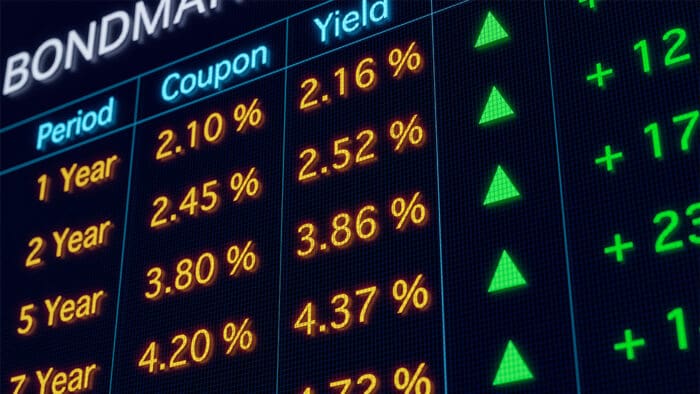
Rising yields are sapping risk appetites on Wall Street today as heavier inflation expectations essentially remove a Fed cut from this year’s curve while sparking an intraday reversal in stocks. Meanwhile, the chance of a 2026 hike is up to 23% as climbing oil prices, robust consumer spending and tariff factors are poised to push the CPI north of 4% this month after next Tuesday’s April print is likely to be up to 3.7%. In reflection of the tightening financial conditions, some key maturities across the Treasury complex are near pivotal resistance levels, with the 2- and 10-year durations inching towards 4% and 4.5%, while the 30-year has marched well above 5%. WTI crude isn’t cooperating either, trading higher than $107 per barrel earlier as Middle East tensions mount with several overnight stories pointing to violence against ships navigating along the Strait of Hormuz even as President Trump communicated a safe-passage action for certain vessels. Fears of a re-escalation have traders scooping up volatility protection instruments and greenback exposure. In equities, all major domestic benchmarks, sectors and sub-components are retreating minus technology. Similarly, non-energy commodities are depreciating; however, cryptocurrencies and prediction markets are catching bids.
The tense Middle East situation isn’t the only factor weighing on the Treasury complex. Indeed, there is a broad set of additional considerations that were already contributing to heavier borrowing costs. Inflation was running well ahead of the Fed’s target prior to the war, as robust consumer shopping supported servicer pricing power and economic growth, while tariff pressures lifted goods expenses. Meanwhile, failures to materially improve the federal deficit are lifting term premiums, as fixed-income observers demand greater compensation to offset the expanding national debt burden against the backdrop of wider budget shortfall projections. The greatest risks for bondholders from here, however, is a potential reescalation in the Iran conflict that could drive crude towards $130 per barrel and/or a Warsh Fed that adopts increasingly restrictive monetary policy to curb the lift in actual inflation and its expectations. It’s precisely the tolerance and excessive patience of the Powell Fed that had three members of the committee dissenting in a tighter direction in the April meeting, as the central bank has run above objective for over five years and counting. The developments together signal a steeper climb in rates from here, although an honored peace deal would bring immediate relief.
Investor morale in the euro zone improved moderately for this month with the Sentix Investor Confidence Index moving northward from -19.2 in April to -16.4 and surpassing the economist consensus estimate of -20.9. The gain was driven by expectations climbing from -15.5 to -11.3 and views of the current situation moving from -22.8 to -21.5. Germany was an exception. For that country, the gauge dropped from 27.7 to 30.9. Sentix maintains that the headline euro zone result, despite its recent improvement, still points to the increased risk of recession.
The value of Australia building permits issued in March sank 19.4% month over month (m/m) while the number of approvals dropped 10.5% with weakness in both residential and non-residential sectors, according to the Australian Bureau of Statistics. In the dwellings category, the total value dropped 15.8% with the number of permits issued down 10.5% but up 9% year over year (y/y). Private sector dwellings excluding houses led the contraction, with the number of approvals slipping 26% m/m while staying up 3.4% from March 2025. Private sector houses bucked the trend by growing 0.9% m/m and 12% y/y. The value of non-residential groundbreaking approvals, furthermore, fell 25.3% m/m.
The number of job listings in Australia fell 0.8% m/m in April after contracting by a downward revised 3.2% in February, according to Indeed and the Australia and New Zealand Banking Group (ANZ). Despite the recent m/m drop, the number of help-wanted ads was still 5.2% higher than in the year-ago period. ANZ anticipates that the Middle East crisis will cause labor-market softening in coming months and that the Reserve Bank of Australia, which meets tomorrow, is likely to modify its economic summary by eliminating its description of labor conditions being tight.
New to Interactive Brokers?
Open AccountInformation posted on IBKR Campus that is provided by third-parties does NOT constitute a recommendation that you should contract for the services of that third party. Third-party participants who contribute to IBKR Campus are independent of Interactive Brokers and Interactive Brokers does not make any representations or warranties concerning the services offered, their past or future performance, or the accuracy of the information provided by the third party. Past performance is no guarantee of future results.
This material is from IBKR Macroeconomics, an affiliate of Interactive Brokers LLC, and is being posted with its permission. The views expressed in this material are solely those of the author and/or IBKR Macroeconomics and Interactive Brokers is not endorsing or recommending any investment or trading discussed in the material. This material is not and should not be construed as an offer to buy or sell any security. It should not be construed as research or investment advice or a recommendation to buy, sell or hold any security or commodity. This material does not and is not intended to take into account the particular financial conditions, investment objectives or requirements of individual customers. Before acting on this material, you should consider whether it is suitable for your particular circumstances and, as necessary, seek professional advice.
Trading in digital assets, including cryptocurrencies, is especially risky and is only for individuals with a high risk tolerance and the financial ability to sustain losses. Eligibility to trade in digital asset products may vary based on jurisdiction.
For specific platform feedback and suggestions, please submit it directly to our team using these instructions.
If you have an account-specific question or concern, please reach out to Client Services.
We encourage you to look through our FAQs before posting. Your question may already be covered!
Related Articles
















Update
Price action in TLT is worrisome.