
- Solve real problems with our hands-on interface
- Progress from basic puts and calls to advanced strategies
Interactive Options Course
Posted February 5, 2024 at 12:15 pm
Markets are stumbling after Fed Chief Jerome Powell’s higher-for-longer reiterations on 60 Minutes last night. Significantly, Powell’s hawkish message was recorded prior to Friday’s blockbuster jobs number, which points to a Fed committee that’s increasingly tilting to the hawkish side. This morning’s stronger-than-expected ISM-Services print underscored Powell’s statements about the risks of a potential increase in inflation, with the data showing prices expanding faster than a cheetah, fueled in part by robust consumer demand.
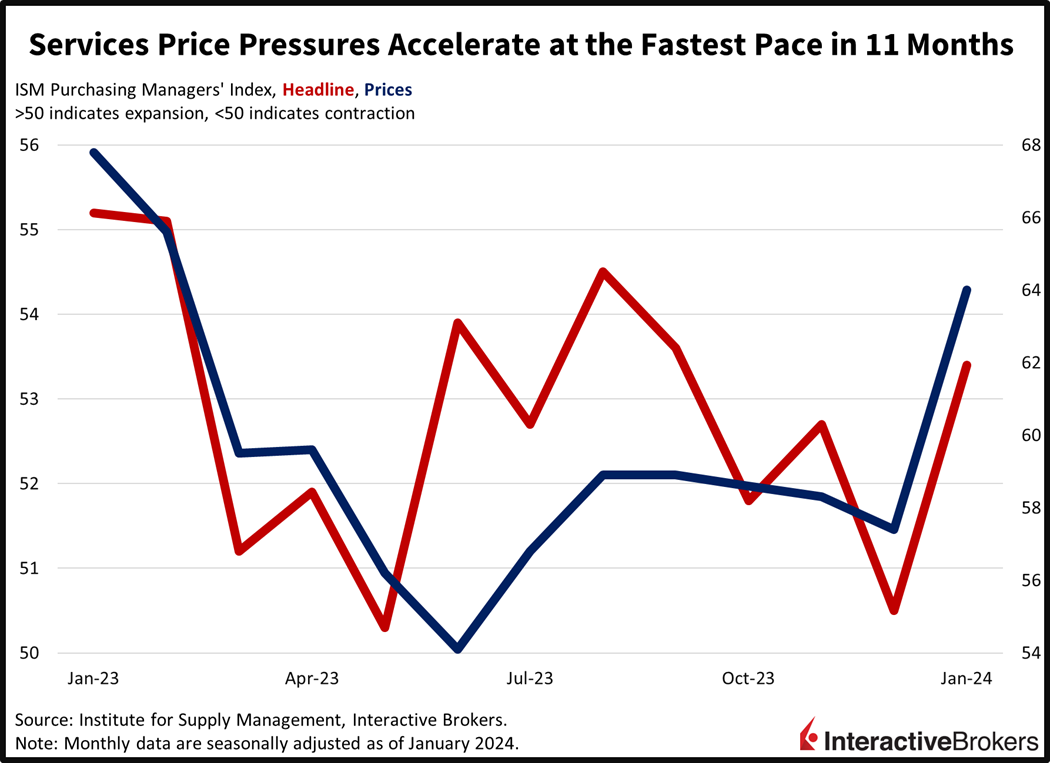
The services sector expanded sharply to start off the year, achieving the quickest pace of growth since September. ISM’s January Purchasing Managers’ Index for Services rose to 53.4, much stronger than projections for 52 and December’s 50.5 figure. What’s worrisome is that prices were the main driver of the services sector’s expansion, with the report’s inflation segment reaching the highest level since February of last year. At a whopping 64, it was much higher than estimates of 56.5 and December’s 57.4. Customer orders drove much of the price gains, with the segment accelerating to 55 from 52.8. Business activity and employment also expanded, reaching levels of 55.8 and 50.5. The former was unchanged from December while the latter reversed from 43.8. Overall, services providers are anxiously awaiting interest rate reductions while they remain wary of persistent price pressures and geopolitical conflicts.
The Middle East conflict is weighing upon McDonald’s Corporation’s results while significant cost cutting has helped Tyson Foods surpass earnings expectations. Meanwhile, the construction industry continues to limp along although energy and infrastructure are exceptions. Those are a few themes from the following fourth-quarter results:
Yields are soaring this morning as the one-two punch of Powell and ISM-Services data prevents market players from achieving further upside. All major equity indices are lower with the rate-sensitive, small-cap Russell 2000 leading the decline, dropping 2.1%. The Dow Jones Industrial, S&P 500 and Nasdaq Composite indices are down 1%, 0.6% and 0.4%, meanwhile. Sectoral breadth is in the tombs, with all sectors lower except for the defensive health care sector, which is up 0.5%. Materials, real estate and consumer discretionary are losing the most on the session, with the segments down 2.6%, 2.1% and 2.0%. The yield curve is shifting higher in a bear-steepening manner, as 2- and 10-year Treasury maturities trade at 4.46% and 4.15%, 8 and 13 basis points (bps) higher on the session. The US dollar is at its highest level since mid-November when gauged relative to a basket of currencies. It is benefiting from anticipations of less rate cuts and loftier long-term yields due to inflation expectations, with its index up 49 bps to 104.47. The greenback is gaining relative to the euro, pound sterling, franc, yen, yuan and Aussie and Canadian dollars. Energy markets are suffering despite continued Middle Eastern tensions, as oil traders focus increasingly on the stifling effects of the Fed’s restrictive monetary policy and persistent economic weakness out of Beijing. WTI crude oil is down 0.2%, or $0.15, to $72.16 per barrel amidst the cross currents.
The Federal Reserve believes its monetary policy tightening has controlled inflation during the past six months, but the central bank needs more evidence that moderating price gains are durable before it feels confident enough to lower the fed funds rate. In sharing his view yesterday, Powell reiterated that he doesn’t think it will cut rates at its March meeting as policymakers will likely want more data to illustrate that recent gains in controlling inflation aren’t transitory. Powell signaled that mid-year would likely be a better time to introduce a cut. Complicating the inflation battle is the potential for goods and commodities to experience price gains as last year’s cooperation on both fronts will be difficult to reproduce. Furthermore, last Friday’s fiery jobs data alongside this morning’s hot services price results are likely to incrementally deter the committee from cutting, with 2024 potentially bringing a resurgence of price pressures. Finally, Powell also suggested that the Treasury is on an unsustainable fiscal path, which is emboldening him and his colleagues, with policy accommodation providing fiscal authorities with further leeway on the deficit front. Kicking the can down the road endangers our children and grandchildren’s generations.
Visit Traders’ Academy to Learn More About Economic Indicators
For specific platform feedback and suggestions, please submit it directly to our team using these instructions.
If you have an account-specific question or concern, please reach out to Client Services.
We encourage you to look through our FAQs before posting. Your question may already be covered!
Information posted on IBKR Campus that is provided by third-parties does NOT constitute a recommendation that you should contract for the services of that third party. Third-party participants who contribute to IBKR Campus are independent of Interactive Brokers and Interactive Brokers does not make any representations or warranties concerning the services offered, their past or future performance, or the accuracy of the information provided by the third party. Past performance is no guarantee of future results.
This material is from IBKR Macroeconomics, an affiliate of Interactive Brokers LLC, and is being posted with its permission. The views expressed in this material are solely those of the author and/or IBKR Macroeconomics and Interactive Brokers is not endorsing or recommending any investment or trading discussed in the material. This material is not and should not be construed as an offer to buy or sell any security. It should not be construed as research or investment advice or a recommendation to buy, sell or hold any security or commodity. This material does not and is not intended to take into account the particular financial conditions, investment objectives or requirements of individual customers. Before acting on this material, you should consider whether it is suitable for your particular circumstances and, as necessary, seek professional advice.
Related Articles
















Current US gov’t fiscal policy: the old saying “spending like drunken sailors”, comes to mind… but then sailors 1. run out of money and 2. sober up after shore leave.