
- Solve real problems with our hands-on interface
- Progress from basic puts and calls to advanced strategies
Interactive Options Course
Posted March 27, 2026 at 12:05 pm
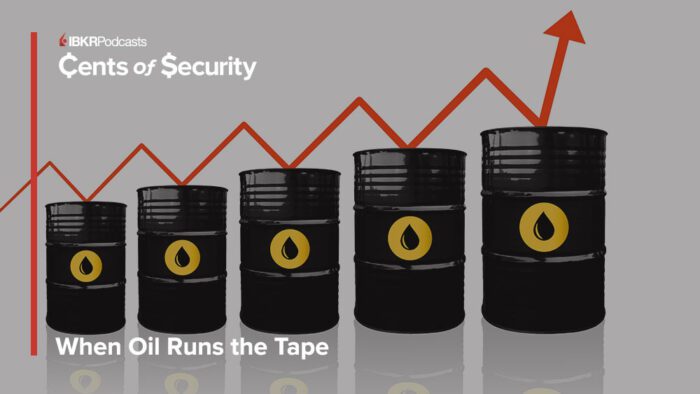
Oil is no longer just a commodity headline — it’s the market’s master switch. Senior Economist Jose Torres breaks down the chain reaction he’s watching in real time: crude, rates, stocks, plus what it means for inflation, the Fed, and recession risk.
The following is a summary of a live audio recording and may contain errors in spelling or grammar. Although IBKR has edited for clarity no material changes have been made.
Hello everybody, and welcome to Cents of Security. Today we’re here with Senior Economist Jose Torres to talk about economics and the markets. Welcome, Jose. How are you?
Hi, Mary. Doing great. Great to join you as always. Happy to talk about these things. We got volatile times these days.
Yeah, there’s lots going on since we last talked. What’s the latest?
The Iran War is ongoing. President Trump has been trying to quell volatility by telling market participants and telling the US public that a deal is on the way. Not to worry too much. Oil prices are going to drop like a rock, but he’s already said that several times. And now folks are growing increasingly pessimistic that this may be an extended conflict.
So as a result, crude oil prices are soaring. Interest rates are also increasing rapidly. In fact, the Fed is now potentially going to hike this year. That’s something that’s a total 180 from where we started the year, Mary, where the Fed was looking, projected to cut two to three times.
Now we’re talking about potentially a hike. If this oil Middle East crisis continues Tehran is denying that they’re having any communications with Washington, they rejected the 15-point peace plan that the US sent them. And President Trump is considering a ground operation in Iran, so that would mean that soldiers would be physically with their feet On Iranian soil trying to control the country in some respect. That’s really driving significant caution in markets because going into this year, there was an expectation that the economy was going to re-accelerate. Because of the Big Beautiful Bill that was passed in 2025 lighter taxation, mild deregulations. I was expected to be a tailwind to activity. At the same time, we expected that subdued energy costs and progress on inflation was going to deliver a few rate cuts this year. But that playbook has been totally turned upside down. Now we’re looking at a slowing economy potential rate hikes and markets, of course, don’t like that because now that there’s slowdown, angst, and recession risk starting to be priced in here at, in our prediction market at Interactive Brokers, we’re at around 38% by year end of a recession. That of course doesn’t bode well for corporate earnings and as a result, all four of the major US benchmarks are now down year to date. Europe is down as well and really just a bad period for markets here. However, if there is a deal and if there’s a ceasefire, things can be remedied quite quickly. And the second half of this year could be pretty constructive for risk assets and for fixed income assets as well.
So with Tehran rejecting Washington’s peace offer and military escalation back on the table. How does geopolitical risk get repriced across markets, and which assets react first when those premiums rise?
Yeah, so we’re really in a single variable market here, Mary. We’re looking at energy prices in the morning, at night, intraday and then off of energy prices that’s where interest rates start to move. And then off of interest rates, that’s where speculative enthusiasms and the stocks start to move. So that’s really the 1, 2, 3 there.
Crude oil, then interest rates and then stocks. One interesting thing earlier this week stocks were very optimistic that the president was going to be able to reach a deal, but interest rates and oil weren’t optimistic. So sometimes we have these bifurcated behaviors in these markets.
Of course, equity investors tend to be more risk on more optimistic fixed income Investors tend to think a lot differently because, they’re thinking more about fixed income or monthly paychecks, whereas equity investors are thinking more about capital gains and their growth ahead.
So, equity investors tend to be, not all the time, but tend to be more aggressive. Then fixed income investors, so fixed income investors and even commodity traders in the oil market. They were a lot more skeptical about President Trump’s optimism as it relates to Middle East than equity investors. And you saw equities rally on Monday, but oil and yields, those are rising too, because folks who are worried about the geopolitics, whereas in the stock market there wasn’t as much caution.
So, what are you really watching now when you’re looking, at all the data that you have in front of you? What are the top three things you’re looking at?
Yeah, I’m doing my now casting for the consumer price index. So essentially every day that we have oil around a hundred dollars, around $90. Every day that starts to materially impact future consumer price index readings. So, for example, March is almost over. March is looking like it’s going to come in at 3.3, 3.4, which is a disaster, Mary, because in January and February we’re at 2.4, 2.4, or close to two, you can deliver a cut or two from the Fed.
But if you’re at 3.4, that’s 70%, 75% of the fed’s 2% target, how could you cut with the inflation rate that high? Oil and the CPI and then of course looking a lot at the labor market to see if employers are responding to the uncertainty by trimming labor, by bringing down payrolls, by trying to cut costs.
But that hasn’t been the case, in fact, this morning, March 26th, Thursday, we got the lowest number of continuing unemployment claims in 22 months. You have to go back to 2024 to see a number as low May 2024 to be precise. That was really encouraging and that also served to lift interest rates because if you have this oil crisis and you have a stable labor market, then the Fed is definitely not going to cut.
And then another thing that I’m watching are the technical oscillators. For the markets you have for example, CNN Fear & Greed Index, been in extreme fear for a while, looking at the moving averages, looking at the relative strength index. And those indicators have really been pointing to a bounce to a short-term bounce in the markets.
And we’ve been getting some bounces, but the economic fundamentals here, Mary, are so bad at this juncture. That really those technical signals, aren’t as useful as they otherwise would be. However, the technical signals do point to a potential 4% one day rally if President Trump does secure a deal with Tehran.
That is significant. So, we can be up 6% in two days if the Iran stuff is behind us.
Which we hope, right?
Absolutely our investors would be very happy. Of course. Our investors, they benefit mostly from rising markets. That’s of course what we would like. And the American public, for that matter, benefits from rising markets. In fact, before we go onto the next question.
Rising markets have really been bolstering consumer spending. The market has become more of the economy, but in the past, there was a saying that said, oh, the market isn’t the economy. But now it increasingly is because the capital gains from stocks and the gains as well as the cash flows from fixed income assets, treasuries, bonds, notes, et cetera, those are increasingly being used to finance expenditure patterns, particularly with an aging population. Folks, they are spending based on their investment portfolios Mary. If they see that they’re up 5%, they’re going out to dinner, they’re flying places, they’re doing the whole nine yards. If they see that their portfolio’s going down, they’re canceling their reservations, maybe two trips instead of four, et cetera, et cetera.
And that’s another key driver about corporate margins. So those trips become a lot more expensive with higher oil prices because jet fuel is a key determinant for airfares. That’s expect that’s why, another reason why it really weighs on activity first, it’s the sales and the revenues.
Firms can’t have trouble making their numbers because consumers and business customers can’t spend as much because they have to allocate more money towards energy, so they can’t spend or invest as much as I say at the same time, the income statement, the expense side is bolstered higher, because of fuel costs as well as interest expenses.
So those are some of the reasons as to why, corporate fundamentals are really deteriorating here. And then from a valuation perspective, when you have higher interest rates, you get paid more to be defensive. So, you don’t want to be offensive, you have a lower risk premium. So, when you have a lower interest rate, you’re essentially encouraging speculative behaviors and equity chasing in markets, but when you have higher interest rates, folks are saying why should I get into the stock market with all this risk? I can park in the two-year treasury right now at 3.98% or the 10-year for 4.42%. Why would I be in the S&P with an earnings yield of 5% and a lot of risk associated with it when the treasury is giving me 4.42% for tens, 3.98% for twos?
So, if oil stays near a hundred and margins compress, where do you expect the labor market stress to show up first hours worked, wages or outright layoffs?
Outright layoffs, unfortunately. Yeah. Oil shocks have been associated with recessions when minus the pandemic in the 2022, we had that technical recession that got revised away. It was a down year for the market. Russia invaded Ukraine oil went to 120. Very similar dynamic to what’s happening now. Back in 2008, you also had oil go up north of $100 in the nineties and eighties same thing. And it’s because of the dynamics that we’ve been speaking about on this call. Mary Oil, price shocks are terrible. They make everything so much more expensive, and firms and individuals have less money to spend. And we have this economy here which is based on consumption and every incremental dollar that isn’t spent and is instead spent on fuel, note that begins to weigh on the overall picture. So, to the extent that we’re above 90 for a few more months, unfortunately, I think we’ll be in an economic downturn.
Yeah, it’s weird. Even like on some level, I know this isn’t probably the happiest thought, but with gas prices going up, I’m glad because there’s less people commuting right on the road with me. So, less traffic. But at the same time, I don’t want it to go up. Obviously, I want this war to be over gas prices to regulate down and just let’s go on and enjoy our summer!
But it, it doesn’t seem that way with the narrative that we got going on right now.
Real shame. Real shame. Beginning of the year, Mary, low energy cost was a key cornerstone of the Trump policy mix. We were going to have heavy production, mild regulations, “Drill Baby Drill”, that was the mantra. And then here we are with 95, 96 oil. So really a disappointment, but hopeful, hopefully short-lived.
Okay. Now I also see that mortgage rates have gone higher too, as of today, right?
Yeah, they essentially follow the treasury market. A lot of reports are reported weekly. But if you look at them every day, they essentially follow the 10-year treasury and the 30-year treasury, the 10, 20, and 30 year treasuries. That’s really where mortgages follow for the most part.
Okay, treasury auctions have been lackluster, while labor data remains firm. How do supply dynamics and macro fundamentals interact to pressure bond prices at the same time?
Yeah, so the auctions, they’ve been lackluster this week, the week that began on March 23rd. Folks are waiting for higher rates. There is a potential that we could have higher interest rates. So, at the auctions, folks aren’t diving in wanting to pick up paper that the government is selling, maybe waiting a little bit, waiting for the uncertainty to diminish a little bit before getting back into the treasury market. So, the general uncertainty just makes folks at the auction table less aggressive, less inclined to want to pick up what the government is selling.
All right, so as you’ve mentioned, equities are broadly lower, but energy real estate and biotech are holding up. What explains that divergence in a risk off tape.
Yeah. So real estate has increasingly become this kind of defensive kind of sector because you have rents across the asset classes in an inflationary environment that are going to at least stay stable. So from that perspective, real estate catches these defensive bids similar to healthcare, utilities, and consumer staples, which are performing decently today.
Not great. Energy, of course, is performing terrific, obvious reasons, those companies sell energy.
When the economy is growing gangbusters. Folks don’t really want to get into real estate. They want to get into tech, they want to get into small caps, industrials, financials, energy. They want to get into things that are sensitive to the cycle, not real estate, but when things are a little defensive, folks look at real estate, it’s kind of like a bond like investment.
Oh, I can buy this and I can get dividends that are pretty secure. Based on the rent and multifamily and office and retail and hotels and industrial warehouses for e-commerce a lot of times, so that’s really what’s been driving these bids for real estate on these weaker days. Which with higher interest rates, you would think, wow, why would you buy real estate with higher interest rates?
But it just goes to show the defensive nature of that sector, at the same time the home builders are getting crushed. So very interesting. The real estate operators are doing fine, but the home builders are getting crushed from a sector perspective,
And that’s because commodity prices are going up or labor, they can’t find the labor. How do you explain that?
I mean it’s a one day move. So, who knows? Let’s see what real estate has done year to date. Just pulling up here. Real estate is flat year to date, so it has outperformed the market. The overall market, the S&P 500 is down probably 5% or 6%, 5.5% as of this moment. It’s been a volatile day. So real estate is outperforming, for those characteristics. It’s not up, but it’s flat. So those income characteristics are desirable to many investors.
So, I want to open this up a little bit internationally. How’s Europe faring? How’s the markets over there?
Europe is not doing well. They import a lot of energy in the UK, they’re talking about maybe two rate hikes this year, ECB as well. So that’s not good, especially because they’re more rate sensitive. Mary, they have a much bigger share of manufacturing as a percentage of the economy. We have a lot of technology and a lot of consumer spending.
They have a lot of manufacturing. So, when rates go up, that really hurts that sector because it’s a sector that’s capital heavy, and a lot of big investments are needed with financing usually. When you have higher rates, that really slows down the activities there. Europe not doing well right now, underperforming now, what is doing well is South Korea and Singapore. Those markets are doing terrific. Really have low valuations. Really big AI countries as well, and that’s really been driving performance there. This is a backloaded strength here because for many years where the US was doing great, those markets were just doing okay, not doing not terrific, but the Kospi and the STI are doing particularly well this year.
In fact, this morning we had a IBKR Podcast with Jeff Howie of SGX and he went to depth on that, but let me just give you the numbers real quick on what the different indices have done year to date. The Singapore Index is up 5% year to date. The South Korea Kospi has been outstanding, Mary 29% year to date.
And then if we look at the DAX Germany down 7.7% year to date, and then the FTSE, that’s the UK that’s also down, not that much, but down around 2%, 3% year to date.
So it’s interesting, it looks like the President may be going to China right, in May. What are you seeing there? We don’t know what the world is going to be going through at that point. We can hope that this war is settling down.
But what do you think about China?
China. That’s going to be interesting. A lot of moving parts with China. Obviously, you have the trade dynamic, you have the tariffs. They’re also allies to Iran. They’re allies to Russia; they’re allies to North Korea. So, there are allies with a lot of our adversaries. So really unpredictable here as to what discussions will take place.
We do know that it was postponed due to the Iran war president Trump decided to delay the initial meeting, so we’ll see what happens. The Chinese economy continues to struggle; however, they even revised down their ambitious growth target of 5%. Down to around four and a half due to just, they have bad demographics.
They have less people they don’t have the immigration tailwinds that we have here in the us when the Democrats are in office, when the Republicans, we don’t have the immigration tailwinds that’s, that ebbs and flows. That’s another podcast! They have over speculation in the real estate sector.
A lot of people are underwater on their mortgages. Property evaluations haven’t kept up with the debt loads. They also have consumer spending that’s been really weak and a very elevated youth unemployment rate. So, they have structurally a lot of bad economic indicator results. And really, I think that it’s just a result, just another piece of evidence of the centrally planned government, kind of economic system not being able to deliver for the constituents in the medium to long term. Of course, in the West we have views that are more supportive of free markets, of human rights, of freedom, of speech, et cetera. And over there it’s direct opposite in a lot of those topics.
So, I think really that’s just the reason why China will continue to underperform. In fact, since I was a kid, I was told that China’s economy was going to become larger than the US is very soon that they’re going to take over. And here I am aging faster than I would like, and China’s economy still not even close to as large as the us.
So, it’s really probably a longer discussion for another podcast. But really as to, why communism doesn’t work, why people out there should really be rooting for capitalism, for free markets, for incentive systems, for freedom of speech, for fair human rights, et cetera, and et cetera.
And you are not aging by the way! You look great! All right, Jose, thank you so much for your time. We know you’re busy out there with everything going on, so we really appreciate it. And folks don’t forget to look at Interactive Brokers IBKR campus. We have market commentary, other podcasts, and also courses for you to take for free.
Thank you.
The analysis in this material is provided for information only and is not and should not be construed as an offer to sell or the solicitation of an offer to buy any security. To the extent that this material discusses general market activity, industry or sector trends or other broad-based economic or political conditions, it should not be construed as research or investment advice. To the extent that it includes references to specific securities, commodities, currencies, or other instruments, those references do not constitute a recommendation by IBKR to buy, sell or hold such investments. This material does not and is not intended to take into account the particular financial conditions, investment objectives or requirements of individual customers. Before acting on this material, you should consider whether it is suitable for your particular circumstances and, as necessary, seek professional advice.
The views and opinions expressed herein are those of the author and do not necessarily reflect the views of Interactive Brokers, its affiliates, or its employees.
Interactive Brokers LLC is a CFTC-registered Futures Commission Merchant and a clearing member and affiliate of ForecastEx LLC (“ForecastEx”). ForecastEx is a CFTC-registered Designated Contract Market and Derivatives Clearing Organization. Interactive Brokers LLC provides access to ForecastEx Forecast Contracts for eligible customers. Interactive Brokers LLC does not make recommendations with respect to any products available on its platform, including those offered by ForecastEx.
This is commentary on economic, political and/or market conditions within the meaning of CFTC Regulation 1.71, and is not meant provide sufficient information upon which to base a decision to enter into a derivatives transaction.
Futures are not suitable for all investors. The amount you may lose may be greater than your initial investment. Before trading futures, please read the CFTC Risk Disclosure. A copy and additional information are available at ibkr.com.











Join The Conversation
For specific platform feedback and suggestions, please submit it directly to our team using these instructions.
If you have an account-specific question or concern, please reach out to Client Services.
We encourage you to look through our FAQs before posting. Your question may already be covered!