
- Solve real problems with our hands-on interface
- Progress from basic puts and calls to advanced strategies
Interactive Options Course
Posted March 3, 2026 at 12:45 pm
How many of you had “Up Day” on your bingo card for “reaction to Iran bombing and Straits of Hormuz closure” yesterday? (Be honest.) That’s why I’m so surprised about how many calls I’m getting today, asking me to explain why we sold off so aggressively this morning. We can’t look at today’s move without the context of yesterday’s. And once again, I really should have bought VIX futures before I took a short vacation!
Today’s equity market reaction expresses the kind of fears that were somehow ignored yesterday. The potent combination of relentless dip buying and the expectation that this geopolitical event would be like so many others – short and with minimal impact upon the majority of US stocks. This morning, we saw the realization that this is not a situation that is likely to resolve itself as quickly as, say, Venezuela, and that the impacts are likely to be much more widespread.
Oil and bonds told us yesterday to be concerned about inflation, but we weren’t listening. April WTI Crude futures were up by 2.78% on Friday and 6.28% yesterday, though they did close well below their overnight highs. Meanwhile, rather than displaying a solid “flight to quality” bid, 2- and 10-Year Treasury yields rose by 10 basis points yesterday. They had both fallen by about 6 bp on Friday, partly on that safety bid, but yesterday and today bond investors focused more on inflationary and budgetary concerns that might arise from a conflict that could keep oil prices elevated for some time. Heck, if bonds didn’t follow the usual “flight to safety” playbook, perhaps it’s understandable why stocks wouldn’t either.
Despite my efforts to stay disconnected over the past few days, plenty of people found me to ask questions – both on Saturday morning (it was early out west) and yesterday. The weekend questions involved what might happen, yesterday’s involved stocks’ blasé response. I attributed the latter to two key factors:
Unfortunately, item 2 was misinterpreted, particularly after another round of bombings reminded us that this might persist longer than we’d hoped. Remember, while we have asserted that stock markets are not adept at pricing geopolitical events, and often do well by ignoring them, bond and commodity markets are excellent at them. Stock traders should pay close attention to those markets and risk problems when they don’t. In most cases, the rubric “how will this event affect Microsoft (MSFT)?” is a reasonable one. Few global events would really dent that company’s earnings. But when rates rise thanks to global inflationary concerns, it is indeed fair to expect that stocks could suffer a broad re-rating. And that is what we saw this morning.
Yet even as I typed this, the dip buyers were re-emerging, right on cue. Yesterday, the S&P 500’s (SPX) 100-day moving average once again provided support and the 50-day offered resistance. This morning, although SPX convincingly broke below its 100-day moving average, the selloff ran out of steam in the 6715-ish region that punctuated late-December’s lows. And once again, buyers stepped in to chase the bounce once the selling stopped. Old habits die hard.
SPX, 6-Months, Daily Candles with 50-Day (grey) and 100-Day (purple) Moving Averages and Horizontal Line at 6715
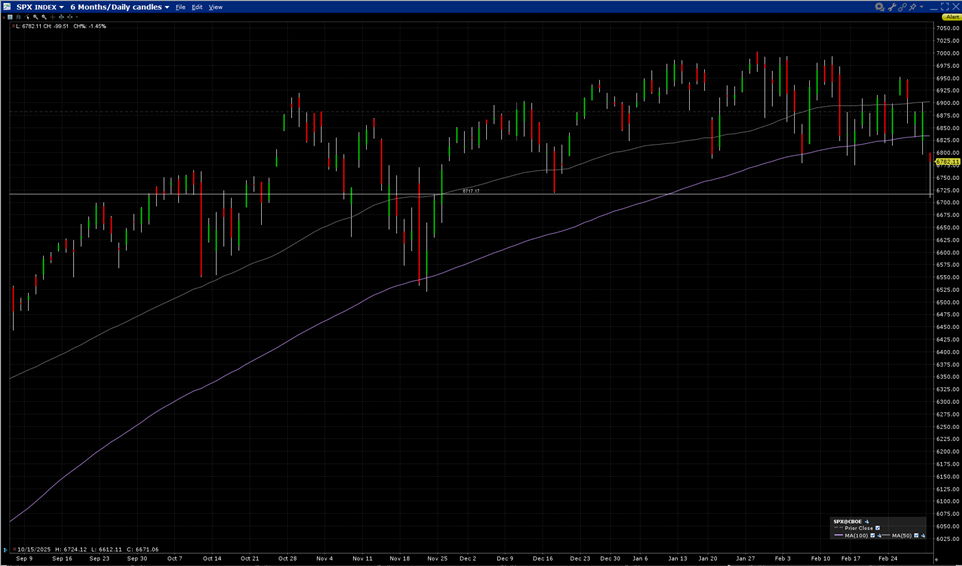
Source: Interactive Brokers
New to Interactive Brokers?
Open AccountAlready an Interactive Brokers Client?
Request Trading PermissionThe analysis in this material is provided for information only and is not and should not be construed as an offer to sell or the solicitation of an offer to buy any security. To the extent that this material discusses general market activity, industry or sector trends or other broad-based economic or political conditions, it should not be construed as research or investment advice. To the extent that it includes references to specific securities, commodities, currencies, or other instruments, those references do not constitute a recommendation by IBKR to buy, sell or hold such investments. This material does not and is not intended to take into account the particular financial conditions, investment objectives or requirements of individual customers. Before acting on this material, you should consider whether it is suitable for your particular circumstances and, as necessary, seek professional advice.
The views and opinions expressed herein are those of the author and do not necessarily reflect the views of Interactive Brokers, its affiliates, or its employees.
Futures are not suitable for all investors. The amount you may lose may be greater than your initial investment. Before trading futures, please read the CFTC Risk Disclosure. A copy and additional information are available at ibkr.com.
For specific platform feedback and suggestions, please submit it directly to our team using these instructions.
If you have an account-specific question or concern, please reach out to Client Services.
We encourage you to look through our FAQs before posting. Your question may already be covered!
Municipal Bonds are only available from Interactive Brokers for IBKR LLC, IBKR Canada, IBKR Hong Kong, IBKR Australia and IBKR Singapore entities.
Related Articles














And do you predict continued dip buying or do you see a true sell off coming? The easy answer is its too early to tell. if you were half cash right now, when would you reinvest in SP 500?
I made out trading on the VIX in the short term. Oil prices rising, so some are looking to trade on that, but I’m content to stand pat and ride it out (for now).
The decline is just starting Trend is your friend on the way up and your enemy on the way down
Buy, please keep buying. I want to sell to you, Yes, every rally. “Save the world?”, “I’m long and I’m so hosed”, “we want to get out money out at higher price points”, any excuse will suffice for a day or so please, make me rich by just waiting.