
- Solve real problems with our hands-on interface
- Progress from basic puts and calls to advanced strategies
Interactive Options Course

Posted September 9, 2026 at 1:07 pm
It is difficult to write a strategy piece while major financial news is breaking, but here we are. Just after 11am ET, the Treasury announced the details of the bond buyback program that it announced three weeks ago. At the time, the Treasury Department announced that it would “at least double, the size of liquidity support buyback operations for longer-dated nominal coupon securities.” We learned that the buybacks would be up to $6 billion per operation, up from the current $2 billion. That is clearly not enough for bond traders’ liking.
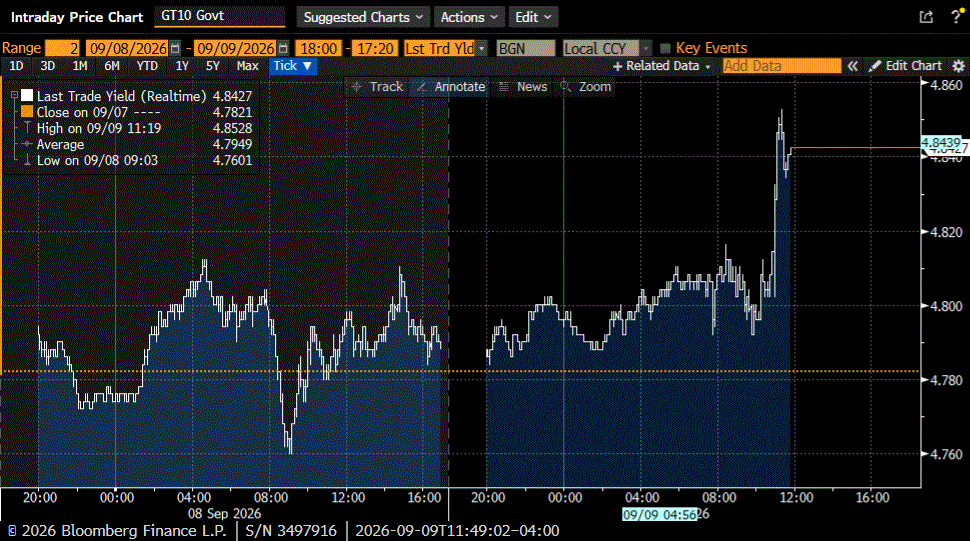
As I type this, about a half hour after the announcement, 10-year yields are rising by more than 5 basis points, touching levels that have not been reached since 2023. Various firms had published estimates that the buybacks would exceed the eventual $6bn figure. As we have seen countless times in stocks after earnings reports, markets can and do react negatively even to solid numbers that fail to reach lofty expectations. Indeed, $6 billion is substantially more than double the previous buyback rate but apparently falls short of what bond traders either hoped or expected.
We can see the market’s initial reaction quite clearly here:
10-Year Treasury Yield, 2 Days
Source: Bloomberg
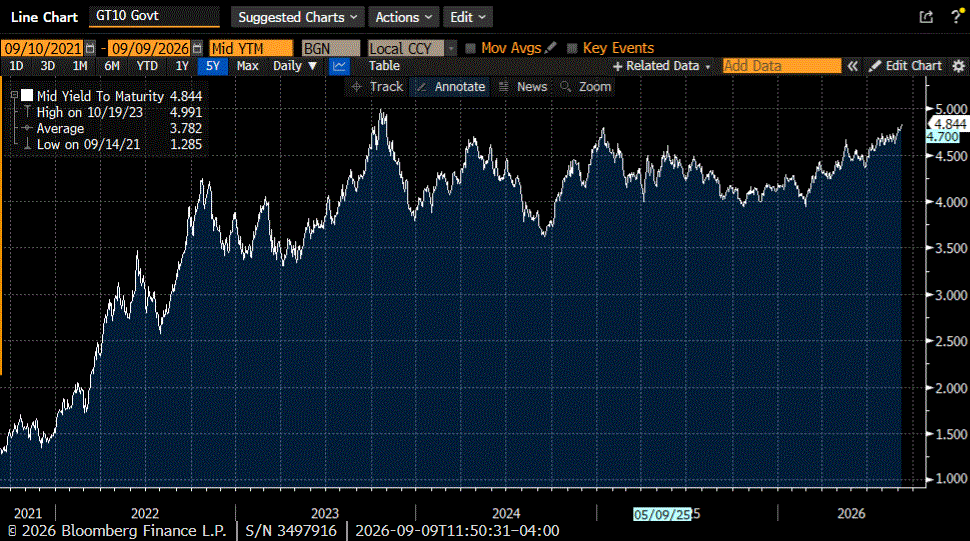
The reaction was obviously fast and fierce. A longer-term view shows that the upward move in yields over the past few months has been steady and secular. There was a brief dip below 4% just before the hostilities in the Persian Gulf began, but since then we have seen yields increase relatively steadily by more than 85 basis points. The rise is not nearly as abrupt as what occurred during the post-Covid rate adjustment, but the previous 5% peak seems to be a likely target:
10-Year Treasury Yield, 5 Years, Daily Data
Source: Bloomberg
It is quite important, though, to put the long-term path of rates in perspective. From a post-Covid perspective, the current level of rates can seem quite lofty. As we zoom out to a 30-year view, we have only reverted to the level that prevailed during the period between the end of the internet bubble and the start of the Global Financial Crisis. While that period was certainly bookended by significant stock market crises, that rate environment enabled stock market gains and financial conditions that were sufficiently loose to enable a wide range of financial innovation – even if that innovation morphed into excesses that led to highly undesirable consequences.
10-Year Treasury Yield, 30 Years, Monthly Data

Source: Bloomberg
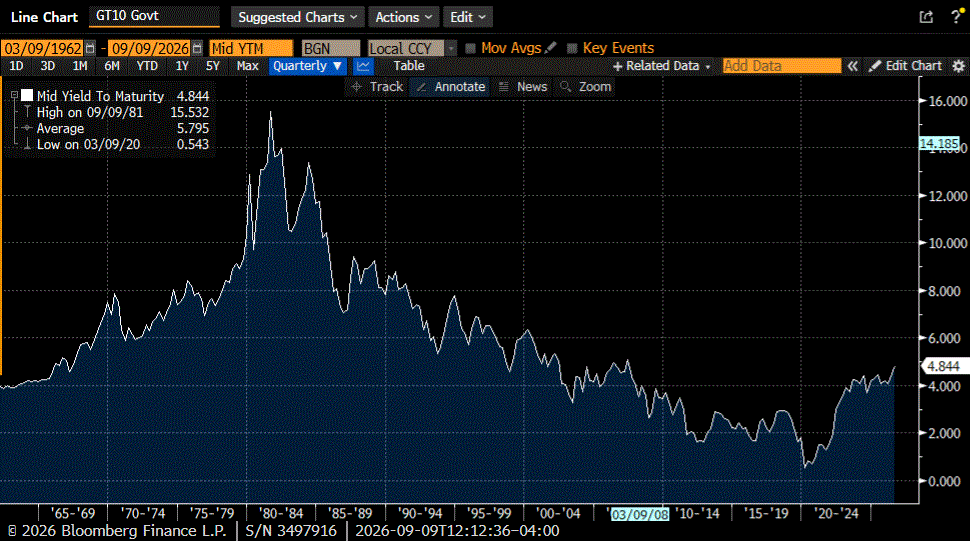
Unfortunately, there are even larger consequences to consider. First, we need to consider whether we have conclusively seen the end of a trend toward lower long-term interest rates that had persisted for several decades. A glance at an even longer-term chart makes that appear obvious, and potentially ominous:
10-Year Treasury Yield, 64 Years, Quarterly Data
Source: Bloomberg
Second, the potential, if not likely, secular change comes at a time when there is significant competition for funds between global governments and major corporations. Deficits and debts in a wide range of countries are growing, with the negative feedback effect of higher rates causing them to worsen further. At the same time, we have billions, if not trillions, of dollars of likely AI-related funding demands – particularly from companies that were once among those with the highest amounts of free cash flow.
Available credit might seem infinite, but it’s not. It has its limits. If the demand for any commodity increases faster than its supply, its price must rise. Interest rates are the price of money. Hence, rates are moving higher. Inflationary expectations aren’t helping long-term yields, but they are not the sole cause. Hence, the concerns that rising rates are indeed secular.
To this point, let’s put something into immediate perspective. Later today, the Treasury will be auctioning $39 billion of 9-year, 11-month notes (the current 10-years), and tomorrow there will be a $29 billion auction of 29-year, 11-month bonds (the current 30-years). That’s $58 billion of long-term paper in the next two days. A $6 billion buyback puts a dent in that sum but hardly offsets it meaningfully.
One must also wonder whether the Treasury Secretary isn’t feeling some hubris right now. At an event at Southern Methodist University yesterday, Secretary Bessent said the following regarding his role in supporting the Japanese yen:
“I am the house now, so when we intervene with the Japanese yen, I have pretty good insight into what the Japanese, what the Bank of Japan is going to do, what Japanese policymakers are going to do,” Bessent said. “And you can bet against me if you want.”
Even though the combination of the U.S. Treasury and the Bank of Japan have likely far outweighed the short-term considerations of leveraged carry traders who short the yen to buy higher-yielding assets –thereby spurring a rally in the yen – it is surprising to find the Secretary (1) referring to markets in casino terms, and (2) forgetting the lessons he learned first-hand about the limitations of governmental actors in fighting secular market trends. A measured response from the Treasury to shape the yield curve might be welcome, even if it is specifically timed to end on the day before the midterm elections. A knee-jerk response from a cocky leader who personalizes the efforts is less likely to be so.
New to Interactive Brokers?
Open AccountAlready an Interactive Brokers Client?
Request Trading PermissionThe analysis in this material is provided for information only and is not and should not be construed as an offer to sell or the solicitation of an offer to buy any security. To the extent that this material discusses general market activity, industry or sector trends or other broad-based economic or political conditions, it should not be construed as research or investment advice. To the extent that it includes references to specific securities, commodities, currencies, or other instruments, those references do not constitute a recommendation by IBKR to buy, sell or hold such investments. This material does not and is not intended to take into account the particular financial conditions, investment objectives or requirements of individual customers. Before acting on this material, you should consider whether it is suitable for your particular circumstances and, as necessary, seek professional advice.
The views and opinions expressed herein are those of the author and do not necessarily reflect the views of Interactive Brokers, its affiliates, or its employees.
There is a substantial risk of loss in foreign exchange trading. The settlement date of foreign exchange trades can vary due to time zone differences and bank holidays. When trading across foreign exchange markets, this may necessitate borrowing funds to settle foreign exchange trades. The interest rate on borrowed funds must be considered when computing the cost of trades across multiple markets.
Short selling is an advanced trading strategy involving potentially unlimited risks and must be done in a margin account.
Trading on margin is only for experienced investors with high risk tolerance. You may lose more than your initial investment. For additional information regarding margin loan rates, see ibkr.com/interest
Spot currencies are not available at IBKR Singapore.
Related Articles
















Join The Conversation
For specific platform feedback and suggestions, please submit it directly to our team using these instructions.
If you have an account-specific question or concern, please reach out to Client Services.
We encourage you to look through our FAQs before posting. Your question may already be covered!