- Solve real problems with our hands-on interface
- Progress from basic puts and calls to advanced strategies
Interactive Options Course
Posted August 4, 2026 at 1:12 pm
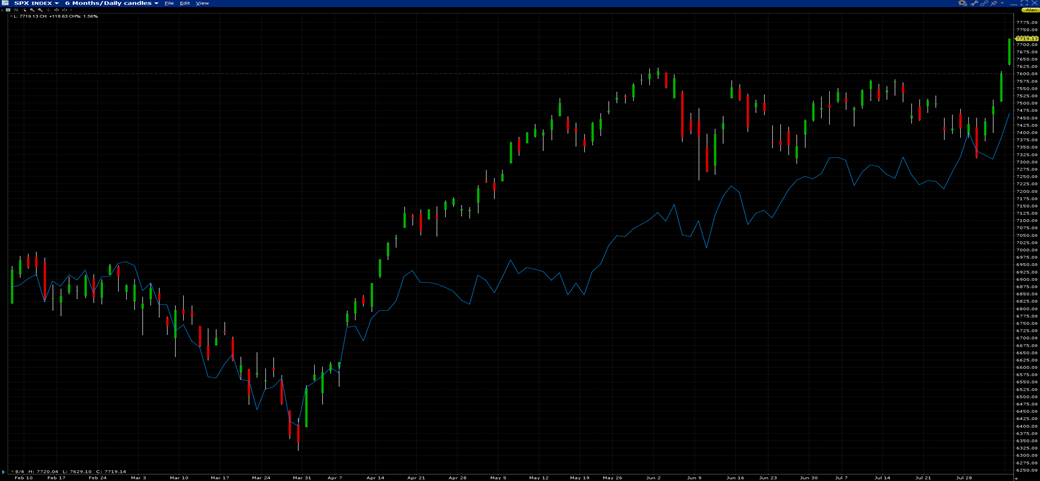
It’s become quite clear that the S&P 500 (SPX) is breaking out to a new high today after flirting with one yesterday. Furthermore, it’s quite clear that the strategy of buying a breakout is quite popular today, since stocks have barely bothered to take a breather in their relentless advance. As wonderful as that is for most investors, it behooves us to consider why SPX is up over 5% in fewer than four sessions. Some of that is clearly related to [yet another round of] hopes for a resolution in the Persian Gulf, but that’s not the only factor. I give the “Fab Four” plenty of credit.
The rally began on Thursday when SPX wiped out a 1.5% loss during the prior session. Although Wednesday’s losses were easily attributable to the stunning rise in long-term interest rates that followed Kevin Warsh’s second post-FOMC press conference as Chair, equity investors quickly pivoted their focus to the relief rally that occurred when it became clear that any forced selling related to the Situational Awareness hedge fund would cease. Immediate supply/demand considerations took an understandable first position in the equity market mindset over more vague concerns about inflation and long-term rates, especially when we could credibly attribute some of the prior day’s decline to that factor.
The tourniquet applied to Situational Awareness was indeed a powerful positive, but it was also accompanied by a significant shift in investor sentiment toward hyperscalers. Microsoft (MSFT) had spent a good portion of 2026 as a relative also-ran, but that changed abruptly after it released earnings on Wednesday afternoon. The stock rallied over 15% on Thursday and has added nearly another 10% in the two-plus sessions since then. The report was indeed terrific, buoyed by growth in Azure and an announced intention to hold spending steady rather than increase it. Was the report worth an additional $750 billion to MSFT’s market capitalization? Apparently so, say investors.
Since this market no longer does anything in half-measures, we saw something similar the next day with Amazon (AMZN). That completed a key shift in the prevailing mentality towards other key “makers” in the prior dichotomy between AI-related spenders and the recipients of that spending – generally semiconductor stocks, but also a wide range of other providers to data center buildouts. That shift allowed Meta Platforms to recoup its 8% decline on Thursday after its poorly received release by yesterday afternoon and allowed Alphabet’s shares (GOOG, GOOGL) to rise nearly 18% in the seven sessions that followed their own 7% drop after earnings in the prior week.
Say what you will about the Mag 7, or the “Lag 7” as some had referred to that group’s relative sideways movement. While indices were able to put in solid performances during the weeks when those stocks lagged, it is much easier for market-cap-weighted indices to rally when their largest components do much of the heavy lifting. It is arguably more appropriate to think of the aforementioned stocks as the “Fab Four,” since Tesla (TSLA) and Apple (AAPL) have not yet recovered from their post-earnings swoons and Nvidia (NVDA) is far from a recent performance leader.
That said, it is not fair to place all the credit on a tiny subset of the overall market. The equal-weighted version of the S&P 500, SPW, has been putting in new highs for several weeks. It is a testament to the powerful earnings growth being delivered by a wide range of companies. According to Bloomberg data, Q2 earnings for SPX are running 21.1% ahead of last quarter, or a 53.5% growth rate over last year. If there is ever a great reason for stocks to rally, solid earnings are it.
Might we question whether this sort of growth rate is sustainable in an environment where nominal GDP growth is projected to be about 5% for the coming quarters? That’s fair. Might we also question whether the hopes for a lasting improvement in the Gulf are either overblown or a setup for a “buy the rumor, sell the news” scenario? Also fair. But if we’ve learned one thing over the years, especially in the past few, it’s that fighting the tape can be a futile and expensive battle. If you think we’ve gone too far, too fast – also fair, by the way – you might want to wait for the speeding train to slow down a bit before getting in its way.
Source: Interactive Brokers
New to Interactive Brokers?
Open AccountAlready an Interactive Brokers Client?
Request Trading PermissionThe analysis in this material is provided for information only and is not and should not be construed as an offer to sell or the solicitation of an offer to buy any security. To the extent that this material discusses general market activity, industry or sector trends or other broad-based economic or political conditions, it should not be construed as research or investment advice. To the extent that it includes references to specific securities, commodities, currencies, or other instruments, those references do not constitute a recommendation by IBKR to buy, sell or hold such investments. This material does not and is not intended to take into account the particular financial conditions, investment objectives or requirements of individual customers. Before acting on this material, you should consider whether it is suitable for your particular circumstances and, as necessary, seek professional advice.
The views and opinions expressed herein are those of the author and do not necessarily reflect the views of Interactive Brokers, its affiliates, or its employees.
Related Articles













Join The Conversation
For specific platform feedback and suggestions, please submit it directly to our team using these instructions.
If you have an account-specific question or concern, please reach out to Client Services.
We encourage you to look through our FAQs before posting. Your question may already be covered!