
- Solve real problems with our hands-on interface
- Progress from basic puts and calls to advanced strategies
Interactive Options Course

Posted July 30, 2026 at 1:15 pm
(Musical Accompaniment: The Beatles)
We can certainly say one thing about yesterday’s FOMC press conference – it moved markets. Treasury bonds, which are most attuned to the nuances of Fedspeak, reacted somewhat violently, leading to a significant steepening of the yield curve in less than an hour. Stocks responded negatively, seemingly to the abrupt rise in long-term yields, though some of the fall seems attributable to a hedge fund blowup that was revealed this morning. Today, one of those asset classes is reversing its moves while the other continues yesterday’s trends.
Since our readership is more likely to be active in stocks than bonds, let’s address the equity move first. It was apparent that the recent pullback in tech stocks, particularly in the semiconductor sector, was something more than a mild pullback. It was a real-time verification of our adage:
“Parabolic uptrends are almost always unsustainable for long periods of time and tend to reverse abruptly and sharply. The question is when.”
While we refrained from reflexively categorizing the >20% downdraft in key semiconductor indexes, like SOX, as a bear market, it seemed evident that leveraged investments that had succeeded extraordinarily well in recent weeks had gone awry. South Korea seemed to be the epicenter of the leveraged speculation, but the global tech sector was apparently not immune to its effects. Today, we found out the name of a key culprit.
We learned early this morning that the prime brokers for Situational Awareness were scrambling to raise cash. It was reported that the hedge fund, which started in 2024, had assets under management that surged from $3 billion at the start of the year to a peak of $45 billion at the start of July. This was thanks largely to leveraged long investments in fast-moving technology infrastructure stocks and short positions in software shares. Then, shortly after the open, we were informed that one large hedge fund had taken over its portfolio of public shares (as I was typing this, it was reported that Citadel was the buyer).
It was rumored that Situational Awareness had been levered as much as 4:1. If that was the case, a pullback of 25% or more in many of its holdings would have wiped out the fund’s equity. Traders have interpreted today’s news as a market-clearing event, reducing tech sector risk and forcing short covering by those who had been pressing downside bets. And for those of you who might be concerned about the welfare of the fund’s wunderkind founder, sometimes nothing helps a hedge funder’s reputation as much as a spectacular blowup. The thinking often goes, “Heck, he’s not likely to repeat the same mistakes again, right?”
While the goings-on at a large hedge fund and its prime brokers are a key short- to medium-term event, the more important event for the long-term market scenario was yesterday’s FOMC meeting and press conference. Put simply, bond traders doubted Chair Warsh’s resolve. While he appeared to paint himself as a single-mandate Chair, focused primarily on “stable prices” (the term “inflation” was mentioned 41 times during the press conference, 29 of them by Warsh) over “full employment” (mentioned only thrice by Warsh), fixed income investors felt that there was insufficient concrete proof of definitive measures toward achieving that goal.
The chart below shows the intraday moves in the S&P 500 (SPX) alongside 2-, 10-, and 30-year yields that occurred yesterday after the FOMC statement and press conference. Short rates adapted quickly, removing the likelihood of a near-term hike – expectations for a first hike have been pushed back to December, after the midterm elections – but then long-term rates moved sharply higher as concerns about future inflation took root. Stocks initially rallied on hopes for fewer hikes but then faded quickly after long-term rates ate into stock valuations.
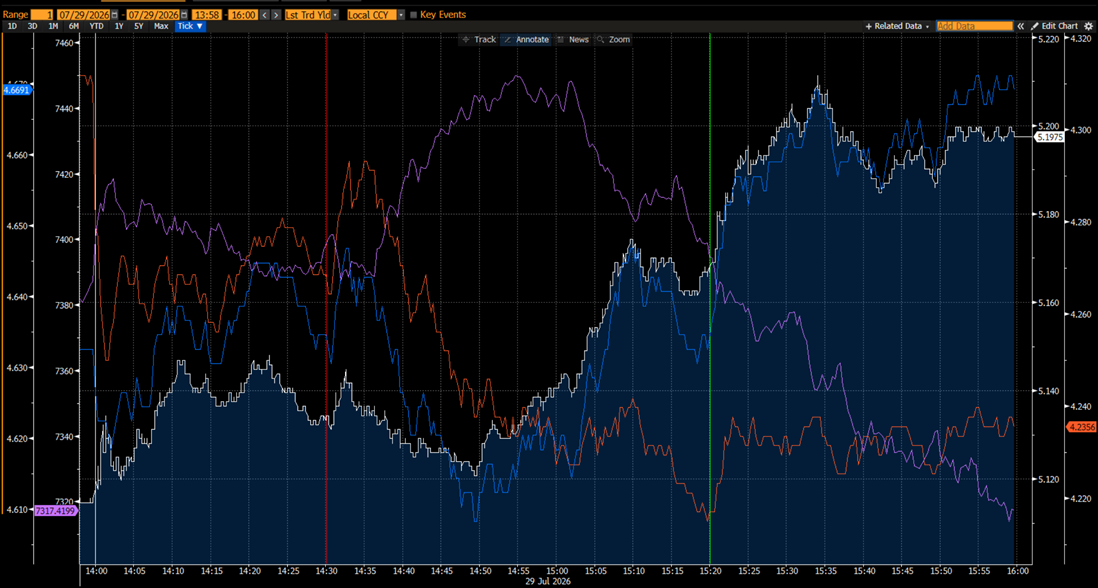
Source: Bloomberg
The 2-day moves in the yield curve are displayed below. The steepening of the yield curve is evident, with 3-month yields falling by about 10 basis points while 10-year and 30-year yields rose by about 5 and 12 basis points, respectively. It is very difficult for equity valuations to ignore such a sharp rise in long-term rates, especially when so many of the market leaders are intending to borrow billions of dollars to finance their AI-related buildouts.

Source: Bloomberg
That said, the rise in rates was not enough to daunt the enthusiasm shown by Microsoft (MSFT) investors over that company’s plans to merely hold the line on capital spending. Their results blew past expectations, led mainly by a gain in its Azure cloud and a bump in paid Copilot usage. That was enough to add about $500 billion to MSFT’s market capitalization, helping to boost stocks even beyond the market-clearing bounce after the resolution of the hedge fund trauma and the 10% decline in Meta Platforms (META).
Tomorrow’s activity will depend upon market reactions to Apple (AAPL) and Amazon (AMZN) earnings and a clearer look at whether residual concerns about excessive leverage continue. Month-end shenanigans after a turbulent July could also come into play. Tomorrow never knows.
New to Interactive Brokers?
Open AccountAlready an Interactive Brokers Client?
Request Trading PermissionThe analysis in this material is provided for information only and is not and should not be construed as an offer to sell or the solicitation of an offer to buy any security. To the extent that this material discusses general market activity, industry or sector trends or other broad-based economic or political conditions, it should not be construed as research or investment advice. To the extent that it includes references to specific securities, commodities, currencies, or other instruments, those references do not constitute a recommendation by IBKR to buy, sell or hold such investments. This material does not and is not intended to take into account the particular financial conditions, investment objectives or requirements of individual customers. Before acting on this material, you should consider whether it is suitable for your particular circumstances and, as necessary, seek professional advice.
The views and opinions expressed herein are those of the author and do not necessarily reflect the views of Interactive Brokers, its affiliates, or its employees.
Hedge Funds are highly speculative, and investors may lose their entire investment.
Short selling is an advanced trading strategy involving potentially unlimited risks and must be done in a margin account.
Trading on margin is only for experienced investors with high risk tolerance. You may lose more than your initial investment. For additional information regarding margin loan rates, see ibkr.com/interest
Municipal Bonds are only available from Interactive Brokers for IBKR LLC, IBKR Canada, IBKR Hong Kong, IBKR Australia and IBKR Singapore entities.
Related Articles















Join The Conversation
For specific platform feedback and suggestions, please submit it directly to our team using these instructions.
If you have an account-specific question or concern, please reach out to Client Services.
We encourage you to look through our FAQs before posting. Your question may already be covered!