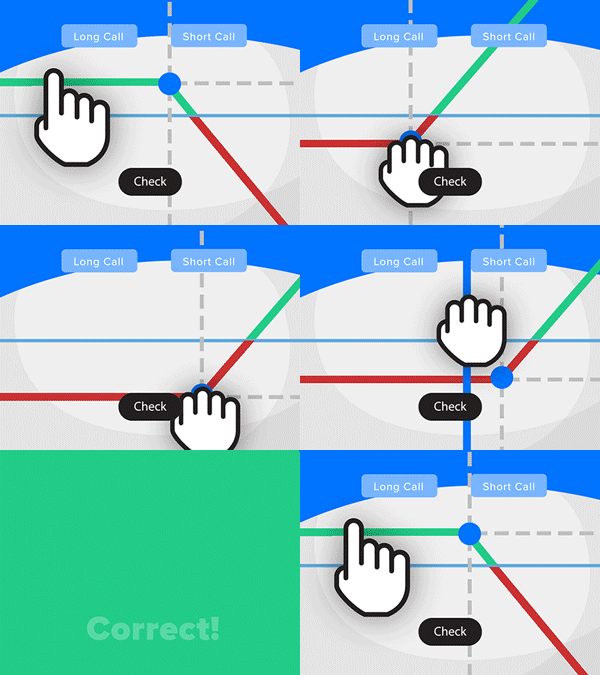
- Solve real problems with our hands-on interface
- Progress from basic puts and calls to advanced strategies
Interactive Options Course

Posted October 30, 2026 at 1:09 pm
A Halloween growth scare is hitting Wall Street on this Friday as the Nasdaq 100 plunges over 3% and inches closer to a 10% drawdown, which would place it in correction territory. Investors are becoming increasingly worried that tech firms are devoting significant capital expenditures to an AI expansion that appears to be decelerating. Companies are having trouble reaching nosebleed expectations and worrying shareholders that the stellar performances of the past won’t be repeated anytime soon. Amazon and Intel specifically intensified those concerns after the closing bell yesterday, as they pointed to lackluster returns from monumental outlays that have brought free cash flow levels deeply negative. Moreover, market sentiment is also getting crushed from the biggest cryptocurrency heist in history, amounting to $6.3 billion taken out of Binance, the largest bitcoin exchange in existence, which is raising eyebrows as it relates to the reliability of digital asset infrastructure. Additionally, rising oil prices stemming from worries that President Trump might reinitiate Middle East attacks following the midterm elections this Tuesday are lifting interest rates, which are holding back the cyclical equities that are trying to hang in there but failing to do so thus far. Still, 5 of the 11 principal sectors are advancing and attempting to offset weakness in tech, whose substantial influence has the four major domestic equity benchmarks in the basement. Volatility protection instruments are seeing heightening demand in case there’s more turbulence around the corner. Elsewhere, a bear-flattener yield curve climb is strengthening the greenback and risk-off attitudes are punishing non-energy commodities.
Despite corporate earnings decelerating from a peak that was reached earlier this year, a strong economy continues to underpin profitability expansions in the double-digit vicinity. There was no question that the nosebleed figures seen throughout this year’s AI boom would settle in once capital return prospects neutralized as the race to augment capacity progressed, but that slowdown process is an uncertain one, and investors are clearly concerned that sales and margins could fall off of a cliff. The expected blue sweep coming up in the midterm elections is further influencing risk-off postures, as Wall Street grows anxious about the Democrats potentially focusing on suppressing the AI build-out via tighter regulations and greater oversight. Additionally, rising yields stemming from escalating geopolitical tensions and the cryptocurrency volatility are adding more fuel to the fire and blocking potential advances in Treasuries and cyclical equities, which is what occurred yesterday, as well as a possible rotation into Bitcoin, that when taken together, could have resulted in a narrow tech selloff instead of a broad plunge. Meanwhile, we’re flipping the calendar to the strongest month for stocks on Monday from a seasonal perspective, and as folks realize that a split government, robust consumer spending, stable hiring, a patient Fed, and ongoing fiscal support present a healthy backdrop for stocks irrespective of milder business investment momentum, a year-end rally to fresh records is still in the cards, at least for the S&P 500 and the Dow Jones.
The Bank of Japan held its key interest rate at 1.25% last night and Gov. Kazuo Ueda held short of claiming that the war against inflation is over. The bank needs to ensure that price pressures are contained in a stable and sustainable manner, but that goal has yet to be achieved, he said. The outcome of this week’s BoJ meeting was widely anticipated with the Interactive Brokers Prediction Markets placing a 96% likelihood of the rate remaining unchanged. Tokyo’s Consumer Price Index, which is viewed as an early indication of inflation across the country, accelerated from 2.7% in September to 2.8% for October but was cooler than the economist consensus estimate of 3.3%, according to yesterday’s release of the data. The core version, however, eased from 2.7% to 2.6%, matching the economist consensus outlook.
Other data released either today or yesterday included the following:
Gross domestic product in the eurozone expanded by 0.4% quarter over quarter in the three-month period ended in September, according to preliminary data from Eurostat. The result exceeded the economist consensus estimate of 0.2% but decelerated from the preceding period’s 0.6%. The y/y rate, at 1.3%, however, blew past both the 1.1% estimate and the second quarter’s 1.2% uptick. For the q/q print, France and Lithuania were headwinds with declines of 0.1% and 1%. Conversely, Ireland led with a 5.5% jump, although Eurostat warns that the country’s data is incomplete and somewhat experimental. Spain, Estonia and the Netherlands, also led growth with expansions of 0.6%. Germany, which is the region’s largest economy, grew only 0.2%.
Mexico’s economy grew 3.2% y/y during the third quarter, according to a preliminary report. The pace exceeded the 2.5% forecast and the preceding period’s 2.1% expansion. When compared to the three-month period ended in June, GDP was up 0.9%. The result was stronger than the 0.7% q/q estimate, but it slowed from the 1.4% pace in the second quarter.
New to Interactive Brokers?
Open AccountInformation posted on IBKR Campus that is provided by third-parties does NOT constitute a recommendation that you should contract for the services of that third party. Third-party participants who contribute to IBKR Campus are independent of Interactive Brokers and Interactive Brokers does not make any representations or warranties concerning the services offered, their past or future performance, or the accuracy of the information provided by the third party. Past performance is no guarantee of future results.
This material is from IBKR Macroeconomics, an affiliate of Interactive Brokers LLC, and is being posted with its permission. The views expressed in this material are solely those of the author and/or IBKR Macroeconomics and Interactive Brokers is not endorsing or recommending any investment or trading discussed in the material. This material is not and should not be construed as an offer to buy or sell any security. It should not be construed as research or investment advice or a recommendation to buy, sell or hold any security or commodity. This material does not and is not intended to take into account the particular financial conditions, investment objectives or requirements of individual customers. Before acting on this material, you should consider whether it is suitable for your particular circumstances and, as necessary, seek professional advice.
Futures, event contracts, and forecast contracts are not suitable for all investors. Before trading these products, please read the CFTC Risk Disclosure. For a copy, visit our Warnings and Disclosures Page.
Trading in digital assets, including cryptocurrencies, is especially risky and is only for individuals with a high risk tolerance and the financial ability to sustain losses. Eligibility to trade in digital asset products may vary based on jurisdiction.
Trading Bitcoin involves significant risk. Bitcoin prices can be highly volatile and may fluctuate rapidly, potentially resulting in substantial losses. Because Bitcoin operates on a decentralized blockchain, network congestion or technical issues may occasionally delay transaction settlement. Regulatory frameworks for digital assets are still evolving and could impact availability, liquidity, or pricing. When trading through Interactive Brokers, execution and custody are facilitated by regulated partners such as Paxos or zerohash; however, these arrangements do not eliminate the possibility of operational or counterparty risk.
Related Articles


















Join The Conversation
For specific platform feedback and suggestions, please submit it directly to our team using these instructions.
If you have an account-specific question or concern, please reach out to Client Services.
We encourage you to look through our FAQs before posting. Your question may already be covered!