
- Solve real problems with our hands-on interface
- Progress from basic puts and calls to advanced strategies
Interactive Options Course

Posted August 10, 2026 at 12:55 pm
For several years, almost certainly dating back to the Global Financial Crisis, stock investors have benefited from a positive liquidity backdrop. Interest rates were generally low, thanks to subdued inflation, which facilitated a highly favorable supply/demand backdrop for stocks. Solid but steady economic growth amid those conditions facilitated a stable to shrinking supply of publicly traded shares, which was facilitated by buybacks and takeovers. Now, those dynamics have changed. They were a reliable tailwind for equities; now they risk becoming a headwind.
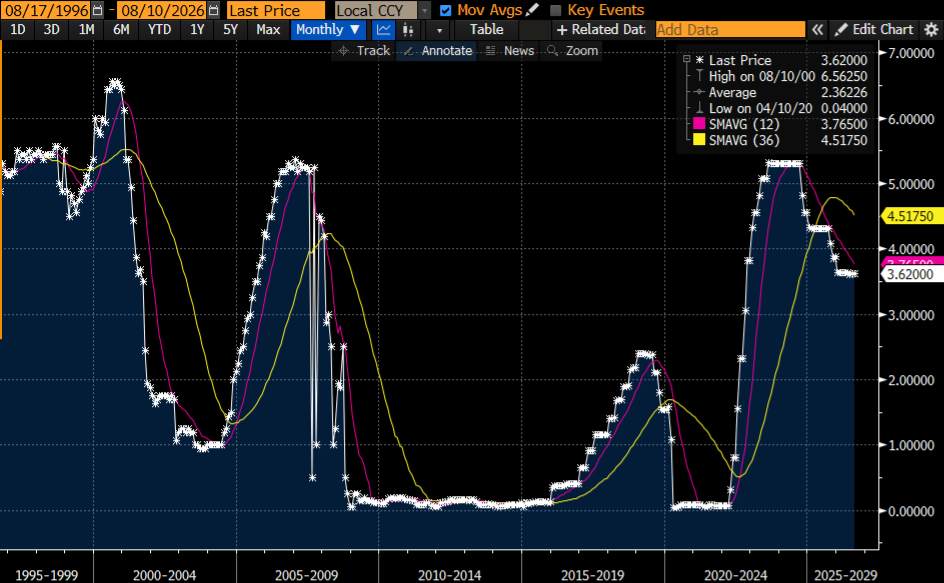
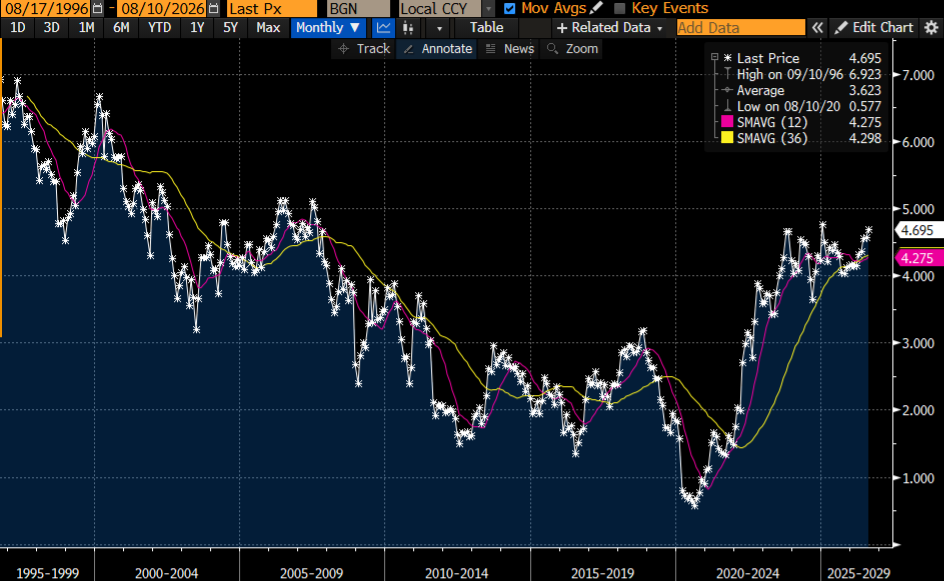
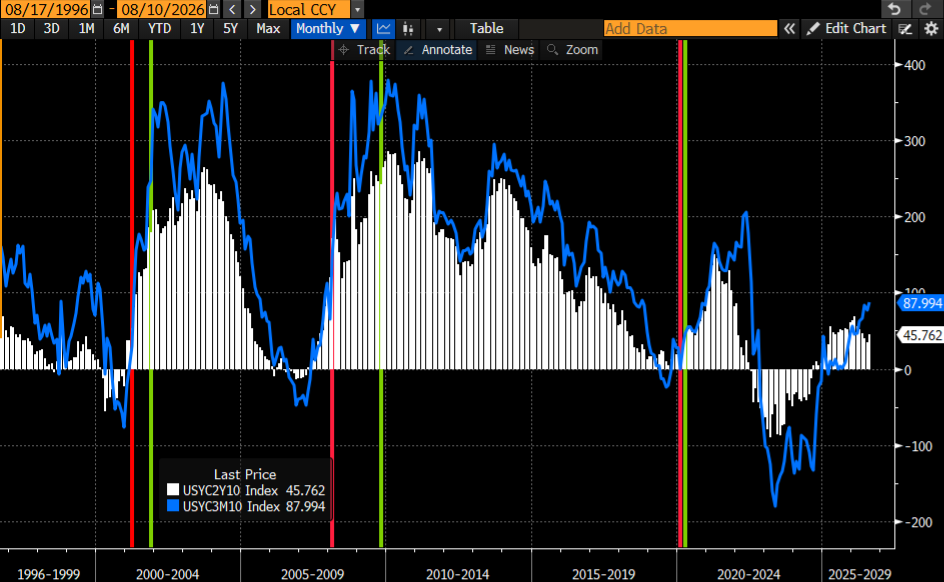
Certainly, conditions have not always been favorable for stocks throughout the past 16 or so years. Rising Fed Funds rates led to down years for stocks in 2018 and 2022 (the last two midterm election years, by the way), but longer-term rates remained contained during those periods. Even during 2022, when short-term rates rose quite sharply – from zero to over 5% – long-term rates remained well-contained. This is shown in the three charts below. The first shows the prevailing Fed Funds rate over the past 30 years; the second shows the 10-year Treasury yield over that timeframe; while the third shows the spread between 3-month/10-year and 2-year/10-year Treasury yields.
Fed Funds Target Rate (white), with 12-Month (magenta) and 36-Month (yellow) Moving Averages; 30-Years, Monthly Data
Source: Bloomberg
10-Year US Treasury Yields (white), with 12-Month (magenta) and 36-Month (yellow) Moving Averages; 30-Years, Monthly Data
Source: Bloomberg
10-Year Minus 2-Year US Treasury Yields (white), 10-Year Minus 3-Month US Treasury Yields (blue), with NBER Recession Start (red) and End (green) Dates; 30-Years, Monthly Data
Source: Bloomberg
We can see that longer-term rates were significantly inverted during much of the 2022-2025 period, which enabled much of the tailwind to continue. Remember, long-term interest rates are more important for determining equity market valuations than their short-term counterparts. Many equity valuation measures utilize present values of dividends, earnings, or cash flows, with long-term rates being used as the discounting factor. The lower the long-term interest rate, the higher the present value of the future dividends/earnings/cash flows; and vice versa. Thus, the higher the long-term rates, the lower the present value of the stock – at least in theory.
Higher interest rates also impact the ability for private equity firms or other corporate buyers to pay cash as the consideration for mergers and acquisitions. Unless the company has immense amounts of cash on hand, such as Berkshire Hathaway (BRK.B) or Apple (AAPL), it needs to borrow copious amounts of money to finance the buyout. This has slowed down buyout activity. At the same time, concerns about private credit have put pressure on some private equity firms to look for opportunities to sell holdings, rather than buy more.
Meanwhile, some of the companies that have been huge generators of free cash flow now find themselves needing to borrow money or sell stock to fund their AI ambitions. Alphabet (GOOG, GOOGL) has done both recently, selling over $85 billion in bonds and $20 billion in stock. We have not yet seen the other hyperscalers come to market with secondary stock offerings, but Meta Platforms (META) and Amazon (AMZN) each had bond offerings in recent months. These companies have not all fully ceased buybacks, but they are more likely to use buybacks merely to offset the dilution that occurs when employees cash in their holdings rather than reduce their share counts in meaningful ways.
Finally, we have large IPOs coming down the pipeline. The recent SpaceX (SPCX) IPO and SK Hynix ADR (SKHY) offerings were initially well-received by investors, even though both have pulled back from their early gains. But when we consider the potential overhang of post-lockup SPCX shares alongside the widely expected mega-IPOs of Anthropic and OpenAI, there is clearly an awful lot of stock that is likely to find its way into the market.
None of this is cause for immediate alarm. Corporate insiders are not stupid – they’re not going to sell stock willy-nilly into a market that is less than eager for their shares. This is a reason why SPCX rallied after the lockup expired last week. The anticipated deluge of shares didn’t arrive. Those shares might be fed into the market if the stock once again surpasses its $135 IPO price, but there is currently no indication of a fire sale. Private equity and venture capital firms might be looking to cash out of some of their holdings, but they too can hold off until favorable market conditions arise (at least the ones who are not unduly burdened by private credit woes).
But this all lurks in the background. Just as the beneficial supply/demand dynamics were a secular, steady tailwind for equity prices for many years, we need to recognize that the prevailing wind patterns may have shifted. They won’t necessarily impede our forward progress, but they may slow it down and risk pushing us into reverse.
New to Interactive Brokers?
Open AccountAlready an Interactive Brokers Client?
Request Trading PermissionThe analysis in this material is provided for information only and is not and should not be construed as an offer to sell or the solicitation of an offer to buy any security. To the extent that this material discusses general market activity, industry or sector trends or other broad-based economic or political conditions, it should not be construed as research or investment advice. To the extent that it includes references to specific securities, commodities, currencies, or other instruments, those references do not constitute a recommendation by IBKR to buy, sell or hold such investments. This material does not and is not intended to take into account the particular financial conditions, investment objectives or requirements of individual customers. Before acting on this material, you should consider whether it is suitable for your particular circumstances and, as necessary, seek professional advice.
The views and opinions expressed herein are those of the author and do not necessarily reflect the views of Interactive Brokers, its affiliates, or its employees.
Related Articles
















Join The Conversation
For specific platform feedback and suggestions, please submit it directly to our team using these instructions.
If you have an account-specific question or concern, please reach out to Client Services.
We encourage you to look through our FAQs before posting. Your question may already be covered!