
- Solve real problems with our hands-on interface
- Progress from basic puts and calls to advanced strategies
Interactive Options Course

Posted September 2, 2026 at 1:31 pm
Today’s weaker-than-anticipated ADP employment report paired with market friendly commentary from NY Fed President John Williams and Treasury Secretary Scott Bessent is halting bond pain and driving bargain hunters into equities. The slowest pace of hiring since January was accompanied by decelerating wage gains and half of the publication’s 10 categories losing jobs, which signals an increasingly fragile labor situation that may prohibit the US monetary policy authority from hiking more than once. Furthermore, the leader of the Fed’s second district, who votes at every meeting, stated that inflation is easing and mentioned that yields are soaring due to robust growth driven by the AI-buildout rather than worries about price pressures. Meanwhile, Washington’s fiscal chief said that the jump in rates is temporary and will ease after the Middle East conflict is resolved, although geopolitical affairs remain complicated and there’s currently not much light at the end of the tunnel. The messaging is boosting investor sentiment, which has faced significant headwinds in recent sessions. As a result, the yield curve is descending modestly in bull-steepening fashion led by the shorter tenors while all major stock benchmarks are advancing amidst 9 of the 11 sectors in the green. Additionally, demand for downside hedges is dropping as volatility protection instruments see lighter premiums. Elsewhere, the greenback and cryptocurrencies are nearly flat, commodities are broadly higher and prediction markets are catching bids.
A cyclical downturn in hiring last month weighed on this morning’s ADP-jobs report. The headline figure of 38k marked the third consecutive deceleration, missed the consensus expectation of 47k and was below July’s 46k. Employment losses totaling 17k, 16k, 5k, 5k and 4k across the manufacturing, professional/business services, natural resources/mining, trade/transportation/utilities and information sectors offset gains in four of the economically sensitive areas. Indeed, the leisure/hospitality, construction, other services and financial activities categories only increased headcounts by 16k, 12k, 6k and 6k. The education/health services segment kept the overall statistic positive, as the group led the way, gaining 45k. Meanwhile, roster additions were dominated by large firms with 500 people or more on staff, as they collectively expanded their payrolls by 34k. But the small- and mid-size establishments, characterized by businesses with 1-49, and 50-499 employees, registered a 3k increase on the former, while coming in unchanged on the latter. Furthermore, compensation trends weakened too, with the median year over year (y/y) change in gross pay dropping from 7.5% to 7.3% for job-changers, while remaining flat at 4.4% for those that stayed with their current company.
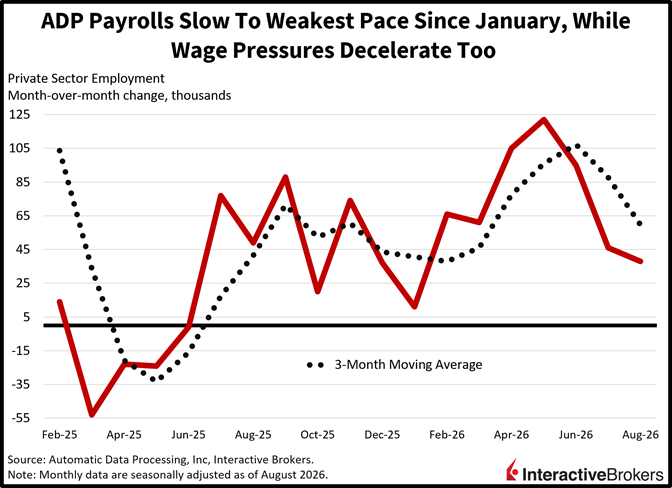
Today’s meaningful recovery in equities doesn’t have a fundamental justification. Rather, it’s likely that bulls just got tired of losing for three consecutive sessions and investors were looking for a reason to buy the dip. But the positive vibes coming from leadership in Washington and from the Fed’s branch right in the vicinity of Wall Street offered enough motivation from a cabinet member and a voting policymaker that the resumption of fresh stock market records could be around the corner. It’s the combined focus squarely on a case for lower interest rates that got participants excited, with one leader mentioning a temporary lift from geopolitical tensions while the other communicated that inflationary pressures are actually cooperating quite well when you exclude the volatile energy component. Furthermore, Williams’s statement detailing that heavier fuel charges haven’t spread much to the overall economy provided a sense of optimism that cost forces and yields would plunge if and when a resolution between the US and Iran is reached, a view that Treasury Secretary Bessent declared also. Meanwhile, this afternoon and tomorrow are poised to present quiet trading action absent any unforeseen events, as the financial community gets ready for a significant nonfarm payrolls report this Friday, following a July number that featured a notable contraction.
The Bank of Canada this morning decided to maintain its key overnight interest rate at 2.25%, but it stated that there is an upside risk to inflation with growing uncertainty regarding both energy prices and the trade war with the US. On a positive note, it reported that higher fuel prices do not appear to have triggered stronger price pressures in other areas of the economy. This morning marked the eighth consecutive decision to maintain the rate, which was established with a 25-basis point cut last October. This decision to hold was widely anticipated by fixed-income markets.
In recent months, annualized inflation has been around 3%, considerably hotter than the bank’s 2% target. Nevertheless, in its post meeting statement, the bank noted that the Middle East crisis is keeping oil and gas prices higher for a longer period than originally anticipated.
The Middle East conflict isn’t the only source of uncertainty with the latest US trade dispute, which includes tariffs and retaliatory duties, clouding the outlook. The new taxes from the trade war could eventually be passed on to consumers, fueling higher inflation and threatening Canada’s economic recovery. In the meantime, the nation continues to experience excess supply. In other areas, exports have been improving, labor conditions have strengthened and consumption has made solid gains.
Inflation picked up in Korea last month with the Consumer Price Index climbing 0.2% month over month (m/m) and 3.1% y/y following July’s 0.2% monthly decline and 2.8% 12-month ascent, according to the Ministry of Data and Statistics. Despite the hotter results, the metrics were below the economist consensus estimates for 0.3% and 3.2% m/m and y/y prints. The core version, which includes food and energy because of their volatile prices, was mixed with the m/m rate falling from 0.4% in July to 0.2% last month. When compared to the year-ago period, however, the core gauge was up 3.4% following July’s 2.6% print.
Within the headline publication, categories that increased m/m and the extent of their changes were as follows:
Clothing and footwear, education, and miscellaneous goods and services were unchanged while the categories of health and transport experienced 0.1% declines. Prices for the recreation and culture group, furthermore, slipped by 0.4%.
Australia’s gross domestic product growth in the second quarter slowed from 2.5% y/y during the first three months of 2026 to 2.1%, according to the Australian Bureau of Statistics. The slowing growth was still strong enough to exceed the economist consensus estimate of 1.8%. The quarter-over-quarter comparison was favorable too with GDP expansion of 0.4%. Economists anticipated a repeat of the first quarter’s 0.3% advance. For the q/q result, household consumption contributed 0.2 percentage points. Discretionary spending jumped 1.4% with sales of electric and hybrid cars hitting an all-time high because consumers sought to lower vehicle operating costs. Tourism weakened, however, because the Middle East conflict disrupted travel to the northern hemisphere. Households also consumed less gasoline in response to higher prices.
Trade contributed another 0.1 percentage point with the increase in exports exceeding the growth of products and services purchased from abroad. Demand for thermal coal as a substitute for liquid national gas during global supply disruptions was a tailwind. Favorable metallurgical prices also contributed to the acceleration in exports. Also during the second quarter, more robust private investment in buildings and construction was offset by a decline in business machines, including computer-related items. As a result, the broad category had no impact on GDP. In other areas, profits among private non-financial corporations ascended by 2.5%, largely due to strengthening sales and higher prices for coal, crude oil and lithium. The second quarter also included a 1.5% increase in employee compensation.
New to Interactive Brokers?
Open AccountInformation posted on IBKR Campus that is provided by third-parties does NOT constitute a recommendation that you should contract for the services of that third party. Third-party participants who contribute to IBKR Campus are independent of Interactive Brokers and Interactive Brokers does not make any representations or warranties concerning the services offered, their past or future performance, or the accuracy of the information provided by the third party. Past performance is no guarantee of future results.
This material is from IBKR Macroeconomics, an affiliate of Interactive Brokers LLC, and is being posted with its permission. The views expressed in this material are solely those of the author and/or IBKR Macroeconomics and Interactive Brokers is not endorsing or recommending any investment or trading discussed in the material. This material is not and should not be construed as an offer to buy or sell any security. It should not be construed as research or investment advice or a recommendation to buy, sell or hold any security or commodity. This material does not and is not intended to take into account the particular financial conditions, investment objectives or requirements of individual customers. Before acting on this material, you should consider whether it is suitable for your particular circumstances and, as necessary, seek professional advice.
Futures, event contracts, and forecast contracts are not suitable for all investors. Before trading these products, please read the CFTC Risk Disclosure. For a copy, visit our Warnings and Disclosures Page.
Trading in digital assets, including cryptocurrencies, is especially risky and is only for individuals with a high risk tolerance and the financial ability to sustain losses. Eligibility to trade in digital asset products may vary based on jurisdiction.
Related Articles














Join The Conversation
For specific platform feedback and suggestions, please submit it directly to our team using these instructions.
If you have an account-specific question or concern, please reach out to Client Services.
We encourage you to look through our FAQs before posting. Your question may already be covered!