- Solve real problems with our hands-on interface
- Progress from basic puts and calls to advanced strategies
Interactive Options Course

Posted September 15, 2026 at 12:34 pm
Corporate insiders (executives, directors, and other senior figures within a company) have something outside investors do not: direct exposure to the company’s operations, strategy, customers, costs, and internal expectations.
That does not mean every insider transaction is informative. Executives sell shares for many reasons, including diversification, taxation, liquidity needs, and compensation-related plans. Purchases can also be routine or mechanically driven.
The interesting question is therefore not simply whether an insider is buying or selling, but whether certain patterns of insider activity contain information about future stock returns.
Several decades of academic research suggest that they can.
The evidence becomes particularly interesting when we distinguish between purchases and sales, routine and opportunistic trades, isolated transactions and clusters of multiple insiders buying within a short period of time.
A useful starting point is the study by Leslie Jeng, Andrew Metrick, and Richard Zeckhauser, The Profits to Insider Trading: A Performance-Evaluation Perspective.
Using reported U.S. insider transactions from 1975 to 1996, the researchers constructed portfolios containing stocks purchased and sold by corporate insiders and evaluated their performance against several benchmarks.
The result was striking.
After adjusting for characteristics such as company size, value, and momentum, the portfolio of insider purchases generated abnormal returns of approximately 37 to 47 basis points per month, or roughly 0.4% per month.
The timing of the effect was also notable: roughly one-sixth of the abnormal return appeared within the first five days after the transaction, one-third within the first month, and three-quarters within six months.
The corresponding portfolio of insider sales did not generate statistically or economically significant abnormal returns.
The authors provide an intuitive explanation. Insiders may sell because they need liquidity, want to diversify their personal wealth, or because they received shares through executive compensation. A sale therefore does not necessarily express a negative view about the company.
A voluntary purchase is different: an insider is actively deciding to increase his or her financial exposure to the company.
Another important piece of the puzzle comes from Joseph Piotroski and Darren Roulstone in Do Insider Trades Reflect Both Contrarian Beliefs and Superior Knowledge About Future Cash Flow Realizations?
Their findings suggest that insiders are simultaneously contrarian investors and possessors of superior information.
Insider trading activity is negatively related to recent stock returns and positively related to book-to-market ratios. In practical terms, managers tend to buy more after their company’s share price has performed poorly and when valuation characteristics point toward potential undervaluation.
At the same time, insider activity is positively related to future earnings performance.
This distinction matters.
Insiders may therefore have an advantage for two separate reasons:
Piotroski and Roulstone explicitly document that managers are more likely to purchase shares during periods of falling stock prices.
This means that an insider purchase following a sharp decline should not automatically be interpreted as a warning sign. In some cases, the decline itself may be the reason the insider considers the stock attractive.
Josef Lakonishok and Inmoo Lee examined more than one million insider transactions in Are Insiders’ Trades Informative?
Their research finds that insider activity can help predict future stock returns and that much of the strongest stock-level predictive power appears among smaller companies.
One reason may be information asymmetry.
Large companies are typically followed by many analysts, institutional investors, financial media outlets, and sophisticated market participants. New information may therefore be incorporated into their share prices relatively quickly.
A smaller company may have considerably less analyst coverage. In that environment, insiders could potentially possess a larger informational advantage.
Lakonishok and Lee find that the difference in subsequent returns between companies showing strong insider buying and strong insider selling is particularly pronounced among smaller stocks, whereas the signal becomes much weaker for large companies.
That said, the evidence is not completely uniform across academic studies.
Jeng, Metrick, and Zeckhauser, using a different portfolio-based methodology, do not find statistically significant differences in insider profitability between small and large firms.
The sensible conclusion is therefore not simply “insider buying works in small caps.” Rather, company size may be one proxy for the broader information environment surrounding a stock.
Perhaps one of the most useful contributions to insider-trading research comes from Lauren Cohen, Christopher Malloy, and Lukasz Pomorski.
In their 2012 Journal of Finance paper, Decoding Inside Information, they ask a simple question:
Can we distinguish trades that are probably routine from trades that may contain genuine information?
Their method is surprisingly intuitive.
An insider who repeatedly trades during the same calendar month over several consecutive years is classified as a routine trader. An insider whose trading history does not display that predictable timing pattern is classified as opportunistic.
Why should this matter?
Because a recurring transaction may be linked to bonuses, stock grants, diversification programs, liquidity needs, or other predictable events rather than a changing view of the business.
The difference in performance is substantial.
A value-weighted long-short portfolio based exclusively on opportunistic insider trades generated approximately 0.82% abnormal return per month, or 9.8% annualized in the historical sample.
Abnormal returns associated with routine traders were essentially zero.
Even more interestingly, opportunistic trades predicted not only future returns but also subsequent company news, analyst recommendations, earnings forecasts, management forecasts, and earnings announcements.
This is an important lesson for investors.
The fact that an insider bought shares is not enough. The context and history of that insider’s behavior may be much more important.
The research becomes even more interesting when multiple insiders buy shares of the same company within a short period of time.
Dallin Alldredge and Brian Blank studied this phenomenon specifically in their 2019 Journal of Financial Research paper, Do Insiders Cluster Trades with Colleagues? Evidence from Daily Insider Trading.
Their sample contains 52,532 corporate insiders at 8,789 firms between 1986 and 2014.
They find substantial evidence that insiders do not always trade independently.
Around 23% of insider purchases occurred on the same day as another insider purchase at the same company. Insiders were nearly four times more likely to buy when another insider at the same firm was also buying that day.
Moreover, the quantity of shares purchased around peer insider purchases was significantly larger.
But the most important finding concerns subsequent stock performance.
Purchases occurring within two days of another insider purchase were followed by approximately 2.1% abnormal return in the following month.
That was roughly 0.9 percentage points more than the abnormal return following solitary insider purchases.
In other words:
One insider buying may be interesting; several insiders independently buying within a few days may carry a stronger signal.
Alldredge and Blank also find evidence that the internal relationships between insiders matter.
CEOs and CFOs were each more than four times as likely to purchase shares when the other had purchased within the previous two days. Other officers were more than three times as likely to purchase following recent purchases by CEOs, CFOs, or other officers.
Directors also tended to follow other directors and the CEO.
Perhaps most importantly, clusters involving CEOs, CFOs, and directors exhibited particularly strong information content when measured through subsequent stock performance.
The researchers also found that clustering increased when investor attention was low, uncertainty was high, and information asymmetry was greater.
This reinforces the idea that the value of insider activity cannot be separated from the information environment around the company.
Chang-Mo Kang, Donghyun Kim, and Qinghai Wang examine the same phenomenon in the 2018 working paper Cluster Trading of Corporate Insiders.
They define a cluster as multiple insiders making trades in the same direction in the same stock on the same day or on consecutive trading days.
Their dataset covers insider activity from 1986 through 2016 and contains 457,539 purchases and more than one million sales. About 40% of insider transactions were classified as cluster trades.
The subsequent return differences are significant.
For purchases:
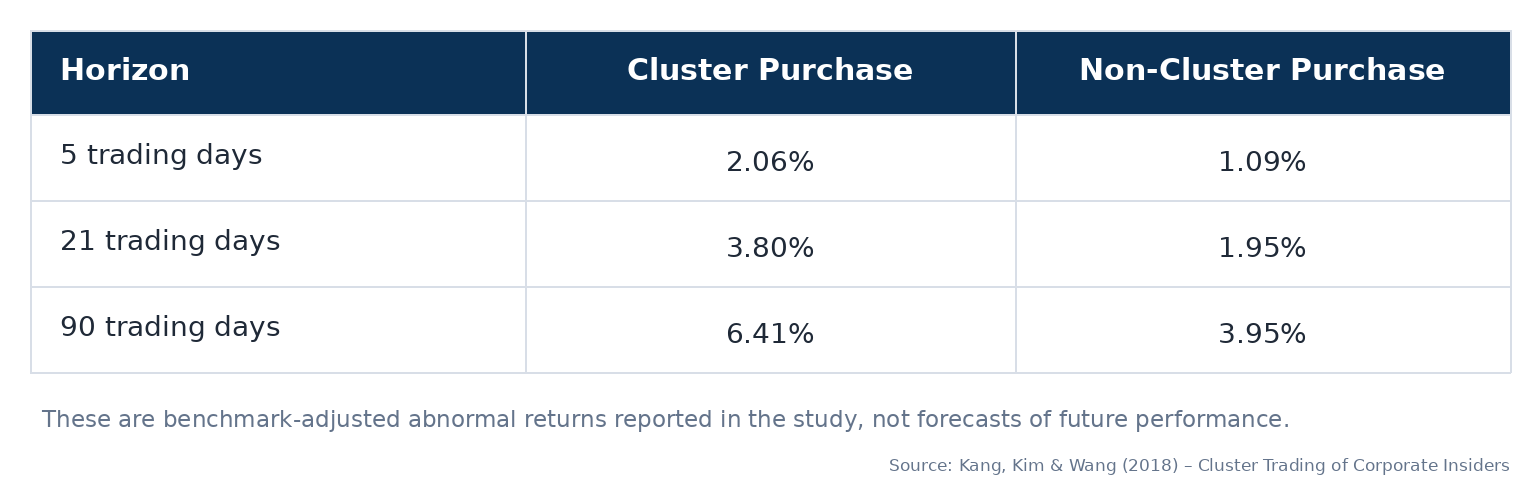
These are benchmark-adjusted abnormal returns reported in the study, not forecasts of future performance.
The authors also find that cluster purchases involving both executives and directors tend to carry stronger information than purchases involving only one group.
Another fascinating result is that cluster identification and the routine/opportunistic classification discussed earlier appear to contain complementary information.
A cluster is therefore not merely a collection of opportunistic trades. The two signals can potentially tell investors different things about insider behavior.
The challenge for investors is obvious.
Thousands of insider transactions are disclosed over time. Simply displaying a list of Form 4 filings does not solve the problem, because academic research suggests that the quality of the signal varies enormously from one transaction to another.
This is the idea behind the new Insider Tracker inside Forecaster Terminal.
Instead of focusing exclusively on individual trades, Insider Tracker is designed to highlight situations in which several potentially relevant characteristics converge.
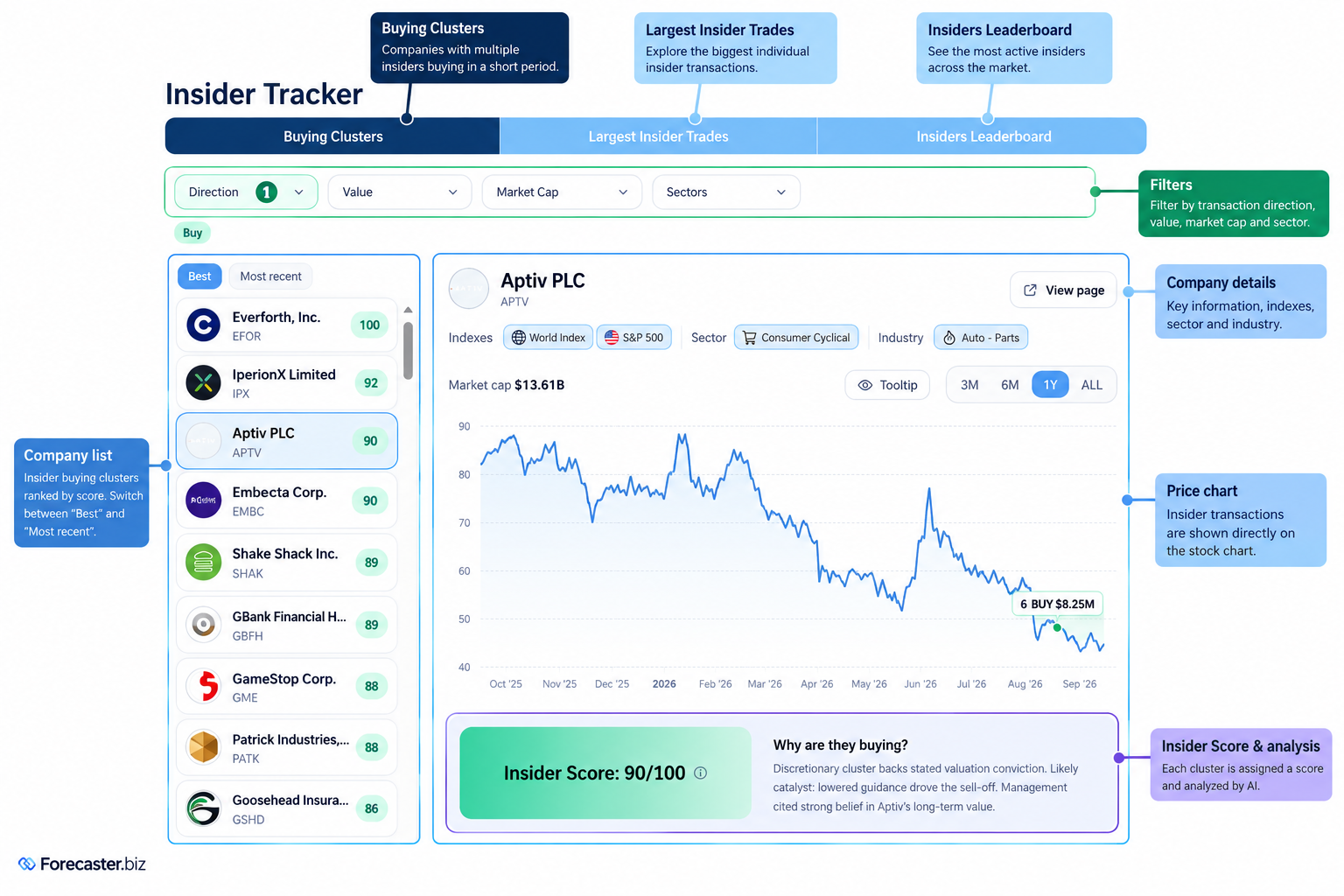
For example, investors can identify cases where multiple insiders are buying the same stock within a short period of time, creating a cluster similar to those examined in the academic literature.
The analysis can then go deeper by considering the number and roles of the insiders involved, the timing of the transactions, their size, and whether the activity appears more consistent with a recurring pattern or with an unusual, spontaneous purchase.
And because Insider Tracker sits inside Forecaster Terminal, insider activity can also be interpreted alongside other information already available on the platform.
Consider a hypothetical situation:
A stock has fallen 35% from its highs.
Forecaster’s valuation analysis suggests that the company may be undervalued.
Fundamental data are beginning to improve.
Then four different insiders purchase shares within a few days, while no meaningful insider selling occurs.
None of these observations alone proves that the stock will rise.
But academic research suggests that the convergence of several independent signals can be considerably more interesting than a single insider transaction viewed in isolation.
That is the purpose of Insider Tracker: not to blindly copy insiders, but to help investors filter, classify, and contextualize insider activity.
Taken together, these studies lead to a much more nuanced conclusion than the simple idea that “insiders know more.”
The academic evidence suggests that several characteristics deserve particular attention:
There is, however, an important caveat.
These results come from historical samples and different methodologies. Abnormal returns calculated in academic research do not represent guaranteed future returns, and a real-world strategy would also need to consider transaction costs, liquidity, disclosure timing, portfolio construction, and risk.
The objective should therefore not be to treat insider purchases as automatic buy signals.
The more useful approach may be to ask a different question:
When several pieces of evidence point in the same direction, is insider activity telling us something the broader market has not yet fully recognized?
That is where insider data becomes much more interesting.
Information posted on IBKR Campus that is provided by third-parties does NOT constitute a recommendation that you should contract for the services of that third party. Third-party participants who contribute to IBKR Campus are independent of Interactive Brokers and Interactive Brokers does not make any representations or warranties concerning the services offered, their past or future performance, or the accuracy of the information provided by the third party. Past performance is no guarantee of future results.
This material is from Forecaster.biz and is being posted with its permission. The views expressed in this material are solely those of the author and/or Forecaster.biz and Interactive Brokers is not endorsing or recommending any investment or trading discussed in the material. This material is not and should not be construed as an offer to buy or sell any security. It should not be construed as research or investment advice or a recommendation to buy, sell or hold any security or commodity. This material does not and is not intended to take into account the particular financial conditions, investment objectives or requirements of individual customers. Before acting on this material, you should consider whether it is suitable for your particular circumstances and, as necessary, seek professional advice.
Related Articles
















Join The Conversation
For specific platform feedback and suggestions, please submit it directly to our team using these instructions.
If you have an account-specific question or concern, please reach out to Client Services.
We encourage you to look through our FAQs before posting. Your question may already be covered!