
- Solve real problems with our hands-on interface
- Progress from basic puts and calls to advanced strategies
Interactive Options Course
Lesson 9 of 11
New to Interactive Brokers?
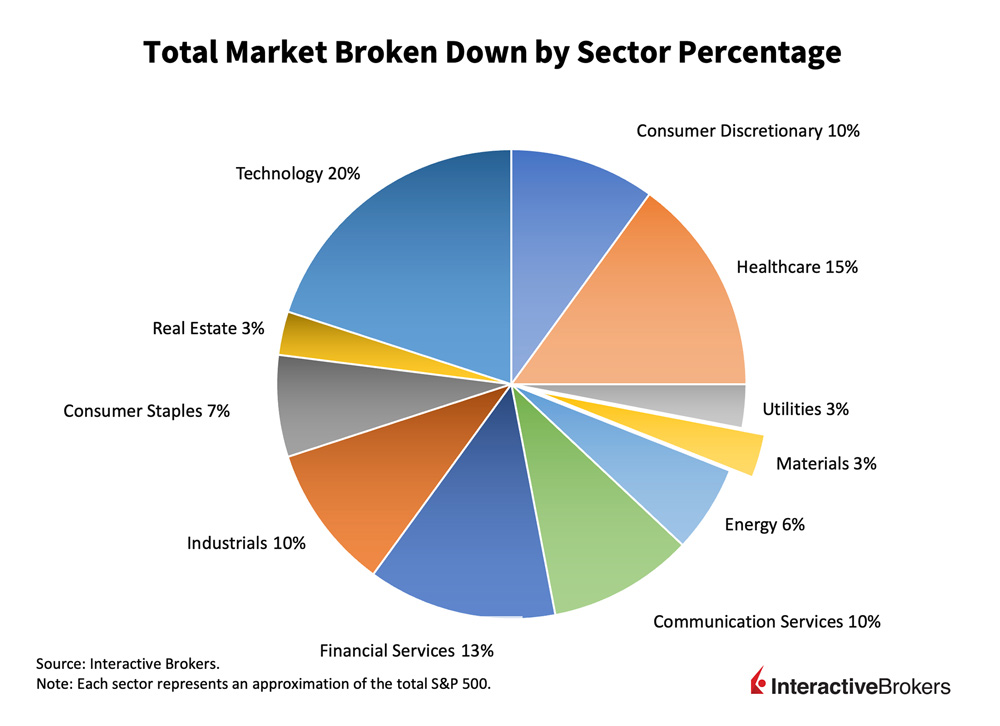
The Materials Sector is a cornerstone of the global economy, encompassing industries that discover, develop, and process raw materials into finished goods. This sector is vast, ranging from mining and metals to chemicals and construction materials, playing a crucial role in industrial and infrastructural growth worldwide. While the sector only comprises only 3% of the S&P 500 index, it has a total of 268 stocks with a combined market cap of $2.106 trillion and a total revenue of $1.168 trillion. The total workforce of all the industries within the sector employs approximately 1.69 million people across the country. This sector’s significance is underscored by its contribution to economic health, acting as a barometer for broader economic vitality and serving as an effective hedge against inflation due to its inherent link with commodity prices.
The broader materials markets rely on the demand for the products that use the materials in production. Physical goods are all created from raw materials, and the demand for these materials fluctuates between the different markets for them. Furthermore, companies and industries must consider how basic materials are a finite resource. For example, the demand for lumber is dictated by housing markets, and if there is a high demand for lumber, the prices of both houses and lumber will increase. The government regulates finite resources by taxing the companies that source them to help limit the exploitation of the resources.
The Materials sector performance is closely tied to global economic cycles, with its growth or contraction often mirroring the health of the global economy. The sector’s resilience is further highlighted by its ability to adapt to changing market conditions and geopolitical events, which can significantly impact commodity prices and supply chains. This allows the sector to be dynamic and causes the various sub-sectors to experience different growth trajectories. Notably, the Paper and Forestry Products industry leads with a growth rate of 4.52%, followed by Packaging at 3.61%, and Chemicals at 2.38%. Despite Metals and Mining showing a decline (-3.09%), the sector remains robust, driven by the continuous demand for raw materials across various industries.
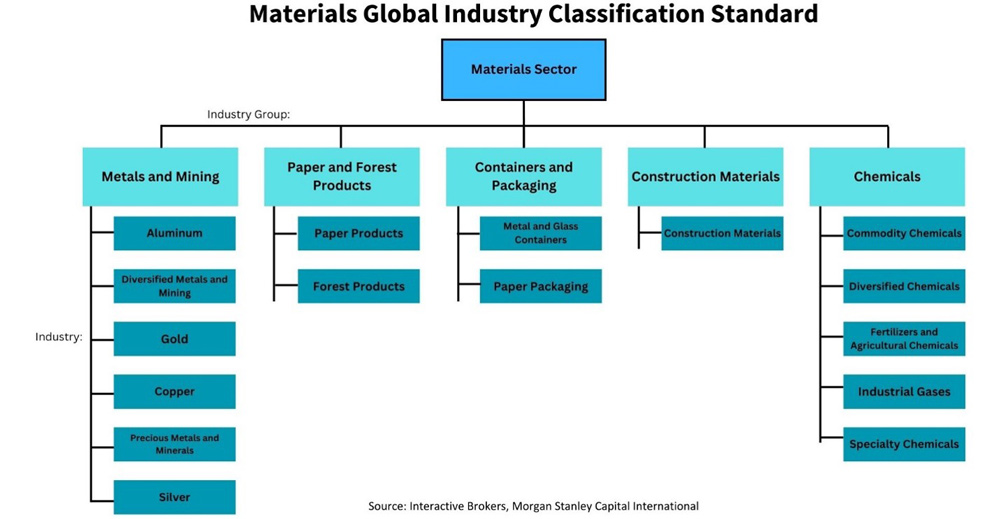
Underneath the umbrella of the Materials sector, there are several key industries, each with its unique characteristics and investment opportunities. The Mining and Metals industry involves the extraction and processing of minerals and metals, crucial for manufacturing and construction. Companies in this sector are exposed to significant volatility due to fluctuations in commodity prices and geopolitical tensions. The Chemicals industry produces a wide range of products, from plastics and fertilizers to pharmaceuticals and specialty chemicals. It is known for its high level of innovation and its role in supporting various other industries. The Construction Materials industry involves the production of materials used in construction, including cement, aggregates, and wood products. It is closely tied to the real estate and construction industries, experiencing growth during periods of economic expansion. The Paper and Forest Products industry is responsible for sourcing lumber and other forest products at a sustainable rate. It is also closely tied to the construction and housing industries as they are very codependent. Lastly, the Containers and Packaging industry is responsible for sourcing and creating metal and glass containers and created paper packaging.
Investments in the materials sector have the potential to generate gains when performed correctly. When investing in the materials sector, one can either choose to make purchases of mutual funds or ETFs that track the larger index or select companies within individual industries that were previously mentioned.
Making investments in the materials sector does come with associated risk. Since the sector is cyclical, investments will mirror the positive or negative performance of the economy. Furthermore, the value of materials themselves are highly volatile as they are closely tied to supply and demand. This causes materials stocks to be highly volatile as well. However, many view this volatility and cyclicality as a benefit, as it can offer high reward despite the high risk.
Likewise, investing in the materials sector can offer compelling opportunities for those looking to capitalize on the sector’s cyclical nature and its role as an inflation hedge. The sector’s performance is influenced by global economic conditions, commodity prices, and technological advancements. Investors can gain exposure through a variety of instruments, including stocks of companies engaged in mining, metals, chemicals, and construction materials.
There are numerous advantages and disadvantages to investing in the Materials sector that one must carefully consider when deciding to invest.
In terms of advantages, the sector is closely linked to economic cycles, thus performs well when the economy does well and performs poorly when the economy does so too. This can be beneficial for active traders who are particularly risk loving. Another advantage is that the sector is very expansive; if the prices and demand for certain commodities and metals increase, it will not necessarily affect the prices of other commodities. The cyclicality of the sector can be advantageous, but not significantly in the long run.
Looking ahead, the Materials sector is positioned for potential growth, driven by the ongoing demand for raw materials in various industries. The sector’s future is likely to be shaped by technological advancements, sustainability initiatives, and shifts in global trade patterns. Investors should keep an eye on developments in renewable energy, electric vehicles, and the circular economy, as these trends could significantly impact the demand for materials. The sector’s long-term prospects are also influenced by demographic trends, urbanization, and the need for infrastructure development in emerging economies.
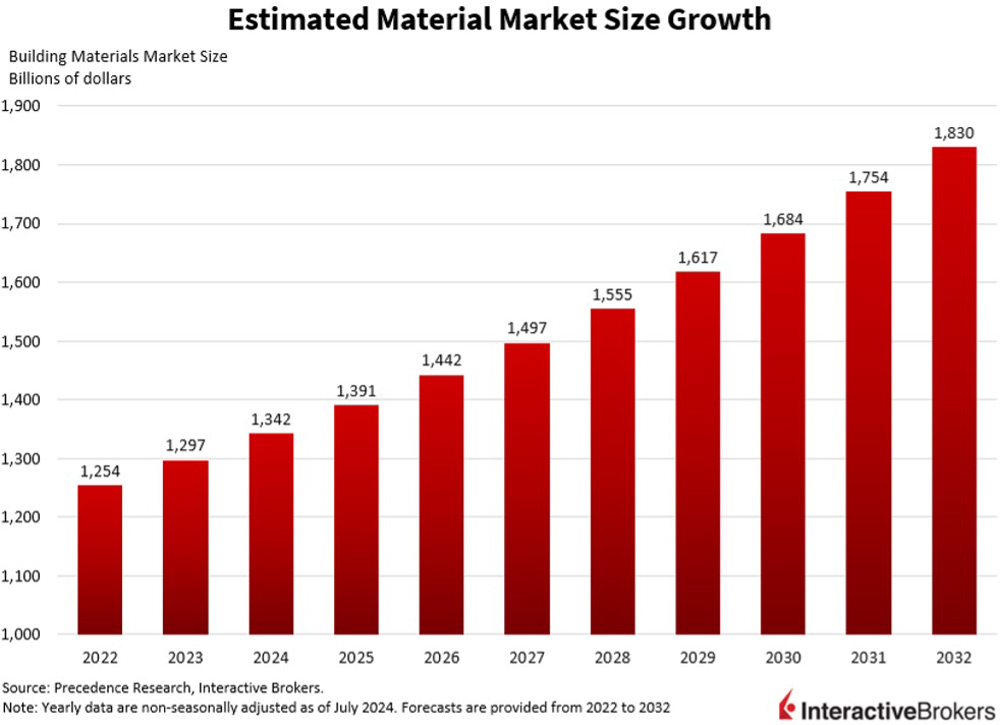
The market size for the materials sector is predicted to reach $1.829 trillion by 2032, expanding at a compounded annual growth rate (CAGR) of 3.90% during the forecast period over the next eight years. The materials market is expected to expand the fasted in North America, despite the Asia-Pacific region holding a significant amount (38%) of the global market for materials.
The materials sector is a potential profitable sector of the market that is closely connected to economic cycles and fluctuations. Active investors generate gains from the dynamic prices of individual industries and commodities, and passive investors can invest in mutual funds and ETFs that track the index of the sector. The constant demand for materials and the interconnection to other sectors makes for the materials sector to be one of the most essential of the 11.
Resources
https://www.spglobal.com/spdji/en/indices/equity/sp-500-materials-sector/#overview
https://www.spglobal.com/spdji/en/indices/equity/sp-500-materials-sector/#data
https://www.spglobal.com/spdji/en/indices/equity/sp-500-materials-sector/#news-research
The analysis in this material is provided for information only and is not and should not be construed as an offer to sell or the solicitation of an offer to buy any security. To the extent that this material discusses general market activity, industry or sector trends or other broad-based economic or political conditions, it should not be construed as research or investment advice. To the extent that it includes references to specific securities, commodities, currencies, or other instruments, those references do not constitute a recommendation by IBKR to buy, sell or hold such investments. This material does not and is not intended to take into account the particular financial conditions, investment objectives or requirements of individual customers. Before acting on this material, you should consider whether it is suitable for your particular circumstances and, as necessary, seek professional advice.
The views and opinions expressed herein are those of the author and do not necessarily reflect the views of Interactive Brokers, its affiliates, or its employees.











Join The Conversation
For specific platform feedback and suggestions, please submit it directly to our team using these instructions.
If you have an account-specific question or concern, please reach out to Client Services.
We encourage you to look through our FAQs before posting. Your question may already be covered!