
- Solve real problems with our hands-on interface
- Progress from basic puts and calls to advanced strategies
Interactive Options Course
Posted May 15, 2026 at 12:05 pm
Check out the new IBKR InvestMentor website for daily news explainers that cut through financial headlines, break down the jargon, and show you why the story matters for markets.
A US president landing in Beijing after nearly a decade could have marked a diplomatic reset. Instead, the visit revealed how brittle the relationship between the world’s two largest economies has become. Presidents Donald Trump and Xi Jinping spent three days working through a crowded agenda: tariffs, rare earths, AI chips, Taiwan, and the Iran war. But the talks ended without major deals or big public commitments. Even China’s pledge to buy 200 Boeing aircraft ended up sending the US planemaker’s shares lower as investors had hoped for a much bigger contract.
The tone at the summit was cordial, but the diplomatic distance indisputable.
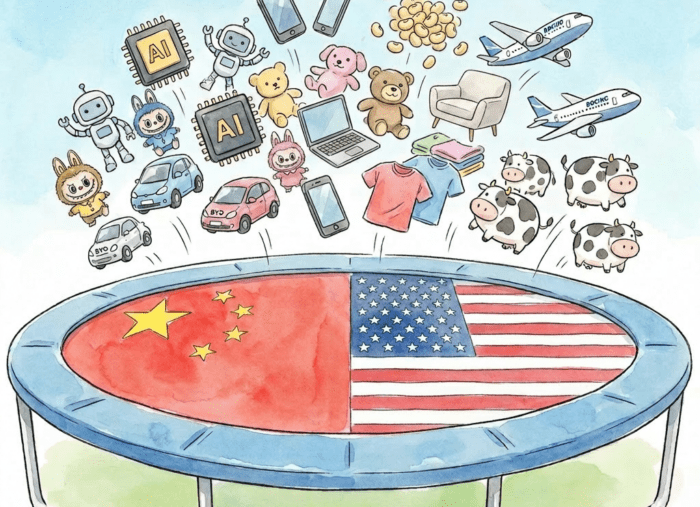
The US and China generate more than a third of global GDP, which means their disputes are never strictly bilateral. Their tiffs spill over onto factory floors, commodity markets, and grocery bills.
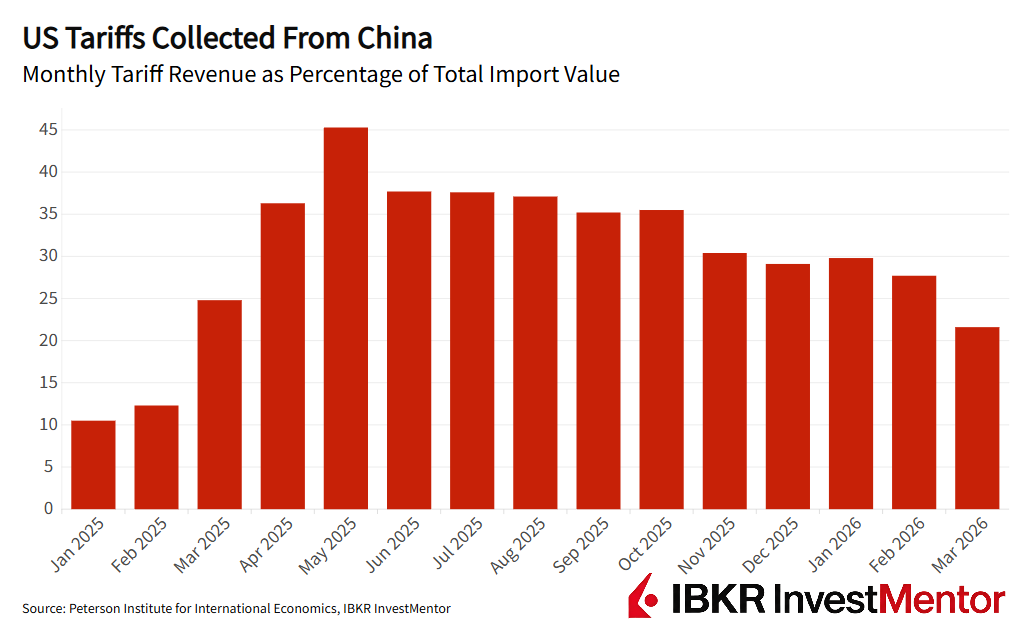
Tariffs remain the yardstick of the relationship. US duties on Chinese goods briefly hit nearly 150% in 2025, effectively freezing trade. Today, the tariffs collected average about 22%. That figure is much more reasonable in comparison, but still a high threshold for many companies to cross. China maintains a 10% blanket tariff on most US goods, with extra charges on energy and agriculture.
Despite the tariff tit-for-tat, the Chinese export machine has powered on, with the trade surplus exceeding one trillion dollars for the first time in 2025.
US officials say both sides are making progress earmarking roughly $30 billion in “non‑sensitive” goods that could see reduced tariffs. The US delegation also touted deals on agriculture, although China was tight-lipped about whether anything was agreed. American farmers may feel cautiously optimistic. But Beijing’s mixed signals — including a brief, quickly reversed approval for US beef imports — showed how fraught this trading partnership remains.
Xi set one ground rule on the first day: Taiwan is non‑negotiable to China. If the US takes a wrong step on the topic, the relationship breaks.
Beijing sees the island as part of its territory and has made reunification a long‑term goal. Washington doesn’t recognize Taiwan as an independent state but supports its self-defense and opposes any forced change to the status quo.
China is pushing for a clearer stance from the US, making the balancing act harder. The US has approved $11 billion in new weapons for Taiwan, with another package expected to reach $14 billion. After the summit, President Trump refused to confirm whether he would allow the second package to go ahead.
Xi warned that missteps could lead to “clashes and even conflicts.” This tricky topic underpins everything else that the two giants negotiate on, from tariffs to rare earths.
China controls almost all global refining for rare earth metals like samarium, yttrium, and dysprosium. These are essential for aircraft, EV motors, chipmaking, and defense systems. The dominance over rare earths has become China’s perhaps most potent economic weapon, and it has not been afraid to wield it.
Beijing halted most exports last spring in response to the US tariffs, with some metals fetching more than 100 times higher prices outside China. A tougher set of controls was postponed for one year in October, and companies around the world were hoping for the Trump-Xi summit to extend the pause. Yet, no breakthrough was announced on the issue.
The presence of tech industry heavy-weights — Nvidia’s Jensen Huang, Apple’s Tim Cook, and Tesla’s Elon Musk — in Beijing showed how deeply American firms depend on predictable access to China’s industrial ecosystem.
Then there’s the fight over access to high-end chips, which are crucial in the race to make the most advanced AI models. This dispute has taken a strange turn, as it’s now China that’s blocking the sales of US chips to its domestic companies.
Washington has given Nvidia a green light to sell its second-best AI chips to China. Around ten Chinese tech firms have already received US permissions to buy up to 75,000 units of H200 GPUs. But not a single chip has been delivered yet.
This is because China wants to reduce reliance on US technology and push local champions like Huawei, whose chips can already run DeepSeek’s latest AI model. Before the export controls, Nvidia held a 95% market share in advanced chips in China. That era is over.
Trump and Xi appear to get along personally, but friendly handshakes and garden walks are not enough to resolve structural tension. Businesses on both sides are attempting to navigate two vast markets that increasingly pull in different directions — politically, technologically, and strategically.
And for all the friction over tariffs and Taiwan, the world’s two largest economies still share responsibilities that are bigger than their rivalry.
Take the Strait of Hormuz. China is the biggest buyer of Gulf oil. The US would benefit from stable energy markets and cheaper gasoline. Yet, Beijing and Washington can’t seem to cooperate on something as fundamental as keeping oil flowing through the crucial shipping route. A lukewarm statement that the parties want the strait to remain open is unlikely to bring the crude prices down by much.
Download IBKR InvestMentor app for free, bite-sized lessons that build your confidence in the financial markets.
IBKR InvestMentor (dba “InvestMentor”) is a service of Interactive Academy LLC, an affiliate of IB LLC and majority-owned by IBG LLC. All content provided by InvestMentor is for informational and educational purposes only and should not be interpreted as implying any sponsorship, partnership, endorsement, recommendation, or approval by IB LLC or its affiliates.
Information posted on IBKR Campus that is provided by third-parties does NOT constitute a recommendation that you should contract for the services of that third party. Third-party participants who contribute to IBKR Campus are independent of Interactive Brokers and Interactive Brokers does not make any representations or warranties concerning the services offered, their past or future performance, or the accuracy of the information provided by the third party. Past performance is no guarantee of future results.
This material is from InvestMentor, an affiliate of Interactive Brokers LLC, and is being posted with its permission. The views expressed in this material are solely those of the author and/or InvestMentor and Interactive Brokers is not endorsing or recommending any investment or trading discussed in the material. This material is not and should not be construed as an offer to buy or sell any security. It should not be construed as research or investment advice or a recommendation to buy, sell or hold any security or commodity. This material does not and is not intended to take into account the particular financial conditions, investment objectives or requirements of individual customers. Before acting on this material, you should consider whether it is suitable for your particular circumstances and, as necessary, seek professional advice.
IBKR InvestMentorSM is a service of Interactive Academy LLC, an affiliate of IB LLC and majority-owned by IBG LLC. All content provided by IBKR InvestMentorSM is for informational and educational purposes only and should not be interpreted as implying any sponsorship, partnership, endorsement, recommendation, or approval by IB LLC or its affiliates.
For specific platform feedback and suggestions, please submit it directly to our team using these instructions.
If you have an account-specific question or concern, please reach out to Client Services.
We encourage you to look through our FAQs before posting. Your question may already be covered!
Related Articles












Taiwan is non‑negotiable to China, which has been the case since I first started investing in TSMC back in 2017. I don’t see that changing. Washington may not explicitly recognize Taiwan’s sovereignty, but sure does everything it can to ensure it. I believe President Trump will make good on that commitment with continued aid for Taiwan’s defense. The real Achilles heal is Rare earths, which is a separate, yet related issue, and the proverbial ace in the hole for Xi. China’s Achilles heel for now, is delivery of oil from Iran. Companies like Nvidia have more than proven selling GPUs to China is a luxury, rather than a necessity for maintaining good revenues and earnings, so I’m unconcerned about sales to China; actually, I think I’d prefer they don’t sell them chips. I’d love to have been a fly on the wall during some of the one on one talks between the 2 leaders. President Trump does hold his cards close to the vest when it’s called for, so not concerned about reportedly dubious outcomes from the trip to China,