
- Solve real problems with our hands-on interface
- Progress from basic puts and calls to advanced strategies
Interactive Options Course

Posted December 23, 2025 at 11:00 am
Many value stocks are trading well below historical norms, with valuations at a 30% discount to the S&P 500 Index.
Energy, financials, healthcare, and industrials are typical value sectors and can help reduce exposure to concentrated growth or AI-centric stocks.
Companies with solid balance sheets, consistent earnings, and tangible cash flows may be able to benefit from renewed economic momentum.
If the economy reaccelerates and the Federal Reserve (Fed) continues its interest rate-cutting cycle — as markets currently expect — value stocks may be poised for a resurgence. While rate cuts have historically broadly supported stocks, their impact on value versus growth can vary depending on the macroeconomic backdrop.
Lower interest rates mean businesses can borrow at a lower cost and invest in growth more easily. This usually gives growth companies an advantage because their future earnings can look more certain. In the current rate cycle, however, interest rates are higher, which may benefit value stocks. Plus, they’re currently at attractive entry points because many are still trading at discounts to historical valuations. Value stocks, based on the Russell 1000 Value Index, are at a 30% discount to the S&P 500 Index, and a 50% discount to growth stocks, based on the Russell 1000 Growth Index. (See chart below)
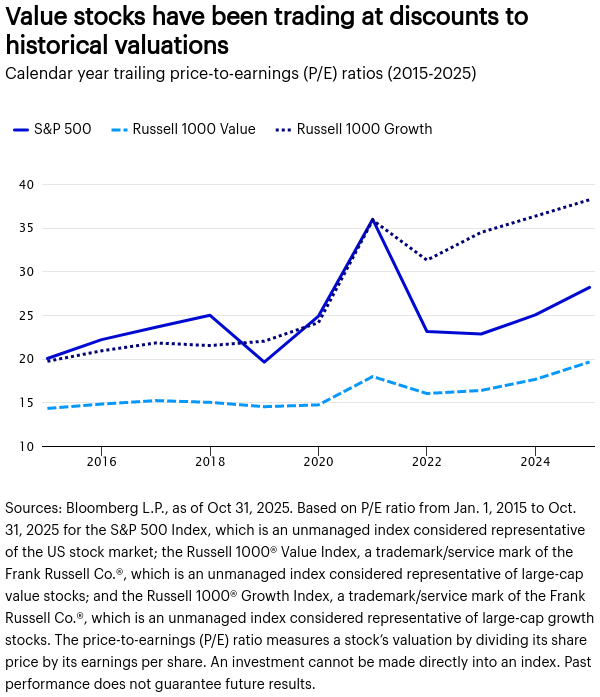
The stock market is also broadening beyond mega-cap technology stocks, potentially giving value sectors like energy, industrials, financials, and healthcare room to outperform. Value stocks are also a way to help reduce exposure to concentrated growth or AI-centric risks. Also, companies with strong balance sheets, consistent earnings, and tangible cash flows can be better positioned to weather macro uncertainty and capitalize on reaccelerating demand.
We don’t look at the investing world as value or growth stocks, but cheap or expensive stocks. That framing aligns with our contrarian value philosophy. We believe it’s more accurate to think of the stock market as a price-setting mechanism driven by the most optimistic participants, not necessarily long-term fundamentals.
Stock prices aren’t determined by consensus. They’re set by the most motivated buyer — the investor willing to pay the highest price at the moment. Buyers and sellers submit bids and asks. The bid price is the maximum a buyer is willing to pay, and the ask is the minimum a seller is willing to accept. A transaction occurs when the most aggressive buyer meets the most willing seller. That’s how the market works. So the price reflects the optimism at the time. It’s not a balanced view of the intrinsic value of the stock. That’s based on the company’s fundamentals like cash flow, assets, and growth potential, which are independent of its current market price. In other words, stock prices often reflect the views of a small, bullish minority rather than the broader investor base. So, the cautious, valuation-conscious majority typically has little influence on short-term pricing.
Short-term stock prices can fluctuate wildly, while intrinsic value can evolve steadily. To illustrate this dynamic, consider the hypothetical chart below. It shows market price, which is volatile, sentiment-driven, and reactive to short-term events, and the intrinsic value, which is smooth, gradual, and grounded in fundamentals.

Here are four things for value investors to keep in mind:
The stock market is a price-setting mechanism driven by optimism. For contrarian value-focused investors, this reinforces the importance of discipline, patience, and a long-term view. Understanding how prices are formed — and how they diverge from fundamentals — can help investors stay the course and potentially capitalize on mispricing.
—
Originally Posted December 16, 2025
Time to consider value? By Invesco US
Important information
NA5052092
All investing involves risk, including the risk of loss.
Past performance does not guarantee future results.
Investments cannot be made directly in an index.
This does not constitute a recommendation of any investment strategy or product for a particular investor. Investors should consult a financial professional before making any investment decisions.
Cash flow is the net amount of cash and cash equivalents generated by a business.
A discount measures how much less one stock (or index) is trading compared with another stock (or index).
Diversification does not guarantee a profit or eliminate the risk of loss.
Earnings per share (EPS) refers to a company’s total earnings divided by the number of outstanding shares.
In general, stock values fluctuate, sometimes widely, in response to activities specific to the company as well as general market, economic, and political conditions.
Growth stocks tend to be more sensitive to changes in their earnings and can be more volatile.
The health care industry is subject to risks relating to government regulation, obsolescence caused by scientific advances, and technological innovations.
Intrinsic value represents the inherent business value of portfolio holdings during a two- to three-year investment horizon based on their estimates of future cash flow.
Many products and services offered in technology-related industries are subject to rapid obsolescence, which may lower the value of the issuers.
A value style of investing is subject to the risk that the valuations never improve or that the returns will trail other styles of investing or the overall stock markets.
The opinions referenced above are those of the authors as of Dec. 9, 2025. These comments should not be construed as recommendations, but as an illustration of broader themes. Forward-looking statements are not guarantees of future results. They involve risks, uncertainties, and assumptions; there can be no assurance that actual results will not differ materially from expectations.
This does not constitute a recommendation of any investment strategy or product for a particular investor. Investors should consult a financial advisor/financial consultant before making any investment decisions. Invesco does not provide tax advice. The tax information contained herein is general and is not exhaustive by nature. Federal and state tax laws are complex and constantly changing. Investors should always consult their own legal or tax professional for information concerning their individual situation. The opinions expressed are those of the authors, are based on current market conditions and are subject to change without notice. These opinions may differ from those of other Invesco investment professionals.
NOT FDIC INSURED
MAY LOSE VALUE
NO BANK GUARANTEE
All data provided by Invesco unless otherwise noted.
Invesco Distributors, Inc. is the US distributor for Invesco Ltd.’s Retail Products and Collective Trust Funds. Institutional Separate Accounts and Separately Managed Accounts are offered by affiliated investment advisers, which provide investment advisory services and do not sell securities. These firms, like Invesco Distributors, Inc., are indirect, wholly owned subsidiaries of Invesco Ltd.
©2024 Invesco Ltd. All rights reserved.
Information posted on IBKR Campus that is provided by third-parties does NOT constitute a recommendation that you should contract for the services of that third party. Third-party participants who contribute to IBKR Campus are independent of Interactive Brokers and Interactive Brokers does not make any representations or warranties concerning the services offered, their past or future performance, or the accuracy of the information provided by the third party. Past performance is no guarantee of future results.
This material is from Invesco US and is being posted with its permission. The views expressed in this material are solely those of the author and/or Invesco US and Interactive Brokers is not endorsing or recommending any investment or trading discussed in the material. This material is not and should not be construed as an offer to buy or sell any security. It should not be construed as research or investment advice or a recommendation to buy, sell or hold any security or commodity. This material does not and is not intended to take into account the particular financial conditions, investment objectives or requirements of individual customers. Before acting on this material, you should consider whether it is suitable for your particular circumstances and, as necessary, seek professional advice.
Related Articles

















Join The Conversation
For specific platform feedback and suggestions, please submit it directly to our team using these instructions.
If you have an account-specific question or concern, please reach out to Client Services.
We encourage you to look through our FAQs before posting. Your question may already be covered!