
- Solve real problems with our hands-on interface
- Progress from basic puts and calls to advanced strategies
Interactive Options Course
Posted March 6, 2026 at 1:08 pm
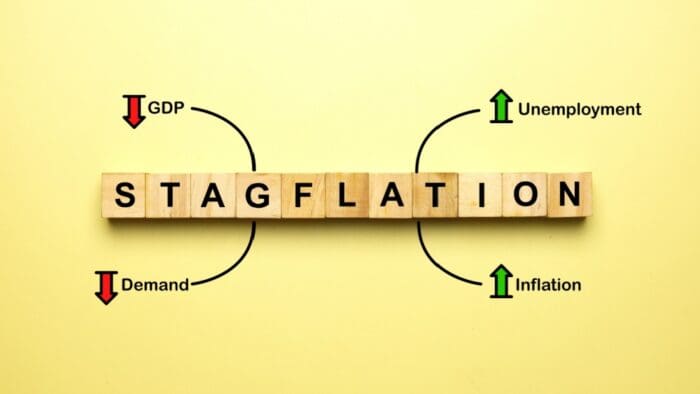
Rising pessimism concerning peace in the Middle East combined with an awful nonfarm payrolls report is sending stagflationary winds throughout markets on this Jobs Friday. A 29-month high in crude prices coinciding with a colossal employment loss of 92k is worrying investors that inflationary risks may keep the Fed from cutting even as labor conditions deteriorate. And in a week that featured terrific economic data up until today, retail sales also posted a decline, generating doubts about the ability for consumers to weather this spike in gasoline costs without derailing expenditures on other staples and discretionary activities. But the traditional Treasury rally you’d expect from weak activity figures isn’t manifesting due to the war in Iran, with participants opting to meaningfully raise exposures in the commodity complex instead, especially gold, silver, oil and natural gas. Stocks are getting creamed across sectors and benchmarks with energy the sole gainer out of the 11 major categories as traders clamor for volatility protection instruments, effectively lifting put option premiums. Elsewhere, risk-off moods are punishing crypto, the greenback is nearly flat and forecast contracts are catching bids.

The US economy lost 92k jobs last month with broad-based reductions across sectors. The enormous disappointment came in well below the consensus expectation for a 50K expansion and downwardly revised 126k additions for January. A strike in the health care industry, a sector that has been a consistent driver of employment gains in the past few years, dented about 31k from the headline. Meanwhile, 9 of the 14 categories saw rosters shrink with the number of losses as follows:
Government, professional/business services and mining experienced headcount drops of 6k, 5k and 2k. Conversely, financial activities, other services, wholesale trade, retail trade and utilities each added 10k or less.
The unemployment rate was also worse than expectations, with the 4.4% figure arriving ahead of the projection calling for an unchanged 4.3%. Part of the uptick in joblessness could be explained by a 50-month low in the labor force participation rate, which dropped to 62% and remains well off its pre-pandemic peak of 63.3%. But on the bright side, wages grew much faster than inflation, with average hourly earnings expanding 0.4% month over month (m/m) and 3.8% year over year (y/y), above forecasts by one tenth of a percent and similar to February’s 0.4% and 3.7% statistics.
Consumers pared back their shopping enthusiasm to start the year, as the January retail sales report posted a contraction. The print was delayed due to the longest government shutdown in history but slightly beat expectations of -0.3%, coming in at -0.2%. The control group, which excludes gas, autos, building materials and food services and serves as a critical input to the government’s gross domestic product (GDP) calculation also came in ahead of projections, growing 0.3% versus the 0.2% forecast while recovering from 0 in December.
Used car prices rose last month, according to the Manheim Index. February costs ascended 0.8% m/m and 4% y/y compared to January’s figures of 2.4% m/m and 2.4% y/y. Traditional engines continued to outperform their electric counterparts, rising 0.9% m/m and 3.7% y/y relative to the latter’s 0.8% and 1.8%.
Despite the meaningful market volatility this week, stocks have not closed near their daily lows because traders have used price declines as buying opportunities. Today’s intraday rebound is significant, as it’s occurring while crude oil is making new highs north of $92. Both developments transpiring simultaneously at this juncture are quite shocking, as the former is telling us that economic fundamentals are weakening due to short-term expectations of an increasingly extended war in Iran, while the latter is potentially signaling that equity investors believe that the conflict may be over faster than commodity watchers think. Meanwhile, there’s no doubt of a heavy dose of uncertainty related to the cycle, and if employers didn’t hire much in February, before the Middle East battle started, then it’s probably the case that they’ll do even less recruiting this month. Overall, activity figures will begin to materially weaken if West Texas Intermediate remains in the vicinity of $100 for a few weeks, and that bodes poorly for the reacceleration trade, rate cuts and ongoing expansions in both corporate earnings and GDP.
Prices in South Korea climbed 0.3% m/m and 2% y/y last month, according to the Consumer Price Index. Both metrics depict slower inflation than the economist consensus estimates for increases of 0.4% and 2.1% relative to January and the year-ago period.
On a m/m basis, consumers paid 1.4% more for recreation and culture. In other areas, the restaurants and hotels classification, the transport segment and the housing, water, electricity, gas and other fuels group each experienced 0.4% hikes while foods and non-alcoholic beverages experienced a 0.3% gain. Other categories either experienced weaker price pressures or no changes except for health and the furnishings, household equipment and routine maintenance categories. They became 0.2% and 0.1% less expensive.
After a handful of volatile trading days for South Korea equities, the country’s KOSPI Index closed the week flat as dip buyers stepped up to the plate after the benchmark fell 20%. Exchange traded funds that seek to generate twice the return of the market intensified the selloff that was triggered by fears about the Middle East war causing oil prices to climb. The country is heavily dependent on imports of the commodity and is one of the world’s largest purchasers of energy products that are shipped through the troubled Strait of Hormuz.
Prices for dwellings in the UK were up 0.3% m/m and 1.3% y/y in February after ascending 0.8% and 1.1% in January, according to the Halifax House Price Index. The m/m metric matched the economist consensus estimate while the y/y statistic was considerably stronger than the expected 0.9% result. The gains brought the average price to £301,151, an all-time high and the y/y print was the strongest in four months. Halifax believes the housing market is gaining momentum after a sluggish end of 2025 despite supply constraints and low affordability. At the same time, real wages have been strengthening, and mortgage rates are easing, helping to improve buyer confidence. Geopolitical uncertainties, however, are likely to cause a slower decline in interest rates than previously anticipated.
New to Interactive Brokers?
Open AccountInformation posted on IBKR Campus that is provided by third-parties does NOT constitute a recommendation that you should contract for the services of that third party. Third-party participants who contribute to IBKR Campus are independent of Interactive Brokers and Interactive Brokers does not make any representations or warranties concerning the services offered, their past or future performance, or the accuracy of the information provided by the third party. Past performance is no guarantee of future results.
This material is from IBKR Macroeconomics, an affiliate of Interactive Brokers LLC, and is being posted with its permission. The views expressed in this material are solely those of the author and/or IBKR Macroeconomics and Interactive Brokers is not endorsing or recommending any investment or trading discussed in the material. This material is not and should not be construed as an offer to buy or sell any security. It should not be construed as research or investment advice or a recommendation to buy, sell or hold any security or commodity. This material does not and is not intended to take into account the particular financial conditions, investment objectives or requirements of individual customers. Before acting on this material, you should consider whether it is suitable for your particular circumstances and, as necessary, seek professional advice.
Trading in digital assets, including cryptocurrencies, is especially risky and is only for individuals with a high risk tolerance and the financial ability to sustain losses. Eligibility to trade in digital asset products may vary based on jurisdiction.
Investments in certain commodities (precious metals) may be subject to significant price volatility and often involve risks related to market fluctuations, liquidity constraints, geopolitical events, and changes in global economic conditions that could adversely affect their value.
U.S. Spot Gold trading through IB LLC accounts is only available to legal residents of the United States that do not reside in Arizona, Montana, New Hampshire, and Rhode Island.
Related Articles
















Join The Conversation
For specific platform feedback and suggestions, please submit it directly to our team using these instructions.
If you have an account-specific question or concern, please reach out to Client Services.
We encourage you to look through our FAQs before posting. Your question may already be covered!