
- Solve real problems with our hands-on interface
- Progress from basic puts and calls to advanced strategies
Interactive Options Course
Posted October 23, 2025 at 11:00 am
In recent months, gold prices have reached new historical highs, surpassing $4,000 per ounce. For many investors, this rally might seem sudden — but in reality, it’s the continuation of a long-term structural trend that began more than a decade ago.

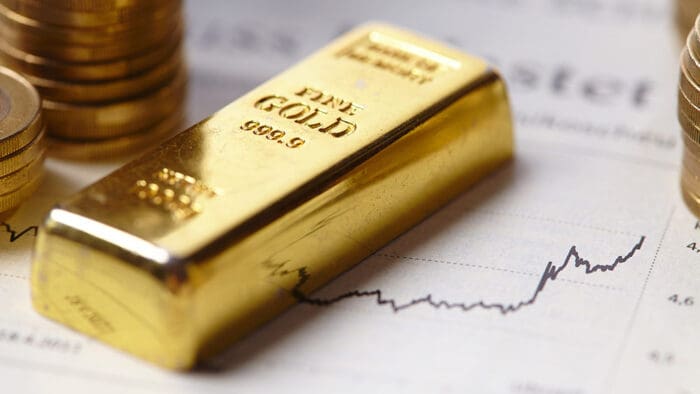
Gold futures have climbed steadily over the past two decades, gaining more than 770% since 2005 and recently surpassing the $4,000 per ounce mark — underscoring the long-term structural demand for safe-haven assets. Source: Forecaster.biz
From Confidence to Caution: The 2008 Turning Point
For much of the 1990s and early 2000s, global investors showed strong confidence in the U.S. dollar and U.S. Treasury securities, which were seen as the ultimate safe havens. However, the 2008 global financial crisis marked a major inflection point.
Data show that the percentage of U.S. debt held by foreign investors began to decline after 2008 (red line in picture below) — a sign that trust in the dollar’s stability was starting to erode. At the same time, central banks around the world began to increase their allocations to gold within their official reserves.(blue line in picture below)
This shift was not immediate, but persistent. Over the past 15 years, the share of gold in global official reserves has steadily risen, while the share of U.S. Treasuries held overseas has trended lower.

Since the 2008 global financial crisis, the share of U.S. debt held by foreign investors (red line) has steadily declined, while the share of gold in official reserve assets (blue line) has increased — highlighting a gradual shift by central banks toward diversification away from dollar-denominated holdings.
Recent geopolitical events — including the Russia–Ukraine war and the freezing of foreign reserves by Western governments — have further accelerated the diversification away from dollar-denominated assets. For many countries, these events highlighted the political risk of holding reserves primarily in one currency or jurisdiction.
As a result, gold has regained its appeal as a politically neutral and historically proven store of value. Central banks in emerging markets — notably China, India, and several Middle Eastern economies — have been among the largest buyers in recent years.

Following the outbreak of the Russia–Ukraine war, central banks worldwide have significantly increased their net gold purchases, reaching the highest levels in more than a decade as they seek to diversify their reserves away from traditional assets.
While gold remains the cornerstone of reserve diversification, the discussion around digital assets as potential reserve instruments has begun to surface. A few countries have started experimenting with Bitcoin holdings, either through direct ownership or exploratory policy proposals, signaling a gradual evolution in how nations think about monetary reserves.
One of the most notable examples comes from Switzerland, where a formal popular initiative titled “For a financially solid, sovereign and responsible Switzerland (Bitcoin initiative)” was officially submitted to the Swiss Federal Chancellery and validated on December 31, 2024. The proposal seeks to amend Article 99 of the Swiss Constitution, which currently requires the Swiss National Bank (SNB) to hold part of its reserves in gold, by adding three simple words: “and in Bitcoin.”
The initiative does not prescribe a specific allocation amount, leaving full discretion to the SNB. Its proponents argue that including Bitcoin alongside gold could help strengthen Switzerland’s financial independence and ensure the country remains at the forefront of innovation in reserve management. Because the Bitcoin market operates 24/7 and is highly liquid, supporters claim that it would offer the SNB flexibility to adjust its holdings dynamically in response to changing market or geopolitical conditions.
While the proposal is still in its early stages and must gather 100,000 signatures to qualify for a national referendum, it illustrates how the conversation about safe-haven diversification is broadening beyond traditional assets. In this context, digital assets like Bitcoin are increasingly viewed not only as speculative instruments but also as potential long-term stores of value within a diversified reserve framework.
Although it remains to be seen whether initiatives such as this one will materialize into policy, their emergence underscores an important reality: the definition of “safe haven” is expanding, reflecting both technological progress and a gradual transformation of the global monetary landscape.
What Lies Ahead
The underlying forces driving demand for safe-haven assets — economic uncertainty, geopolitical fragmentation, and declining trust in traditional currencies — are unlikely to disappear anytime soon.
Even if gold experiences short-term corrections after strong rallies, the structural demand from central banks and investors seeking diversification suggests that the long-term uptrend could persist.
In parallel, the conversation around alternative stores of value, including Bitcoin, is expected to grow as technology and regulation continue to mature.
The world’s monetary landscape is changing. The gradual shift away from dollar dependency toward a multi-asset reserve framework is not a short-term reaction, but a structural realignment.
For investors, understanding this dynamic — and the role of gold and other potential safe-haven assets — remains crucial in navigating an increasingly complex global market.
Disclaimer:
This article is for informational and educational purposes only and does not constitute investment advice, a recommendation, or an offer to buy or sell any financial instrument. Past performance is not indicative of future results. Investing involves risk, including the possible loss of principal.
—
Originally Posted on October 22, 2025
Information posted on IBKR Campus that is provided by third-parties does NOT constitute a recommendation that you should contract for the services of that third party. Third-party participants who contribute to IBKR Campus are independent of Interactive Brokers and Interactive Brokers does not make any representations or warranties concerning the services offered, their past or future performance, or the accuracy of the information provided by the third party. Past performance is no guarantee of future results.
This material is from Forecaster.biz and is being posted with its permission. The views expressed in this material are solely those of the author and/or Forecaster.biz and Interactive Brokers is not endorsing or recommending any investment or trading discussed in the material. This material is not and should not be construed as an offer to buy or sell any security. It should not be construed as research or investment advice or a recommendation to buy, sell or hold any security or commodity. This material does not and is not intended to take into account the particular financial conditions, investment objectives or requirements of individual customers. Before acting on this material, you should consider whether it is suitable for your particular circumstances and, as necessary, seek professional advice.
U.S. Spot Gold trading through IB LLC accounts is only available to legal residents of the United States that do not reside in Arizona, Montana, New Hampshire, and Rhode Island.
Futures are not suitable for all investors. The amount you may lose may be greater than your initial investment. Before trading futures, please read the CFTC Risk Disclosure. A copy and additional information are available at ibkr.com.
TRADING IN BITCOIN FUTURES IS ESPECIALLY RISKY AND IS ONLY FOR CLIENTS WITH A HIGH RISK TOLERANCE AND THE FINANCIAL ABILITY TO SUSTAIN LOSSES. More information about the risk of trading Bitcoin products can be found on the IBKR website. If you're new to bitcoin, or futures in general, see Introduction to Bitcoin Futures.
Trading in digital assets, including cryptocurrencies, is especially risky and is only for individuals with a high risk tolerance and the financial ability to sustain losses. Eligibility to trade in digital asset products may vary based on jurisdiction.
For specific platform feedback and suggestions, please submit it directly to our team using these instructions.
If you have an account-specific question or concern, please reach out to Client Services.
We encourage you to look through our FAQs before posting. Your question may already be covered!
Related Articles
















king royal james, you a kid?
After the DOJ seized $15B in wallets 10 days ago what country would store their reserves in BTC? It is at risk of loss in many ways vs. gold being stored in country in a vault. If there is a global war and power is lost where is your BTC? Who is going to maintain the network? So you can get out?