
- Solve real problems with our hands-on interface
- Progress from basic puts and calls to advanced strategies
Interactive Options Course

Posted January 9, 2026 at 12:00 pm
Momentum investing is one of the few quantitative strategies that has shown persistent outperformance over long periods and across different market regimes. Rather than focusing on company fundamentals, valuation ratios, or macroeconomic forecasts, momentum strategies rely on a single, powerful idea: assets that have performed best in the recent past tend to continue performing well, at least for a certain period of time.
Academic research and real-world implementations suggest that momentum is not a short-term anomaly, but a structural market effect driven by behavioral biases, delayed information diffusion, and institutional portfolio rebalancing.
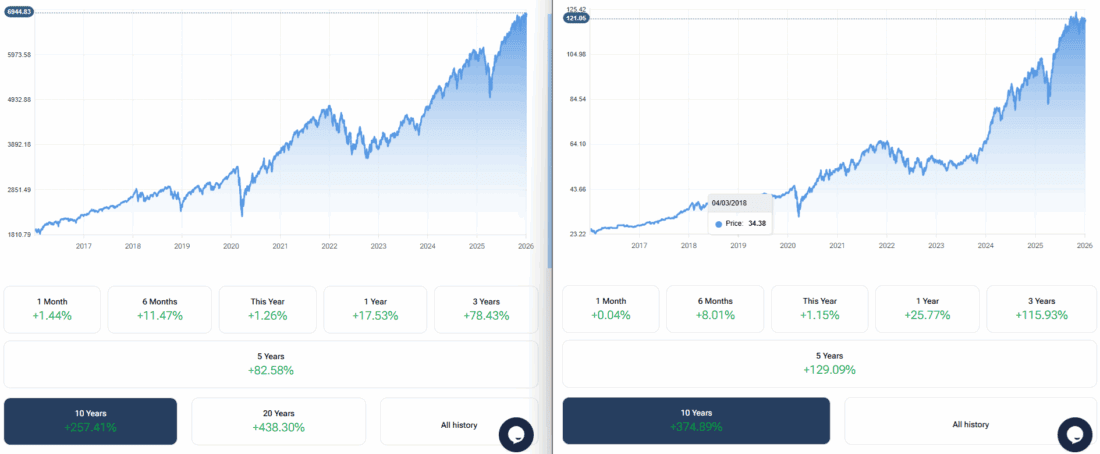
Across all medium- and long-term horizons shown, the S&P 500 Momentum index (right) clearly outperforms the traditional S&P 500 (left):. Source: Forecaster.biz
A momentum strategy ranks securities based on their past price performance, typically over a 6- to 12-month window, and then invests in the top performers while excluding laggards.
In its purest form, momentum investing:
When applied to a broad equity universe such as the S&P 500, this approach creates a portfolio concentrated in stocks that have shown the strongest relative strength over the previous year.
Historical data shows that momentum-based versions of the S&P 500 have consistently outperformed the traditional capitalization-weighted index over long horizons.
For example:
Why Momentum Works
Momentum works not because markets are inefficient in a trivial sense, but because human behavior is slow to adjust.
Key drivers include:
As a result, price trends tend to persist longer than classical financial theory would predict.
Replicating the Strategy Using Forecaster Terminal
With Forecaster Terminal, the replication process becomes fully systematic and data-driven.
Using the platform, the strategy can be implemented as follows:
This approach allows investors to create a rules-based “custom momentum index” and monitor its performance over time using consistent data and standardized metrics.

With a single click in the Price Change section of the S&P 500 page, you can instantly rank all index components by their 1-year performance — making it easy to identify the strongest momentum stocks:. Source: Forecaster.biz
Risk Considerations
Despite its strong historical track record, momentum investing is not without risks.
Key considerations include:
For these reasons, momentum strategies are best viewed as long-term, rules-based approaches, rather than short-term tactical tools.
Final Thoughts
Momentum investing demonstrates that simplicity does not imply inferiority. On the contrary, some of the most robust investment strategies are built on clear rules, disciplined execution, and long-term consistency.
While momentum is not a substitute for diversification or risk management, its historical ability to outperform traditional benchmarks makes it a compelling component of a systematic investment framework—especially when supported by transparent data and replicable tools.
—
Originally Posted on January 8, 2025
Information posted on IBKR Campus that is provided by third-parties does NOT constitute a recommendation that you should contract for the services of that third party. Third-party participants who contribute to IBKR Campus are independent of Interactive Brokers and Interactive Brokers does not make any representations or warranties concerning the services offered, their past or future performance, or the accuracy of the information provided by the third party. Past performance is no guarantee of future results.
This material is from Forecaster.biz and is being posted with its permission. The views expressed in this material are solely those of the author and/or Forecaster.biz and Interactive Brokers is not endorsing or recommending any investment or trading discussed in the material. This material is not and should not be construed as an offer to buy or sell any security. It should not be construed as research or investment advice or a recommendation to buy, sell or hold any security or commodity. This material does not and is not intended to take into account the particular financial conditions, investment objectives or requirements of individual customers. Before acting on this material, you should consider whether it is suitable for your particular circumstances and, as necessary, seek professional advice.
For specific platform feedback and suggestions, please submit it directly to our team using these instructions.
If you have an account-specific question or concern, please reach out to Client Services.
We encourage you to look through our FAQs before posting. Your question may already be covered!
Related Articles


















This article is severely, fundamentally flawed. It fails to account for dividends. If you had bought 100 shares of the S&P 500 ETF (aka “the SPY”) in January 2006 when it was $128 it would have cost you $12800. It closed Friday at $694.07. But the dividends you would have collected the past 20 years total $8512, so your actual cost basis would be lowered from $12800 to $4288. Your 100 shares of the SPY would now be worth $69400, so that is a gain of over 1500 Percent (!!!)
As long as dividends are excluded from both sides of the comparison does it really matter? Or are you saying that, in general, high momentum stocks pay lower dividends?
What good is an investment strategy that only tells you when to buy and not when to sell? Is there some omitted component of this that says when a stock’s momentum drops below some absolute or relative threshold you sell?
Hi Roger, thank you for reaching out. IBKR does not provide investment advice.
8 of the 14 stocks shown are tech stocks, and as the writer points out when the market has another big tumble–and it will again at some point– some of the names here will likely get obliterated.