
- Solve real problems with our hands-on interface
- Progress from basic puts and calls to advanced strategies
Interactive Options Course

Posted January 29, 2026 at 11:15 am
Gold has been on a remarkable run, pushing to new highs and reigniting an old question in a new macro regime: is this move a late-cycle blow-off, or part of a longer structural repricing?
The truth may be “both.” Gold can remain in a long-term uptrend while still experiencing meaningful pullbacks along the way—especially when positioning, seasonality, and major macro catalysts (such as central-bank policy decisions) converge.
Important: This material is provided for informational and educational purposes only and is not a recommendation, offer, or solicitation to buy or sell any security, commodity, derivative, or investment product. Investing involves risk, including the possible loss of principal. Past performance is not indicative of future results.
Why gold can keep rising even after a powerful run
Gold does not need a single narrative to trend higher. It often advances when multiple drivers overlap—some cyclical, some structural:
One of the most significant shifts in recent years has been the steady rise in central bank purchases of gold. Unlike many market participants, central banks typically operate with multi-year objectives: reserve diversification, reduced reliance on a single currency bloc, and protection against geopolitical and sanction risk.
Gold is uniquely positioned in that context because it is:
When long-horizon buyers accumulate persistently, the effect can be structural: even if speculative flows fluctuate, baseline demand may remain supportive over time.
Gold also tends to respond to:
Even when inflation is not accelerating, uncertainty about future inflation can be enough to maintain demand. In other words, gold can benefit from a regime where confidence in forward stability is lower—even if the spot inflation print is not the only story.

When analyzing commodities, one of the most useful public datasets is the CFTC’s Commitment of Traders (COT) report, published weekly. It breaks down futures positioning across participant categories and helps investors understand how different types of market players are positioned.
While the report has limitations (it is not real-time and reflects futures positioning rather than the entire global spot market), it can still provide valuable context—especially for identifying potential inflection points.
Among the categories, one group is often particularly interesting for commodities: Producers/Merchants/Processors/Users (commonly called “producers” for simplicity).
These participants typically use futures markets to hedge operational exposure, not to speculate:
Because of that function, producers are frequently net short—this is normal and expected.
What becomes interesting is not that producers are net short, but how their net position changes over time, particularly when prices are rising.
A simplified way to interpret it:
If prices rise and producers reduce short hedges:
They may be hedging less aggressively despite higher prices—potentially reflecting expectations that prices could remain strong or move higher, or that hedging is less attractive at current levels.
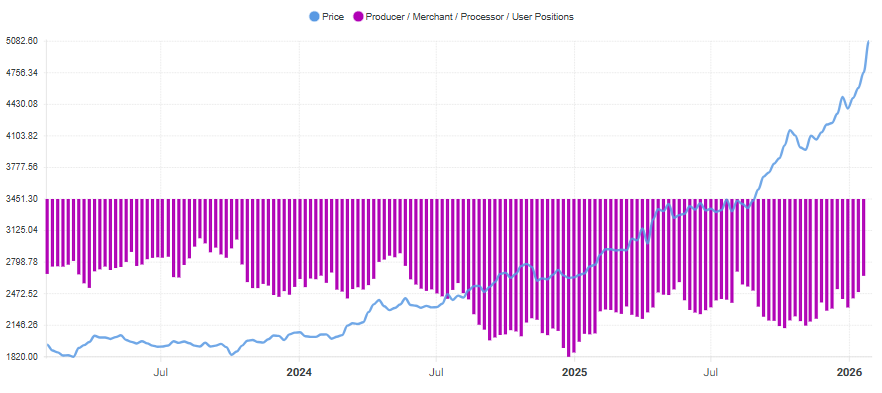
Producers are reducing their downside (net short) exposure in gold even as prices surge — a divergence that may suggest they expect further upside ahead. Source: Forecaster Terminal COT report on Gold
This is not a guaranteed forecasting tool. Producers can reduce hedging for many reasons (balance sheet, costs, existing hedge books, risk policies, production expectations). But historically, shifts in producer behavior can provide meaningful context because these participants are close to the physical supply chain and the economics of production.
In the recent environment, one notable observation discussed in my market review is that producer net shorts have not necessarily increased in step with rising prices. That kind of divergence—rising price alongside reduced hedging intensity—can be interpreted as an additional piece of evidence that the market’s strength may not be purely speculative.
Bottom line: the COT report is not a timing tool by itself, but it can help investors evaluate whether the gold market is being driven primarily by short-term speculation—or whether positioning across key participant groups aligns with a broader trend.
Market seasonality in financial markets refers to the tendency of certain assets to show recurring performance patterns during specific periods of the year, based on historical data. These patterns can emerge from repeated behaviors such as fiscal calendars, portfolio rebalancing, commodity cycles, and investor psychology. Seasonality analysis does not predict the future with certainty, but it helps investors identify periods that have historically shown stronger or weaker average returns.
From a seasonality perspective, short-term dynamics also suggest some caution. As shown in the chart, the current gold price path is closely tracking the pattern observed in 1996, with a very high correlation of 96.03%. In that historical analogue, prices continued higher into early February before experiencing a noticeable pullback in the following weeks.
If the current pattern continues to mirror that trajectory, gold could be vulnerable to a near-term correction or consolidation phase after its strong recent rally. Seasonality is not predictive by itself, but when such a high historical correlation appears, it can be a useful contextual signal for managing short-term risk and expectations.

Gold’s current price path is closely mirroring the 1996 seasonal pattern, with a 96.03% correlation — a historical analogue that points to a potential short-term pullback after the recent rally. Source: Forecaster Terminal gold Seasonality
Gold’s surge to new highs has many drivers, but the most important distinction for investors is this:
short-term price swings can be noisy, while long-term structural forces can be persistent.
Central bank accumulation, geopolitical hedging, and reserve diversification can provide an underlying bid that supports the long-run trend. At the same time, macro events and positioning dynamics can still produce meaningful pullbacks—sometimes precisely when sentiment is most confident.
A disciplined approach doesn’t require predicting the next week’s move. It requires recognizing what is structural, what is tactical, and how tools like the **COT report—especially the producer/merchant positioning—**can add context to the story.
If you’d like the full structural backdrop, you can also read my previous Interactive Brokers article here: “ The Structural Shift Behind Gold’s New Highs.”
—
Originally Posted on January 29, 2026
Information posted on IBKR Campus that is provided by third-parties does NOT constitute a recommendation that you should contract for the services of that third party. Third-party participants who contribute to IBKR Campus are independent of Interactive Brokers and Interactive Brokers does not make any representations or warranties concerning the services offered, their past or future performance, or the accuracy of the information provided by the third party. Past performance is no guarantee of future results.
This material is from Forecaster.biz and is being posted with its permission. The views expressed in this material are solely those of the author and/or Forecaster.biz and Interactive Brokers is not endorsing or recommending any investment or trading discussed in the material. This material is not and should not be construed as an offer to buy or sell any security. It should not be construed as research or investment advice or a recommendation to buy, sell or hold any security or commodity. This material does not and is not intended to take into account the particular financial conditions, investment objectives or requirements of individual customers. Before acting on this material, you should consider whether it is suitable for your particular circumstances and, as necessary, seek professional advice.
U.S. Spot Gold trading through IB LLC accounts is only available to legal residents of the United States that do not reside in Arizona, Montana, New Hampshire, and Rhode Island.
Investments in certain commodities (precious metals) may be subject to significant price volatility and often involve risks related to market fluctuations, liquidity constraints, geopolitical events, and changes in global economic conditions that could adversely affect their value.
Futures are not suitable for all investors. The amount you may lose may be greater than your initial investment. Before trading futures, please read the CFTC Risk Disclosure. A copy and additional information are available at ibkr.com.
Related Articles


















Join The Conversation
For specific platform feedback and suggestions, please submit it directly to our team using these instructions.
If you have an account-specific question or concern, please reach out to Client Services.
We encourage you to look through our FAQs before posting. Your question may already be covered!