
- Solve real problems with our hands-on interface
- Progress from basic puts and calls to advanced strategies
Interactive Options Course

Posted April 14, 2026 at 11:34 am
The article “The Many Facets of Stock Momentum: Distinguishing Factor and Stock Components” was originally published on Alpha Architect Blog.
Stock momentum has long been a workhorse idea. Buy recent winners. Sell recent losers. Critics argue those profits mostly come from riding factor trends like value, size, or industry tilts. This paper pushes back. It shows there is a durable, stock-specific momentum component tied to how prices react to firm news around earnings dates. The result is a cleaner, lower-risk way to capture momentum without leaning so heavily on broad factor moves.
There is real stock-specific momentum, not just factor timing
The authors isolate the part of 12-month momentum that comes only from returns in short windows around each firm’s earnings announcements over the prior year. This earnings-announcement component predicts future returns in the US, Europe, and Japan over three decades. It remains significant after controlling for changing factor exposures.
Classic momentum loads on factors. the earnings-announcement component does not
Traditional 12-1 momentum carries substantial exposure to market, value, and industry effects. The earnings-announcement strategy shows much lower systematic risk and a high correlation between long and short legs. That makes it a purer expression of firm-level information
Short-term PEAD has faded. longer-horizon announcement momentum persists
Strategies that trade only the latest earnings surprise have weakened in recent years. Aggregating all announcement windows over the past year continues to work. Turnover is also about half that of the short-horizon approach.
Factor momentum can subsume classic stock momentum in the US. but not the announcement component
A principal-component factor-momentum strategy is strong in the US and explains classic momentum. It does not explain the longer-term earnings-announcement strategy. That piece remains economically and statistically robust.
Long-run behavior differs. classic momentum can reverse. announcement momentum does not
When you extend formation to 24 months and skip a year before holding, classic momentum shows reversal in the early 2000s, consistent with prior evidence of overreaction. The earnings-announcement component shows no short- or long-run reversal, consistent with underreaction to firm-specific news.
Separate the signal from the scaffolding
When you use momentum, decompose it. Keep the earnings-announcement component as a core sleeve. Treat the rest as more factor-driven and size it accordingly.
Reduce unintended bets
Industry-adjust or hedge style tilts if you run classic momentum. The paper’s announcement-only construction naturally trims market and value exposures. That can lower drawdown risk when factor cycles flip.
Trade sanely
The year-aggregated announcement signal cuts turnover versus short-term PEAD trades. Apply basic turnover control and realistic cost assumptions. The authors show the premium survives reasonable frictions in large, liquid names.
Use gaps and buffers
Skip the most recent month when you run classic momentum. The announcement strategy is less sensitive, but adding a small implementation lag and buffers helps reduce microstructure noise.
“Momentum is not just riding broad style trends. Some of it comes from markets slowly digesting company-specific news around earnings. By focusing on those brief announcement windows, we can isolate a steadier form of momentum with fewer hidden bets on value, size, or industry effects. It is a cleaner way to use momentum in a diversified portfolio”
Table 2 shows a comparative analysis of the performance of a traditional stock momentum strategy and that of the longer-term earnings-announcement strategy in the large-capitalization segments of three developed markets: the US, Europe, and Japan.


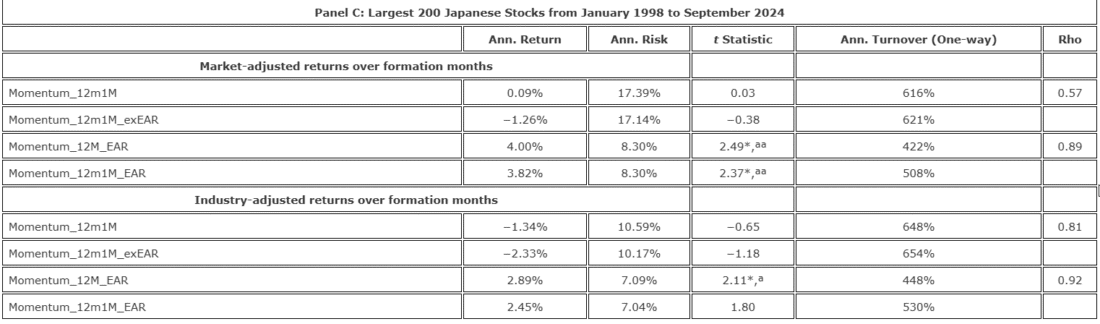
The results are hypothetical results and are NOT an indicator of future results and do NOT represent returns that any investor actually attained. Indexes are unmanaged and do not reflect management or trading fees, and one cannot invest directly in an index.
This study aims to investigate the recent controversy surrounding the existence of stock-specific momentum. Stock momentum consists of both factor- and stock-specific components, but the risk associated with factor momentum might hinder the impact of stock-specific momentum. Using earnings announcement returns that occur during the formation months of the stock momentum strategy, the study captures a component largely unaffected by factor momentum, thereby mitigating the bad-model problem. This stock-specific momentum source predicts future returns, does not reverse in the long run, and is pervasive, as similar results are found in the US, Europe, and Japan over the last 30 years.
The views and opinions expressed herein are those of the author and do not necessarily reflect the views of Alpha Architect, its affiliates or its employees. Our full disclosures are available here. Definitions of common statistics used in our analysis are available here (towards the bottom).
This site provides NO information on our value ETFs or our momentum ETFs. Please refer to this site.
Information posted on IBKR Campus that is provided by third-parties does NOT constitute a recommendation that you should contract for the services of that third party. Third-party participants who contribute to IBKR Campus are independent of Interactive Brokers and Interactive Brokers does not make any representations or warranties concerning the services offered, their past or future performance, or the accuracy of the information provided by the third party. Past performance is no guarantee of future results.
This material is from Alpha Architect and is being posted with its permission. The views expressed in this material are solely those of the author and/or Alpha Architect and Interactive Brokers is not endorsing or recommending any investment or trading discussed in the material. This material is not and should not be construed as an offer to buy or sell any security. It should not be construed as research or investment advice or a recommendation to buy, sell or hold any security or commodity. This material does not and is not intended to take into account the particular financial conditions, investment objectives or requirements of individual customers. Before acting on this material, you should consider whether it is suitable for your particular circumstances and, as necessary, seek professional advice.
For specific platform feedback and suggestions, please submit it directly to our team using these instructions.
If you have an account-specific question or concern, please reach out to Client Services.
We encourage you to look through our FAQs before posting. Your question may already be covered!












This is nice and all, but you neglect how IBKR users can use any IBKR tools to implement this. How does one get “factor exposure and research” from IBKR ?