
- Solve real problems with our hands-on interface
- Progress from basic puts and calls to advanced strategies
Interactive Options Course

Posted January 12, 2026 at 10:30 am
The Dogs of the Dow is one of the simplest and most enduring equity strategies in the US market. The concept was formalized over three decades ago and has since attracted both private and institutional investors interested in dividend income and lower volatility equity exposure. At its core, the strategy selects at the beginning of each calendar year the ten highest dividend-yielding constituents of the Dow Jones Industrial Average, holds them for twelve months, and then rebalances again the following January. Despite its simplicity, the approach has generated competitive long-term returns with a volatility profile that has historically been more defensive than the broader US equity market.
The mechanism behind the strategy is intuitive. The Dow Jones serves as the universe from which the portfolio is constructed, and its 30 components are large, established companies with consistent profitability and long operating histories. Ranking these companies by dividend yield tends to favor mature firms whose share prices underperformed in the previous year. A higher yield often reflects a lower share price rather than a sudden dividend shift, which means the strategy naturally leans toward what might be described as “temporary value” situations among well-capitalized blue chips. The result is an annual basket that blends income generation with the potential for mean reversion in share prices.
Historically, the Dogs of the Dow has not always outperformed the major benchmarks over every time period. During aggressive growth phases — such as the technology-led bull market of the past decade — headline performance has occasionally lagged the Dow Jones Industrial Average. An ETF that tracks a similar dividend-yield methodology, for example, generated roughly 135 percent over the last ten years compared to about 190 percent for the Dow. The appeal of the strategy therefore cannot be evaluated solely by its nominal return figures. The strategy’s proponents highlight its smoother volatility profile, smaller drawdowns during market stress, and more attractive risk-adjusted characteristics when compared to the broader market. In periods where growth stocks dominate market leadership, dividend-based strategies often look pedestrian. In more defensive or late-cycle environments, they frequently become relevant again.
That discussion is particularly timely today. With several US equity indices recently touching new all-time highs, investor attention has rotated toward capital preservation and income stability. The Dogs of the Dow universe is naturally biased toward sectors such as energy, healthcare, industrials and consumer staples. These are businesses that tend to have strong cash flow, more predictable earnings, and established dividend policies. Their performance can diverge significantly from the mega-cap growth stocks that have dominated recent index returns. Investors looking to rebalance away from high-multiple growth exposures often evaluate this strategy precisely for that reason.
In the early years of the strategy, recreating the Dogs of the Dow required manual calculations, newspaper data, and end-of-year printouts. Today the process takes only a few seconds. On Forecaster Terminal, the selection can be replicated by visiting the Ranking section, loading the Dow Jones Industrial Average, navigating to the ratios tab, and sorting the constituents by dividend yield. The ten top-yielding companies at the beginning of the calendar year represent the annual Dogs portfolio within this framework.
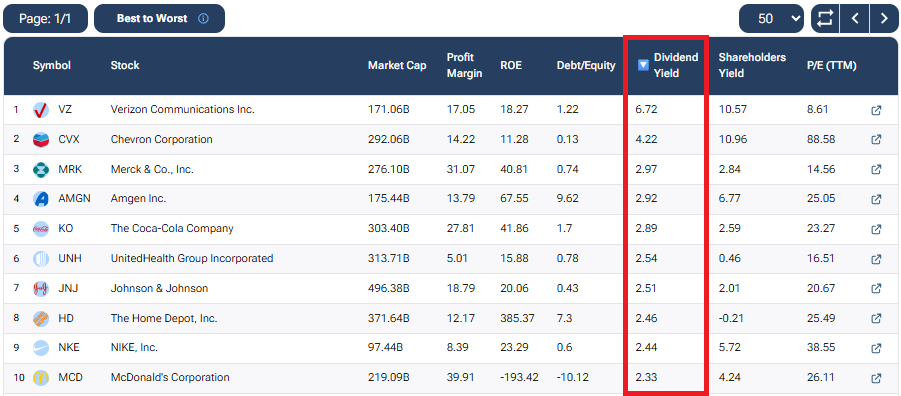
Forecaster Terminal ranking of Dow components by dividend yield at the start of the year.
Once the basket is generated, investors often examine the underlying fundamentals. A useful feature available in Forecaster Terminal is the ability to pull dividend history, shareholder yield metrics, payout ratios and valuation estimates based on models such as Discounted Cash Flow, Economic Value Added or Peter Lynch Fair Value. These valuation tools are not required for running the strategy itself, but they can be helpful for investors who want to understand whether a particular company is in a short-term drawdown that may revert or whether the high dividend yield reflects deeper structural issues.
Chevron provides a good example. The company has paid uninterrupted dividends for decades and has increased its distributions for many consecutive years. A dividend screening methodology would naturally capture such a company if the share price experiences weakness in a given year, as often occurs in the energy sector when oil prices fluctuate. Examining Chevron’s shareholder return profile — not only its dividend but also its buyback programs — reveals why energy companies frequently appear in Dogs screens during cyclical downturns.

Chevron’s annual price performance and steadily rising dividend distributions.
Another distinctive feature of Forecaster Terminal is the AI Agent explanation panel, which summarizes the business activity of a selected company in natural language without requiring the user to sift through regulatory filings. For novice investors, this capability bridges a gap between screening and qualitative understanding, especially when lesser-known names enter the Dogs universe.

AI tools are increasingly able to translate complex financial information into clear and accessible language, helping investors bridge the gap between raw data and qualitative understanding. This shift is accelerating the way research is consumed and integrated into portfolio decisions. Source: Forecaster AI integration.
The Dogs of the Dow remains a rules-based strategy that investors can implement directly through individual stock purchases. Investors who prefer packaged products may also opt for ETF or ETN structures that track similar methodologies. Direct implementation offers greater control over portfolio customization and taxes, while fund structures prioritize simplicity and automatic rebalancing. Regardless of implementation, the approach tends to appeal most to investors with multi-year horizons, an interest in dividend income, and a preference for lower volatility equity exposure.
Of course, the strategy does not eliminate risk. Dividend-oriented portfolios can be sensitive to interest rate dynamics, sector concentration can be significant in certain years, and the high-yield list can occasionally include companies facing fundamental challenges. Nonetheless, in a market environment characterized by elevated valuations, narrower leadership, and stronger investor focus on cash-flow resilience, the Dogs of the Dow continues to stand out as a defensively positioned equity strategy with a three-decade track record.
What makes the Dogs of the Dow notable today is not simply its longevity, but its relevance to the current macro backdrop. A market led by a small cohort of high-growth companies does not always reward strategies built on mean reversion and dividends. Yet over a sufficient time frame, the combination of established companies, shareholder distributions, and exposure to value-oriented mean reversion has proven durable. Modern research platforms now make adopting the strategy easier than ever, allowing investors to screen, analyze, and monitor the Dogs in seconds rather than days. For investors seeking an income-oriented and more volatility-aware allocation within US equities, the Dogs of the Dow remains a compelling strategy worthy of consideration.
—
Originally Posted on January 12, 2025
Information posted on IBKR Campus that is provided by third-parties does NOT constitute a recommendation that you should contract for the services of that third party. Third-party participants who contribute to IBKR Campus are independent of Interactive Brokers and Interactive Brokers does not make any representations or warranties concerning the services offered, their past or future performance, or the accuracy of the information provided by the third party. Past performance is no guarantee of future results.
This material is from Forecaster.biz and is being posted with its permission. The views expressed in this material are solely those of the author and/or Forecaster.biz and Interactive Brokers is not endorsing or recommending any investment or trading discussed in the material. This material is not and should not be construed as an offer to buy or sell any security. It should not be construed as research or investment advice or a recommendation to buy, sell or hold any security or commodity. This material does not and is not intended to take into account the particular financial conditions, investment objectives or requirements of individual customers. Before acting on this material, you should consider whether it is suitable for your particular circumstances and, as necessary, seek professional advice.
Any discussion or mention of an ETF is not to be construed as recommendation, promotion or solicitation. All investors should review and consider associated investment risks, charges and expenses of the investment company or fund prior to investing. Before acting on this material, you should consider whether it is suitable for your particular circumstances and, as necessary, seek professional advice.
For specific platform feedback and suggestions, please submit it directly to our team using these instructions.
If you have an account-specific question or concern, please reach out to Client Services.
We encourage you to look through our FAQs before posting. Your question may already be covered!
Related Articles


















After very outsized gains for the Nasdaq three straight years, I’d rather own the Dow ETF (DIA) than the QQQ now.