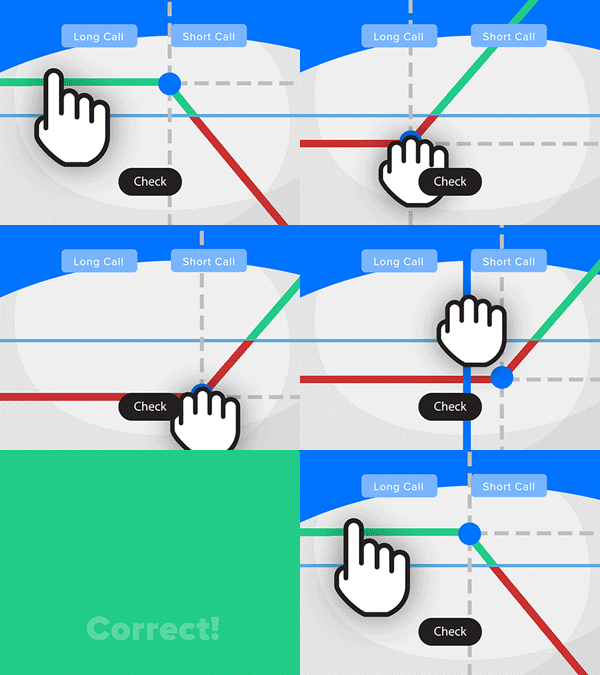
- Solve real problems with our hands-on interface
- Progress from basic puts and calls to advanced strategies
Interactive Options Course

Posted July 2, 2026 at 12:00 pm
Not only do active value managers have to navigate rate volatility, macro uncertainty, and technological disruptions, they also have to determine the difference between undervalued opportunities and the dreaded value trap. Kevin Holt, Chief Investment Officer and Senior Portfolio Manager for Invesco’s US Value Equity Team, joined the latest episode of the Greater Possibilities podcast to explain how he approaches the challenge of value investing in a changing world.
Listen to the full conversation with Kevin HERE and read the highlights below.
“Intellectual honesty is something I think that we all need to be very aware of. And the reality is, whether it’s volatility and/or the proliferation of AI, the world is changing. And in value land, we all like to look at historical valuations, historical attributes … Our investment process does not change, but we have to realize if the cash flows are going to change based on changing fundamentals, we need to be out in front of that. We always say it’s where the puck’s going, not where it’s been. In my role as CIO, I always say I’m an air traffic controller, trying to make sure that all the teams are looking at what the future looks like, not just what the past looks like.”
“I think when people look at the Russell 1000 Value, it has a very high reliance on price-to-book value in terms of its constitution. And we would argue outside of deep cyclicals and/or banks, price-to-book really doesn’t have a role historically in defining value across different industries and sectors … So you need to make sure that you have a dynamic process that basically works through the test of time when you’re approaching investing. And if anyone has any single metric, they’ll probably be good for short periods of time … If you’re a price-to-book investor, when financials work or when you go into an upturn, they work. We want to be able to work overall cycles.”
“Things that particularly look interesting right now for us is health care. … I think a lot of investors who look for innovation used to look at health care and technology. I think a lot of those dollars have gone to technology recently, so health care has become very inexpensive.1 … When you can buy the highest quality companies in industry groups across health care, which is frankly what we’re in the midst of right now, I think that’s very attractive when we have a time arbitrage, 3- to 5-year time horizon on our side. And these are very attractive businesses with very attractive cash flows and very attractive return on invested capital profiles.”
“When a stock is selling at a discounted valuation relative to history, it’s up to us as fundamental investors to determine what are those three or four key issues that investors are concerned about on a 3- to 5-year time horizon and why is this selling at a discounted valuation? So it’s really understanding the fundamentals of the business and understanding why it’s trading like it is that I think ultimately leads you in the direction of being able to identify value traps.”
“There are always pockets in technology that don’t necessarily generate cash flow. but they’re very conceptually interesting. A couple stocks historically just have not fit our process and probably never will … With that said, I think 90% of the technology stocks periodically do hit our radar. And as we predict things out and project cash flows, I think they can be interesting.”
—
Originally Posted July 1, 2026
Value stocks: A dynamic approach in a changing world by Invesco US
Important Information
NA5645172
The opinions expressed are those of the speakers, are based on current market conditions as of June 9, 2026, and are subject to change without notice. These opinions may differ from those of other Invesco investment professionals.
This does not constitute a recommendation of any investment strategy or product for a particular investor. Investors should consult a financial professional before making any investment decisions. Should this content contain any forward looking statements, understand that they are not guarantees of future results. They involve risks, uncertainties and assumptions. There can be no assurance that actual results will not differ materially from expectations.
All investing involves risk, including the risk of loss.
Past performance does not guarantee future results.
Investments cannot be made directly in an index.
Diversification does not guarantee a profit or eliminate the risk of loss.
In general, stock values fluctuate, sometimes widely, in response to activities specific to the company as well as general market, economic and political conditions.
Many products and services offered in technology-related industries are subject to rapid obsolescence, which may lower the value of the issuers.
Artificial intelligence (AI) technology companies are sensitive to specific risks such as small markets, business cycle changes, economic growth, technological progress, obsolescence, and regulation. These companies may have limited products, markets, resources, or personnel, making their securities more volatile, especially for smaller start-ups. Rapid technological changes can adversely affect their results. AI companies often rely on patents, copyrights, trademarks, and trade secrets to protect their technology, but there’s no guarantee these protections will be sufficient. Significant research and development (R&D) spending doesn’t ensure product or service success.
The profitability of businesses in the financial services sector depends on the availability and cost of money and may fluctuate significantly in response to changes in government regulation, interest rates and general economic conditions. These businesses often operate with substantial financial leverage.
The health care industry is subject to risks relating to government regulation, obsolescence caused by scientific advances, and technological innovations.
A value style of investing is subject to the risk that the valuations never improve or that the returns will trail other styles of investing or the overall stock markets.
The Russell 1000® Value Index, a trademark/service mark of the Frank Russell Co.®, is an unmanaged index considered representative of large-cap value stocks.
Cash flow is the net amount of cash and cash equivalents generated by a business.
A discount measures how much less one stock (or index) is trading compared with another stock (or index).
The price-to-book (P/B) ratio is calculated by dividing the market price of a stock by the book value per share. Book value is a company’s total assets minus liabilities and intangible assets.
Return on invested capital (ROIC) is a measure of how efficiently a company is using its capital to generate returns.
A value trap is a stock that appears cheap based on valuation metrics but continues to underperform because its underlying business fundamentals are deteriorating.
CIO stands for Chief Investment Officer.
This does not constitute a recommendation of any investment strategy or product for a particular investor. Investors should consult a financial advisor/financial consultant before making any investment decisions. Invesco does not provide tax advice. The tax information contained herein is general and is not exhaustive by nature. Federal and state tax laws are complex and constantly changing. Investors should always consult their own legal or tax professional for information concerning their individual situation. The opinions expressed are those of the authors, are based on current market conditions and are subject to change without notice. These opinions may differ from those of other Invesco investment professionals.
NOT FDIC INSURED
MAY LOSE VALUE
NO BANK GUARANTEE
All data provided by Invesco unless otherwise noted.
Invesco Distributors, Inc. is the US distributor for Invesco Ltd.’s Retail Products and Collective Trust Funds. Institutional Separate Accounts and Separately Managed Accounts are offered by affiliated investment advisers, which provide investment advisory services and do not sell securities. These firms, like Invesco Distributors, Inc., are indirect, wholly owned subsidiaries of Invesco Ltd.
©2024 Invesco Ltd. All rights reserved.
Information posted on IBKR Campus that is provided by third-parties does NOT constitute a recommendation that you should contract for the services of that third party. Third-party participants who contribute to IBKR Campus are independent of Interactive Brokers and Interactive Brokers does not make any representations or warranties concerning the services offered, their past or future performance, or the accuracy of the information provided by the third party. Past performance is no guarantee of future results.
This material is from Invesco US and is being posted with its permission. The views expressed in this material are solely those of the author and/or Invesco US and Interactive Brokers is not endorsing or recommending any investment or trading discussed in the material. This material is not and should not be construed as an offer to buy or sell any security. It should not be construed as research or investment advice or a recommendation to buy, sell or hold any security or commodity. This material does not and is not intended to take into account the particular financial conditions, investment objectives or requirements of individual customers. Before acting on this material, you should consider whether it is suitable for your particular circumstances and, as necessary, seek professional advice.
Related Articles













Join The Conversation
For specific platform feedback and suggestions, please submit it directly to our team using these instructions.
If you have an account-specific question or concern, please reach out to Client Services.
We encourage you to look through our FAQs before posting. Your question may already be covered!