
- Solve real problems with our hands-on interface
- Progress from basic puts and calls to advanced strategies
Interactive Options Course

Posted June 12, 2026 at 11:30 am
In nature, the most prosperous islands are not the isolated ones.
They are the islands bursting with plant life, birds, insects, trade routes, migration paths, and fertile connections to the mainland. They attract new species, sustain complex ecosystems, and continuously adapt to changing conditions. The island becomes valuable not because it exists, but because life chooses to build there.
Successful blockchains operate in much the same way. The crypto industry often talks about blockchain technology as if technical specifications alone determine success. Faster throughput. Lower fees. Better consensus mechanisms. However, history shows that infrastructure by itself is rarely enough.
A blockchain succeeds when it becomes an ecosystem.
The dead island problem
Many blockchains today resemble remote islands with pristine beaches but no inhabitants. Technically impressive, but quiet and empty.
Developers do not build there. Users do not stay there. Capital does not circulate there. Applications launch, but economic activity fails to compound. The ecosystem lacks biodiversity.
Figure 1: Blockchains with the largest daily user communities
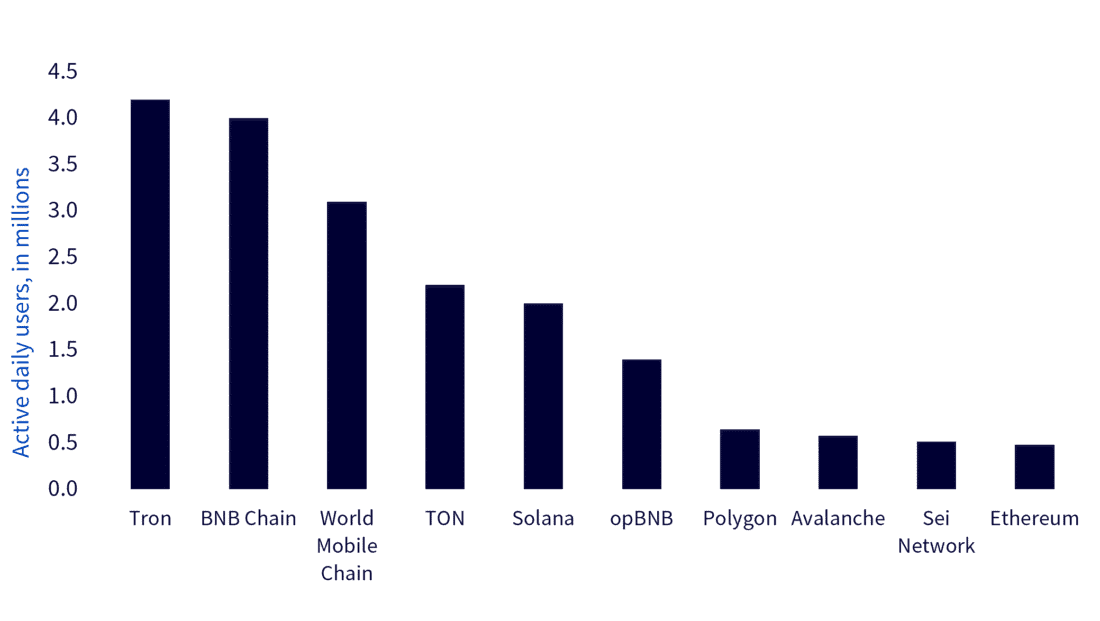
Source: Token Terminal. As at 29 May 2026. Historical performance is not an indication of future performance, and any investment may go down in value.
In blockchain terms, biodiversity means:
Without these layers of activity, a blockchain risks becoming economically sterile.
The importance of biodiversity
A thriving island contains interconnected systems. Birds spread seeds. Plants sustain insects. Insects feed larger animals. Nutrients circulate through the environment. Diversity creates resilience.
The same dynamic exists within blockchain ecosystems. Ethereum’s success, for example, was not solely driven by its smart contract capability. Its strength emerged from the interaction between developers, decentralised finance, institutional infrastructure, exchanges, custodians, and liquidity providers.
Each participant reinforced the network:
This is network compounding.
Importantly, ecosystems with greater diversity tend to survive shocks more effectively. When one application fails, others continue operating. When one narrative weakens, another emerges. The blockchain becomes less fragile.
Connectivity matters more than isolation
The healthiest islands are rarely the most isolated. They trade with the mainland, exchange resources and attract visitors and migration flows. Connectivity enables survival.
This principle is becoming increasingly important in crypto. Early blockchain communities often pursued a vision of self-sufficiency; the idea that a single chain could dominate and operate largely in isolation. But the industry is evolving towards interoperability, recognising that connectivity creates stronger and more resilient networks.
Today, successful blockchains increasingly behave like economic hubs connected through bridges, messaging protocols and shared liquidity layers. A blockchain disconnected from the broader ecosystem risks becoming economically stranded.
Figure 2: Capital movement across blockchains, in $ millions

Source: Artemis Terminal. As at 29 May 2026. Historical performance is not an indication of future performance, and any investment may go down in value.
This is why interoperability infrastructure has become strategically important. Cross-chain bridges, token standards and interoperability protocols are not peripheral innovations; they are trade routes.
Capital wants mobility. Users want flexibility. Developers want access to the largest possible audience. The chains that facilitate these flows may be better positioned to attract sustained activity.
Infrastructure alone does not create civilisation
An empty airport is still empty infrastructure. The same is true for blockchains.
Low transaction fees and high throughput can improve the user experience, but they do not guarantee adoption. Economic gravity emerges when networks create opportunities for participants to coordinate, transact and build wealth together.
This distinction explains why some chains experience explosive early growth but struggle to retain activity over time.
Temporary incentives can attract tourists. Only strong ecosystems create permanent residents.
The blockchain industry is now entering a more mature phase where investors are increasingly evaluating the quality of on-chain economics rather than simply headline transaction metrics. They ask:
The answers to these questions illustrate ecological health.
The future belongs to economic archipelagos
The next phase of blockchain development may not produce a single dominant island. Instead, crypto increasingly resembles an archipelago: multiple specialised ecosystems connected through shared infrastructure.
Bitcoin may function as a monetary bedrock. Ethereum may continue operating as the largest financial settlement layer. Other chains may specialise in gaming, payments, tokenisation, or high-frequency applications.
The networks that ultimately succeed may not necessarily be the most isolated chains. They are more likely to be the networks that combine:
In nature, thriving islands do not survive because they wall themselves off from the world. They survive because life flows through them. The same may ultimately prove true for blockchains.
While ecosystem growth and network effects can support blockchain adoption, there is no guarantee that current leaders will maintain their positions. Blockchain networks face risks including technological change, cybersecurity incidents, regulatory developments, competition from alternative protocols, and shifts in user and developer activity. Digital asset markets can be highly volatile, and changes in network participation or liquidity may affect the long-term viability of individual blockchain ecosystems.
—
Originally Posted June 9, 2026 – Successful blockchains resemble thriving islands
This material is prepared by WisdomTree and its affiliates and is not intended to be relied upon as a forecast, research or investment advice, and is not a recommendation, offer or solicitation to buy or sell any securities or to adopt any investment strategy. The opinions expressed are as of the date of production and may change as subsequent conditions vary. The information and opinions contained in this material are derived from proprietary and non-proprietary sources. As such, no warranty of accuracy or reliability is given and no responsibility arising in any other way for errors and omissions (including responsibility to any person by reason of negligence) is accepted by WisdomTree, nor any affiliate, nor any of their officers, employees or agents. Reliance upon information in this material is at the sole discretion of the reader. Past performance is not a reliable indicator of future performance.
Please click here for our full disclaimer.
Jurisdictions in the European Economic Area (“EEA”): This content has been provided by WisdomTree Ireland Limited, which is authorised and regulated by the Central Bank of Ireland.
Jurisdictions outside of the EEA: This content has been provided by WisdomTree UK Limited, which is authorised and regulated by the United Kingdom Financial Conduct Authority.
Information posted on IBKR Campus that is provided by third-parties does NOT constitute a recommendation that you should contract for the services of that third party. Third-party participants who contribute to IBKR Campus are independent of Interactive Brokers and Interactive Brokers does not make any representations or warranties concerning the services offered, their past or future performance, or the accuracy of the information provided by the third party. Past performance is no guarantee of future results.
This material is from WisdomTree Europe and is being posted with its permission. The views expressed in this material are solely those of the author and/or WisdomTree Europe and Interactive Brokers is not endorsing or recommending any investment or trading discussed in the material. This material is not and should not be construed as an offer to buy or sell any security. It should not be construed as research or investment advice or a recommendation to buy, sell or hold any security or commodity. This material does not and is not intended to take into account the particular financial conditions, investment objectives or requirements of individual customers. Before acting on this material, you should consider whether it is suitable for your particular circumstances and, as necessary, seek professional advice.
Trading in digital assets, including cryptocurrencies, is especially risky and is only for individuals with a high risk tolerance and the financial ability to sustain losses. Eligibility to trade in digital asset products may vary based on jurisdiction.
Investing in cryptocurrencies such as Ether (ETH) involves significant risk. Digital assets are highly volatile and may experience rapid price fluctuations, including complete loss of value. The Ethereum network, smart contracts, and decentralized applications rely on evolving technologies that may be subject to bugs, cyberattacks, regulatory changes, or operational failures. Trading through Interactive Brokers involves execution, custody, and settlement handled by regulated third party partners, which introduces additional counterparty and operational risks. Cryptocurrency products are not legal tender, are not backed by any government, and may not be suitable for all investors.
Trading Bitcoin involves significant risk. Bitcoin prices can be highly volatile and may fluctuate rapidly, potentially resulting in substantial losses. Because Bitcoin operates on a decentralized blockchain, network congestion or technical issues may occasionally delay transaction settlement. Regulatory frameworks for digital assets are still evolving and could impact availability, liquidity, or pricing. When trading through Interactive Brokers, execution and custody are facilitated by regulated partners such as Paxos or Zero Hash; however, these arrangements do not eliminate the possibility of operational or counterparty risk.
Bitcoin Cash (BCH) is a payment focused digital asset subject to high price volatility, adoption and network risks (including forks and upgrades), irreversible transactions reliant on private keys and cybersecurity, variable fees and confirmation times, evolving regulatory treatment, and potential liquidity constraints.
Related Articles


















Join The Conversation
For specific platform feedback and suggestions, please submit it directly to our team using these instructions.
If you have an account-specific question or concern, please reach out to Client Services.
We encourage you to look through our FAQs before posting. Your question may already be covered!