
- Solve real problems with our hands-on interface
- Progress from basic puts and calls to advanced strategies
Interactive Options Course

Posted August 5, 2026 at 1:09 pm
Stocks tapped fresh records in early trading as robust corporate earnings, healthy economic data and a potential Iran deal bolstered risk appetites prior to afternoon profit taking. Equities are still on track for their fifth consecutive daily gain; however, the morning exuberance was followed by equities pulling back toward the flatline with investors waiting for a follow through on the Middle East situation after President Trump said negotiations are ‘’moving along very nicely,” while signaling that an agreement could be reached as soon as today. It makes sense for Wall Street bulls to pause, because declines in both crude prices and yields have reversed in light of traders considering that tensions between Washington and Tehran could re-escalate. Geopolitical developments are certainly the predominant force hitting fixed-income assets recently as illustrated by rates climbing modestly today even with ADP and ISM reports missing expectations. Even the slowest pace of hiring since January is failing to rescue Treasuries, as bond watchers focus on oil prices to gauge how the Middle East talks are progressing. Meanwhile, semiconductors, tech and the Mag7, after having produced a terrific run, are getting battered amidst split sectoral participation. More specifically, it’s critically important that energy and borrowing costs soften for cyclically oriented equities to keep this rally alive. Elsewhere, a weaker greenback is helping commodities and cryptocurrencies advance broadly. Volatility protection instruments are steady while prediction markets catch bids.
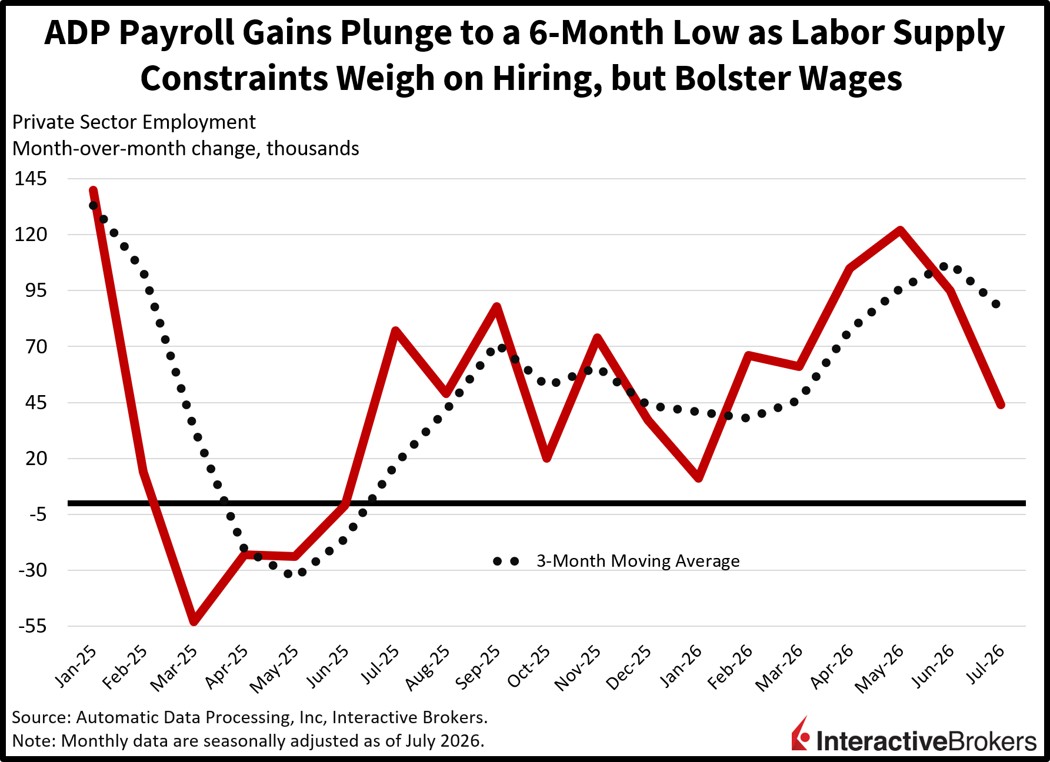
Labor supply constraints caused July payroll additions to hit their weakest level since January. ADP’s employment report printed a headline number of 44k, below both the expected 70k and June’s 95k. Strong wage gains signal that a declining labor force amidst weak participation are to blame for the significant hiring deceleration as the median year-over-year (y/y) change in overall pay rose to 7% from 6.8% for job changers, a key group that is increasingly sensitive to cyclical conditions. Meanwhile, wage gains for stayers remained steady at 4.4%. Still, 7 of the 10 sectors expanded rosters, but only education/health services and financial activities exceeded 9k, arriving at 36k and 10k. Conversely, leisure/hospitality, trade/transportation/utilities and natural resources/mining lost 11k, 8k and 6k. All establishment sizes saw growth in aggregate, with the small (1-49 workers), mid-sized (50-499), and large business (500+) segments boosting payrolls by 23k, 8k and 13k.
Service sectors’ activity accelerated last month as buoyant consumer demand offset payroll reductions. The Institute for Supply Management (ISM) Purchasing Managers’ Index (PMI) hit 54.1, up 0.1 point from June but below the expected 54.5. Progress was broad with the exceptions of the inflation component rising from an elevated 67.7 to 70.3 and employment falling from 51.2 to 47.4. Still, new orders, production, backlogs and exports reported growth of 57.2, 59.1, 52 and 50.9, with most of those figures well above the contraction-expansion threshold of 50.
Crude oil is climbing slightly, trading right around $75 per barrel as Wall Street awaits a potential deal that would reopen the Strait of Hormuz and restore energy flows. A terrific development from an inflationary perspective would be a fall to under $70, because it would widen the path to a 2-handle Consumer Price Index by year-end and propel gains in equities and Treasuries alike. West Texas Intermediate (WTI) was at $67 in early July, and the longer tenors across the yield curve were approximately 20-30 basis points lighter than today. Good news from the Middle East would cause duration to significantly outperform, as the fixed-income complex adjusts to cost forces that can realistically approach the Fed’s 2% target in a reasonable amount of time. Stocks are likely to respond well too, but much of the optimism has already been considered for the most part.
Euro area gate prices fell 0.3% month over month (m/m) during June after climbing 0.2% in May, according to the preliminary Producer Price Index. Economists anticipated a 0.2% June drop. Nevertheless, prices were estimated to be up 4.6% y/y, which matched the economist consensus estimate and moderated from 5.9% in May.
The soft m/m number was brought on by energy sinking 1.5% with the temporary ceasefire in the US-Iran war calming oil and natural gas price pressures. Non-durable goods prices, furthermore, were unchanged while the capital goods category and the intermediate goods classification posted modest gains of 0.2% and 0.3%, respectively.
Retail sales in Singapore grew 1% m/m and 4% y/y after sinking 2.2% m/m and expanding only 2.9% y/y in May, according to Statistics Singapore. For the m/m print, a handful of categories that experienced May declines produced better June results. Examples include the motor vehicles, parts and accessories component, the food and alcohol segment and the watches and jewelry category. After May declines of 4.9%, 4.5%, and 4.3%, transactions for the three groups climbed 5.9%, 2.4% and 2.1%. Similarly, supermarkets and hypermarkets suffered from a 2.7% May sales contraction which reversed in June with transactions jumping 3.7%. Cosmetics, toiletries and medical goods, furthermore, posted a 2.5% m/m uptick following May’s 1.1% slip.
Conversely, categories that experienced declines and the extent of their changes were as follows:
Nominal wages in Japan were up 3.4% y/y in June, an acceleration from the 3.3% print in May, according to the labor ministry. June’s print also matched the economist consensus estimate. After adjusting for inflation, wages were 1.6% higher than in the year-ago period. Meanwhile, overtime pay increased 2.8% y/y, matching the May result. A tight labor market and healthy corporate earnings are sustaining wage growth. The gains, however, could increase the chances of the Bank of Japan (BoJ) hiking its key interest rate in the coming months. Last week, the central bank held its current interest rate at 1% after hiking 25 basis points in June. After the meeting, BoJ Governor Kazuo Ueda warned that upside inflation risks have strengthened, leading observers to believe that the organization is leaning toward lifting its cost of short-term debt. Last Thursday, the Tokyo Core Consumer Price Index, which is a leading indicator of the national inflation gauge, was up 1.9% y/y.
New to Interactive Brokers?
Open AccountInformation posted on IBKR Campus that is provided by third-parties does NOT constitute a recommendation that you should contract for the services of that third party. Third-party participants who contribute to IBKR Campus are independent of Interactive Brokers and Interactive Brokers does not make any representations or warranties concerning the services offered, their past or future performance, or the accuracy of the information provided by the third party. Past performance is no guarantee of future results.
This material is from IBKR Macroeconomics, an affiliate of Interactive Brokers LLC, and is being posted with its permission. The views expressed in this material are solely those of the author and/or IBKR Macroeconomics and Interactive Brokers is not endorsing or recommending any investment or trading discussed in the material. This material is not and should not be construed as an offer to buy or sell any security. It should not be construed as research or investment advice or a recommendation to buy, sell or hold any security or commodity. This material does not and is not intended to take into account the particular financial conditions, investment objectives or requirements of individual customers. Before acting on this material, you should consider whether it is suitable for your particular circumstances and, as necessary, seek professional advice.
Futures, event contracts, and forecast contracts are not suitable for all investors. Before trading these products, please read the CFTC Risk Disclosure. For a copy, visit our Warnings and Disclosures Page.
Trading in digital assets, including cryptocurrencies, is especially risky and is only for individuals with a high risk tolerance and the financial ability to sustain losses. Eligibility to trade in digital asset products may vary based on jurisdiction.
Related Articles
















Join The Conversation
For specific platform feedback and suggestions, please submit it directly to our team using these instructions.
If you have an account-specific question or concern, please reach out to Client Services.
We encourage you to look through our FAQs before posting. Your question may already be covered!