
- Solve real problems with our hands-on interface
- Progress from basic puts and calls to advanced strategies
Interactive Options Course

Posted May 1, 2024 at 12:30 pm
Stocks are crying wolf as investors await Fed Chair Powell’s update on monetary policy this afternoon and digest an abundant buffet of corporate earnings and economic data. Comments from executives and economic statistics are providing mixed messages, however, with some firms worried about consumer health while others appear quite satisfied with shoppers’ momentum. As for job figures, ADP is reflecting persistent labor market strength while ISM and JOLTS are telling a slightly different tale.
The private sector maintained a strong hiring pace last month, according to payroll processing firm ADP. Employers added 192,000 jobs, beating estimates of 175,000 but slightly less than March’s gain of 208,000. Strength was widespread with ten out of eleven sectors increasing headcounts. Leading the charge were the leisure and hospitality category, with 56,000 additions, and the construction category, with 35,000 hires. Other gainers and numbers of additions included the following:
The information category was the sole decliner with a loss of 4,000.

Job growth also extended across business sizes, with large (500+employees), mid (50-499) and small (1-49) firms expanding rosters by 98,000, 62,000 and 38,000. Wage figures remained a problem for the inflation outlook, however, with the median year-over-year (y/y) compensation change for job stayers and job changers coming in at 5.1% and 10%. The former maintained an unchanged growth rate from March while the latter accelerated sharply from 7.6% y/y.
Labor vacancies slipped slightly in March, according to the Job Openings and Labor Turnover Survey (JOLTS) from the Bureau of Labor Statistics. Job openings came in at 8.488 million, much lighter than the 8.69 million projected and the 8.813 million from February. In a sign of reduced confidence from workers being able to replace their current employers, job quits fell sharply to 3.329 million from 3.527 million in the prior month.

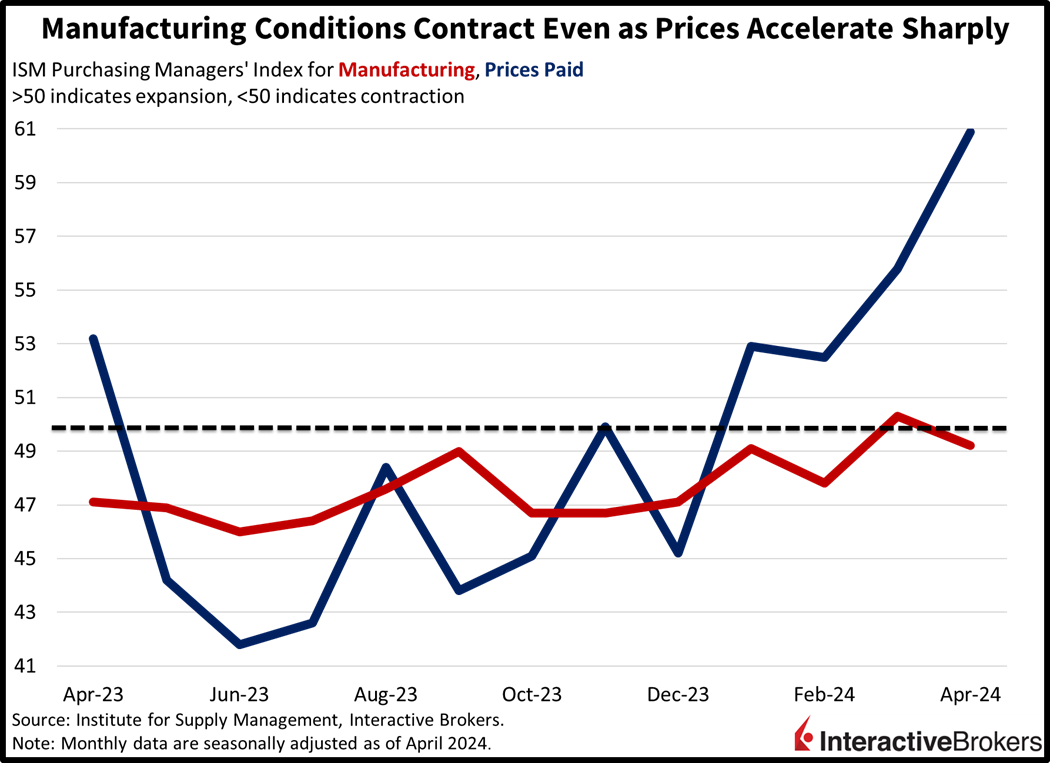
Manufacturing conditions reentered contraction territory last month, according to the Institute of Supply Management (ISM). Prices, however, accelerated strongly despite a reduction in orders and staffing. The ISM’s Purchasing Managers’ Index (PMI) for manufacturing slipped to 49.2 for April, missing the expansion/contraction threshold of 50. Last month’s figure declined from 50.3 in March and missed expectations for 50. Weighing on the headline were contractions in demand, employment, and backlogs, which came in at 49.1, 48.6 and 45.4. Production offset some of the weakness, however, with a score of 51.3. Prices, meanwhile, jumped to 60.9, accelerating fiercely from the previous month’s 55.8.
Consumers are continuing to rely on credit cards for shopping and traveling while restaurants are reporting mixed results with sales. In the tech sector, cloud computing, artificial intelligence (AI) and advertising are helping to support earnings, although in at least one instance, supply chain issues have surfaced. The following highlights elaborate on these prevalent themes from recent earnings calls:
Risk assets are getting creamed as we await Chair Powell’s run from the dugout to the mound. Investors are clamoring for protection as downside hedges are getting pricier alongside safe havens, with gold and Treasuries catching bids. For major stock indexes, though, only the Dow Jones Industrial Average is higher. The Nasdaq Composite, S&P 500 and Russell 2000 benchmarks are lower by 0.6%, 0.3% and 0.3%. Sectoral participation is not as bad, however, with 6 out of 11 segments higher this session. Leading the charge upward are communication services, utilities and materials sectors, which are gaining 1%, 0.8% and 0.5%. Energy, consumer discretionary and technology are collectively pushing equity benchmarks lower, however, with the sectors losing 1.5%, 0.9% and 0.8%. Energy is suffering from a sharp decline in oil prices as WTI crude is down 2.7%, or $2.17, to $79.26 per barrel. Increased optimism about a potential Middle East ceasefire and a significant increase in stateside inventories are to blame. Gold and copper are higher by 0.9% and 0.1%, meanwhile. In fixed-income and currency land, the 2- and 10-year Treasury maturities are trading at 5.01% and 4.66%, 3 basis points (bps) lower on the session for both instruments. The dollar is paring some of yesterday’s upside as traders re-evaluate recent hawkish moves in yields while awaiting further guidance from Powell today. The US currency is down versus most of its major counterparts including the euro, yen, yuan and Aussie and Canadian dollars. The greenback is gaining slightly relative to the pound sterling and franc though.
Chair Powell is truly unpredictable when he starts taking questions from the crowd following his review of economic conditions. Sometimes his comments attempt to strike a balance between the committee’s statement regarding the direction of monetary policy and his presentation. But risk assets selling off prior to the chair approaching the mound is emblematic of what the markets want, which is more upside. Will Powell be sensitive to the hawkish repricing across equities and fixed-income and use that opportunity to take it easy? Or will he talk economic pain, Volcker and the Fed sticking to its 2% inflation goal, hell or high water? As far as what I’m expecting: a hawkish statement, a sympathetic Powell.
Visit Traders’ Academy to Learn More About ISM-Manufacturing and Other Economic Indicators
New to Interactive Brokers?
Open AccountInformation posted on IBKR Campus that is provided by third-parties does NOT constitute a recommendation that you should contract for the services of that third party. Third-party participants who contribute to IBKR Campus are independent of Interactive Brokers and Interactive Brokers does not make any representations or warranties concerning the services offered, their past or future performance, or the accuracy of the information provided by the third party. Past performance is no guarantee of future results.
This material is from IBKR Macroeconomics, an affiliate of Interactive Brokers LLC, and is being posted with its permission. The views expressed in this material are solely those of the author and/or IBKR Macroeconomics and Interactive Brokers is not endorsing or recommending any investment or trading discussed in the material. This material is not and should not be construed as an offer to buy or sell any security. It should not be construed as research or investment advice or a recommendation to buy, sell or hold any security or commodity. This material does not and is not intended to take into account the particular financial conditions, investment objectives or requirements of individual customers. Before acting on this material, you should consider whether it is suitable for your particular circumstances and, as necessary, seek professional advice.
Related Articles
















Join The Conversation
For specific platform feedback and suggestions, please submit it directly to our team using these instructions.
If you have an account-specific question or concern, please reach out to Client Services.
We encourage you to look through our FAQs before posting. Your question may already be covered!