
- Solve real problems with our hands-on interface
- Progress from basic puts and calls to advanced strategies
Interactive Options Course
Posted June 1, 2026 at 9:24 am
Investopedia is partnering with All Star Charts on this newsletter. The contents of this newsletter are for informational and educational purposes only.
The trade everyone agreed on for two years just broke.
For most of the last two years, the dominant narrative in enterprise software was that artificial intelligence was going to replace it.
If a large language model can generate code, automate workflows, draft contracts, and answer customer support tickets, then the value of paying $30 per user per month for the software that used to do those things collapses.
ServiceNow, Salesforce, Snowflake, and Workday were the names most cited as roadkill, and software stocks priced that scenario in earlier this year with a sharp selloff while the semiconductor names continued to dominate.
Then the receipts started coming back.
In April, Uber’s CTO disclosed that the company had burned through its entire 2026 AI budget in four months. Uber had rolled out Anthropic’s Claude Code to roughly 5,000 engineers in December 2025.
By March, 84% of engineers were using the agentic coding tools. Per-engineer monthly API costs ballooned to between $500 and $2,000.
The company’s full annual budget was exhausted by mid-April. Last week on the Rapid Response podcast, Uber COO Andrew Macdonald said the spending could not be justified by the output. “It’s very hard to draw a line between one of those stats and, ‘Okay, now we’re actually producing 25 percent more useful consumer features,'” he said.
Microsoft told a similar story from inside its own walls. In mid-May, the company announced it would cancel most internal Claude Code licenses across its Experiences and Devices division by June 30, the last day of its fiscal year.
The reason was that Claude Code had become so popular among Microsoft’s own engineers that the cost of running it was eating into operating expenses, and the tool was undermining adoption of Microsoft’s own GitHub Copilot CLI.
The reporting from The Verge made clear the move was financially motivated as much as strategic.
Klarna, the Swedish fintech that became the most-cited example of AI replacing white-collar work after laying off 700 customer service agents in 2023, has spent the last year reversing course.
CEO Sebastian Siemiatkowski went on the record saying the company “went too far” with automation. Klarna is now rehiring human agents in a hybrid model. The rehiring costs alone exceeded the original savings.
And Starbucks scrapped its AI inventory system after nine months, with employees reporting that the tool miscounted stock and missed items on shelves.
Internal messages reviewed by Reuters showed workers openly celebrating the tool’s removal.
There is a structural reason this is happening.
Traditional enterprise software charges fixed pricing regardless of how heavily employees use it. AI systems work the opposite way.
The more useful the tool becomes, the more employees use it, and the more expensive it gets. That dynamic flips the entire ROI calculation against AI tools at scale, and it favors the incumbent software vendors who already own the procurement cycles, the audit trails, the integration depth, the compliance and security layers, and the multi-year contracts that nobody at a Fortune 100 IT department wants to rebuild from scratch.
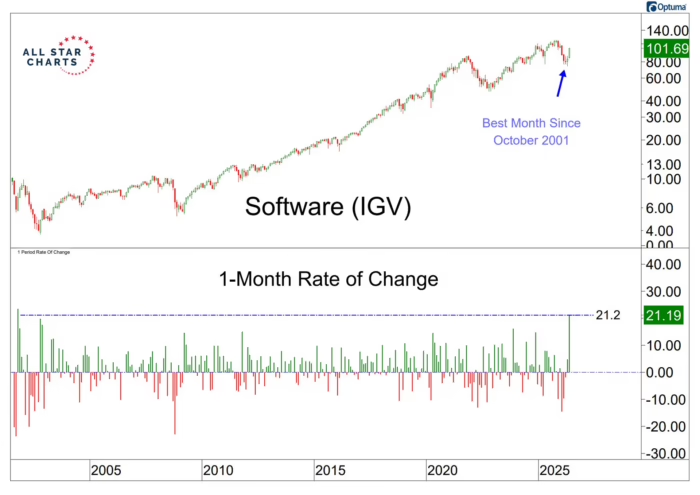
The chart caught up to the story last month.
What the Chart Is Saying
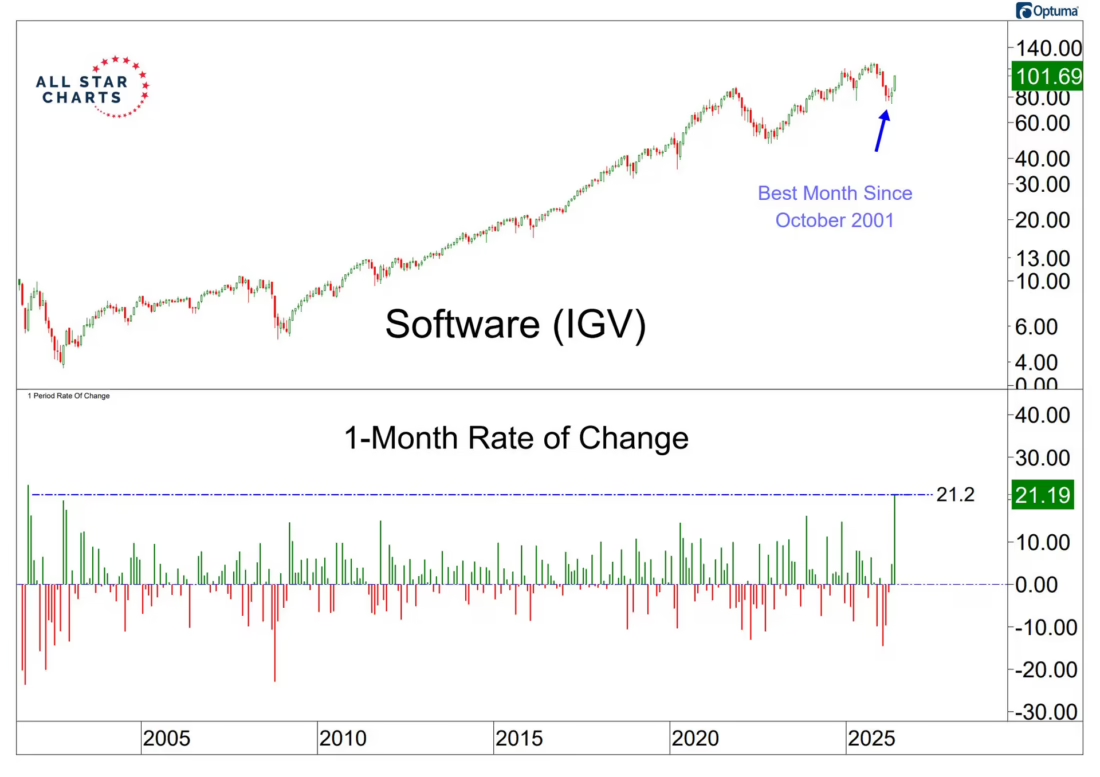
The iShares Expanded Tech-Software ETF (IGV) just posted a 21% monthly gain.
That is the strongest one-month move for software since October 2001, a span of nearly a quarter century that includes the rebound off the financial crisis lows, the COVID stimulus rally, and the AI-driven mega-cap melt-up of 2023.
This is not noise.
Rate of change indicators reveal market turning points better than price alone.
When monthly momentum readings hit extreme levels above 20%, they typically mark either exhaustion or acceleration phases that define the next major directional move for an asset.
The current reading represents institutional capital rotating back into a sector that spent years consolidating while other themes dominated market attention.
Momentum spikes of this magnitude occur when accumulated buying pressure finally overwhelms resistance.
The monthly timeframe filters out noise and captures the big money flows that drive sustained moves.
This type of momentum surge from a high-level consolidation typically signals the beginning of a new leg higher rather than a climactic top.
The pattern suggests institutional accumulation has reached the point where passive buying becomes active pursuit of exposure.
This story is going to take months to play out, and we’re going to be covering it live every step of the way.
The Morning Show airs every weekday and the Stock Market TV Daily Rundown goes out daily.
Both are free, and both are linked below.
===> The Morning Show
===> Stock Market TV Daily Rundown
The chart already moved.
And the story is just catching up.
—
Originally posted 1st June 2026
Investopedia.com: The comments, opinions and analyses expressed herein are for informational purposes only and should not be considered individual investment advice or recommendations to invest in any security or to adopt any investment strategy. While we believe the information provided herein is reliable, we do not warrant its accuracy or completeness. The views and strategies described on our content may not be suitable for all investors. Because market and economic conditions are subject to rapid change, all comments, opinions and analyses contained within our content are rendered as of the date of the posting and may change without notice. The material is not intended as a complete analysis of every material fact regarding any country, region, market, industry, investment or strategy. This information is intended for US residents only.
Information posted on IBKR Campus that is provided by third-parties does NOT constitute a recommendation that you should contract for the services of that third party. Third-party participants who contribute to IBKR Campus are independent of Interactive Brokers and Interactive Brokers does not make any representations or warranties concerning the services offered, their past or future performance, or the accuracy of the information provided by the third party. Past performance is no guarantee of future results.
This material is from Investopedia and is being posted with its permission. The views expressed in this material are solely those of the author and/or Investopedia and Interactive Brokers is not endorsing or recommending any investment or trading discussed in the material. This material is not and should not be construed as an offer to buy or sell any security. It should not be construed as research or investment advice or a recommendation to buy, sell or hold any security or commodity. This material does not and is not intended to take into account the particular financial conditions, investment objectives or requirements of individual customers. Before acting on this material, you should consider whether it is suitable for your particular circumstances and, as necessary, seek professional advice.
Any discussion or mention of an ETF is not to be construed as recommendation, promotion or solicitation. All investors should review and consider associated investment risks, charges and expenses of the investment company or fund prior to investing. Before acting on this material, you should consider whether it is suitable for your particular circumstances and, as necessary, seek professional advice.
Related Articles















Join The Conversation
For specific platform feedback and suggestions, please submit it directly to our team using these instructions.
If you have an account-specific question or concern, please reach out to Client Services.
We encourage you to look through our FAQs before posting. Your question may already be covered!