
- Solve real problems with our hands-on interface
- Progress from basic puts and calls to advanced strategies
Interactive Options Course
Posted January 16, 2026 at 10:32 am
1/ S&P 500
2/ Alphabet
3/ Morgan Stanley
Investopedia is partnering with CMT Association on this newsletter. The contents of this newsletter are for informational and educational purposes only, however, and do not constitute investing advice. The guest authors, which may sell research to investors, and may trade or hold positions in securities mentioned herein do not represent the views of CMT Association or Investopedia. Please consult a financial advisor for investment recommendations and services.
S&P 500
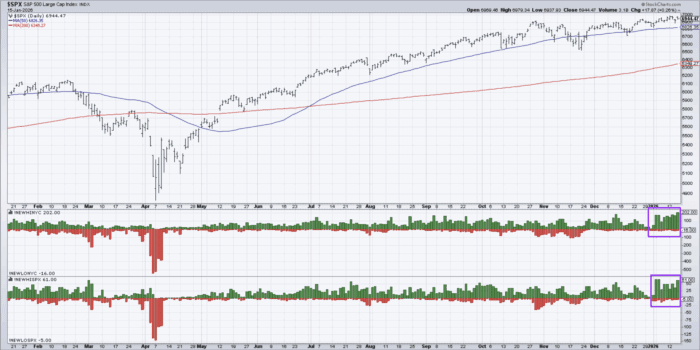
A bull market is usually marked by an expansion in new 52-week highs. Because if there aren’t enough stocks participating in a new uptrend phase, then we have to question the sustainability of the move as it represents stalled demand. A quick review of this breadth indicator shows that there are indeed plenty of stocks participating in the current uptrend.

Just over 12% of the S&P 500 members made a new 52-week on Thursday of this week, as did over 200 stocks listed on the NYSE. In fact, most trading days so far in January have seen 10-12% of the S&P 500 stocks hitting a new 52-week high. Bulls should be looking for this reading to steadily increase, as more and more names achieve their own new high and provide further upside pressure for the SPX.
Alphabet
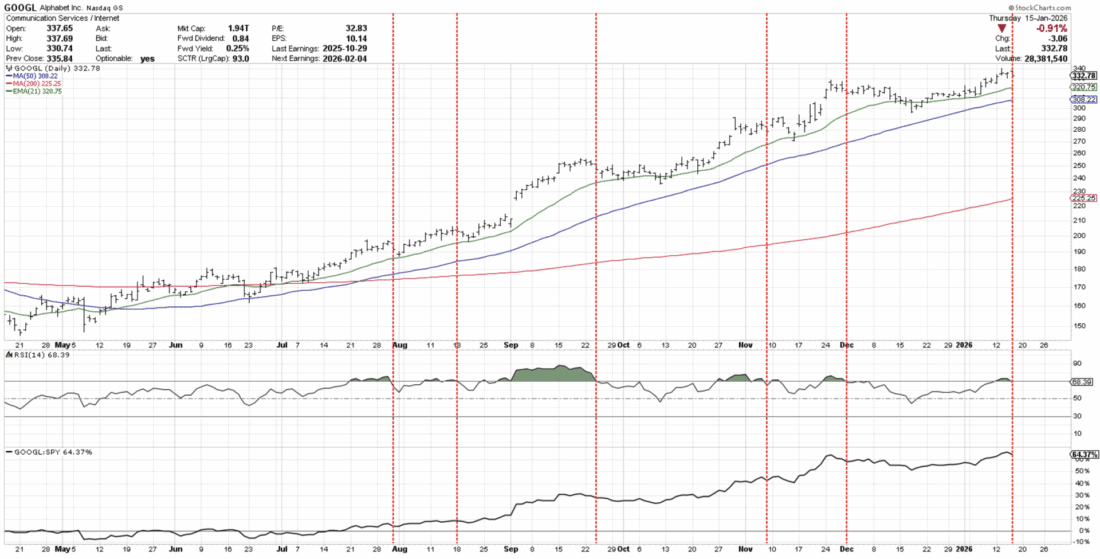
Shares of Alphabet (GOOGL) pulled back on Thursday, bringing the stock’s RSI out of the overbought region. This pattern has occurred five other times since the April market low, and we can see this RSI signal has usually led to a quick retest of moving average support.
To be clear, a stock becoming overbought is not necessarily a bad thing. In fact, stocks often become overbought in the early stages of a bull market phase, as a strong influx in demand pops the RSI to extreme levels. As I like to summarize, “Overbought means up a lot.”
Now when the RSI comes out of the overbought region, even if the long-term uptrend is still in great shape, we may just be seeing a natural short-term corrective move within the context of the long-term uptrend. For GOOGL, previous pullbacks during this uptrend phase have resulted in a pullback to the 21-day exponential moving average. Patient investors may be rewarded with a more ideal entry point in the days to come.
Morgan Stanley
While a number of banks pulled back this week after disappointing earnings, Morgan Stanley (MS) pushed on to achieve a new all-time high on Thursday. With weaker momentum supporting this latest thrust higher, the chart now features a bearish momentum divergence.

There are two ways that a chart can alleviate a bearish momentum divergence. Either the price drops, confirming the bearish divergence as the stock fails on weaker demand, or the price rallies on strong momentum to negate the divergence. Morgan Stanley has often demonstrated the latter, where an initial short-term pullback is soon met with new buyers.
If we do see stronger momentum going into next week, that would represent yet another example where a potential warning sign turns into a continuation signal for this investment banking giant. And as long as MS keeps pounding out a pattern of higher highs and higher lows, the trend is our friend!
—
Originally posted 16th January 2026
Investopedia.com: The comments, opinions and analyses expressed herein are for informational purposes only and should not be considered individual investment advice or recommendations to invest in any security or to adopt any investment strategy. While we believe the information provided herein is reliable, we do not warrant its accuracy or completeness. The views and strategies described on our content may not be suitable for all investors. Because market and economic conditions are subject to rapid change, all comments, opinions and analyses contained within our content are rendered as of the date of the posting and may change without notice. The material is not intended as a complete analysis of every material fact regarding any country, region, market, industry, investment or strategy. This information is intended for US residents only.
Information posted on IBKR Campus that is provided by third-parties does NOT constitute a recommendation that you should contract for the services of that third party. Third-party participants who contribute to IBKR Campus are independent of Interactive Brokers and Interactive Brokers does not make any representations or warranties concerning the services offered, their past or future performance, or the accuracy of the information provided by the third party. Past performance is no guarantee of future results.
This material is from Investopedia and is being posted with its permission. The views expressed in this material are solely those of the author and/or Investopedia and Interactive Brokers is not endorsing or recommending any investment or trading discussed in the material. This material is not and should not be construed as an offer to buy or sell any security. It should not be construed as research or investment advice or a recommendation to buy, sell or hold any security or commodity. This material does not and is not intended to take into account the particular financial conditions, investment objectives or requirements of individual customers. Before acting on this material, you should consider whether it is suitable for your particular circumstances and, as necessary, seek professional advice.
Any discussion or mention of an ETF is not to be construed as recommendation, promotion or solicitation. All investors should review and consider associated investment risks, charges and expenses of the investment company or fund prior to investing. Before acting on this material, you should consider whether it is suitable for your particular circumstances and, as necessary, seek professional advice.
Related Articles


















Join The Conversation
For specific platform feedback and suggestions, please submit it directly to our team using these instructions.
If you have an account-specific question or concern, please reach out to Client Services.
We encourage you to look through our FAQs before posting. Your question may already be covered!