
- Solve real problems with our hands-on interface
- Progress from basic puts and calls to advanced strategies
Interactive Options Course

Posted December 10, 2025 at 10:09 am
Small Caps Continuing to Break Out
Investopedia is partnering with CMT Association on this newsletter. The contents of this newsletter are for informational and educational purposes only, however, and do not constitute investing advice. The guest authors, which may sell research to investors, and may trade or hold positions in securities mentioned herein do not represent the views of CMT Association or Investopedia. Please consult a financial advisor for investment recommendations and services.
On the 4th day of “Chartmas” the market gave to me…
Small caps… continuing to break out after an initial failed breakout (i.e., bull trap), and now they’re holding important levels that make these smaller stocks a very strong candidate for inclusion in an investment portfolio.
Notice how far back in time those prior highs go – all the way back to late-2021… and the way I learned it from my mentors is, “The wider the base, the higher in space.”

…but it’s not just small caps. Micro caps are breaking out in a similar fashion, going all the way back to a triple-top in early-2021.
So again, we’re looking at an (almost) 5-year base here, with very clearly defined risk management (i.e., an exit strategy).
Also, can someone tell me how it is that the market is in the midst of a major top – ready to crash – if the smallest, riskiest companies in the U.S. are breaking out to all-time-highs?
No rush. I’ll wait…
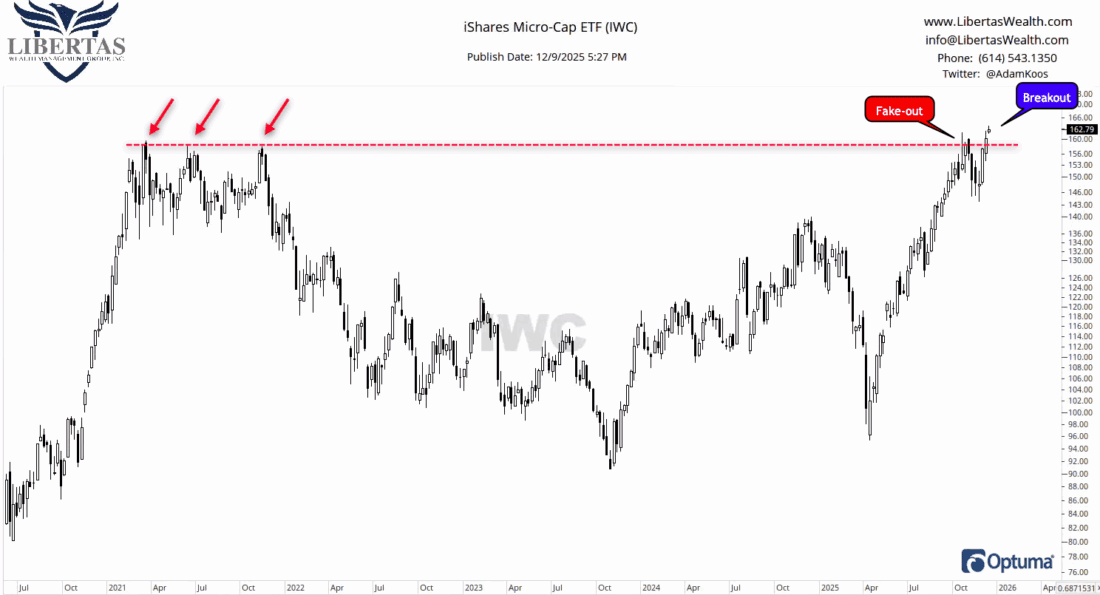
One of the reasons small caps are finally starting to come around – years after their big brothers and sisters (mid, large, and mega caps) have already broken out to their own, respective all-time-highs – is because rates are coming down.
Smaller companies don’t have the buying power or financial leverage that big companies do, so when rates come down, this is very “business friendly,” especially for the smaller “Mom & Pop” companies out there.
You can see in the chart below how the 10-year Treasury Yield peaked in fall of 2023, and while you could call it “trendless” at the moment (with some short-term choppiness and even a potential short-term breakout), the long-term trend is leaning negative, which is where it should continue if the Fed continues cutting rates into 2026 (which they likely will)
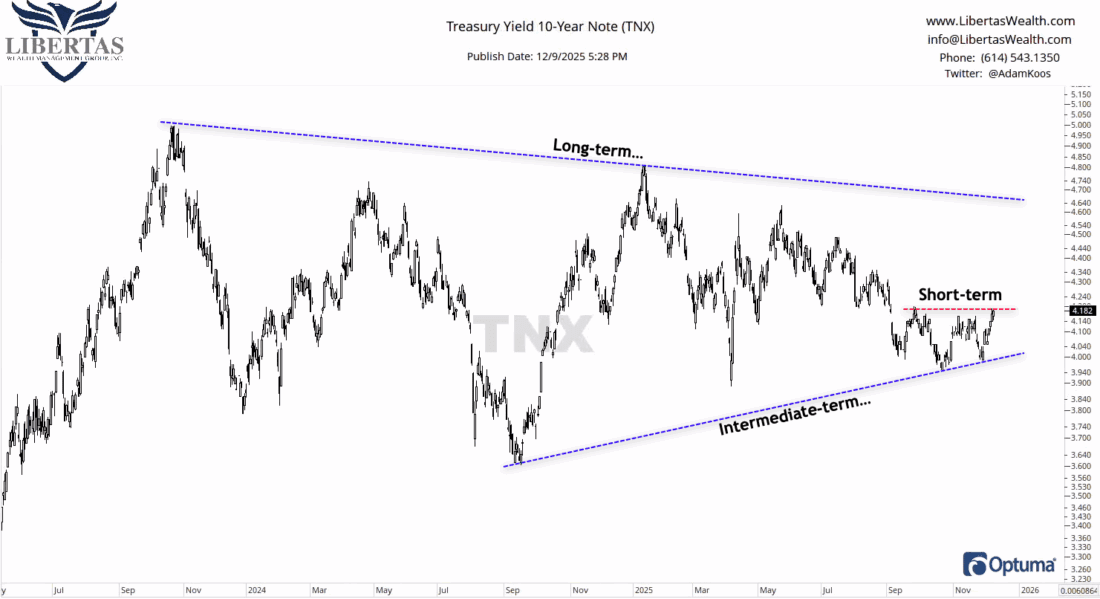
The 10-year Treasury is also closely tied to mortgage rates, by the way, so it wouldn’t be a terrible thing for the housing market to see the chart above resolve lower.
Bottom line, lower rates are a good thing for small and micro-caps, and I’ve never seen a bear market when the highest-beta stocks are breaking out, so I’ll call this more positive evidence as we make our way into 2026.
If you have any questions at all, feel free to email me personally, below.
Otherwise, stay tuned for day four of “The 5 Days of Chartmas” in tomorrow’s issue, and thanks, as always, for taking the time to read!
—
Originally posted 10th December 2025
Investopedia.com: The comments, opinions and analyses expressed herein are for informational purposes only and should not be considered individual investment advice or recommendations to invest in any security or to adopt any investment strategy. While we believe the information provided herein is reliable, we do not warrant its accuracy or completeness. The views and strategies described on our content may not be suitable for all investors. Because market and economic conditions are subject to rapid change, all comments, opinions and analyses contained within our content are rendered as of the date of the posting and may change without notice. The material is not intended as a complete analysis of every material fact regarding any country, region, market, industry, investment or strategy. This information is intended for US residents only.
Information posted on IBKR Campus that is provided by third-parties does NOT constitute a recommendation that you should contract for the services of that third party. Third-party participants who contribute to IBKR Campus are independent of Interactive Brokers and Interactive Brokers does not make any representations or warranties concerning the services offered, their past or future performance, or the accuracy of the information provided by the third party. Past performance is no guarantee of future results.
This material is from Investopedia and is being posted with its permission. The views expressed in this material are solely those of the author and/or Investopedia and Interactive Brokers is not endorsing or recommending any investment or trading discussed in the material. This material is not and should not be construed as an offer to buy or sell any security. It should not be construed as research or investment advice or a recommendation to buy, sell or hold any security or commodity. This material does not and is not intended to take into account the particular financial conditions, investment objectives or requirements of individual customers. Before acting on this material, you should consider whether it is suitable for your particular circumstances and, as necessary, seek professional advice.
Any discussion or mention of an ETF is not to be construed as recommendation, promotion or solicitation. All investors should review and consider associated investment risks, charges and expenses of the investment company or fund prior to investing. Before acting on this material, you should consider whether it is suitable for your particular circumstances and, as necessary, seek professional advice.
Municipal Bonds are only available from Interactive Brokers for IBKR LLC, IBKR Canada, IBKR Hong Kong, IBKR Australia and IBKR Singapore entities.
Related Articles
















Join The Conversation
For specific platform feedback and suggestions, please submit it directly to our team using these instructions.
If you have an account-specific question or concern, please reach out to Client Services.
We encourage you to look through our FAQs before posting. Your question may already be covered!