
- Solve real problems with our hands-on interface
- Progress from basic puts and calls to advanced strategies
Interactive Options Course

Posted May 29, 2026 at 12:45 pm
Samsung Electronics employees in South Korea have just demonstrated how labor can successfully demand a big slice of the cake when money is pouring in.
The AI boom has raised legitimate concerns about workers being displaced and wages coming under pressure as the same work can suddenly be done more cheaply by a chatbot. But at the same time, there are scalding hot sectors within the tech space where employees understand their value and can leverage it, sometimes to astonishing results. In Samsung’s case, memory chip unit workers are set to receive nearly $400,000 in bonuses this year, on average.
Samsung will hand chip workers a 10.8% slice of operating profit during the most lucrative boom the memory industry has ever seen. That’s on top of existing bonuses. The employees are essentially staking a claim on the company itself, especially as much of this will be paid out in shares.
40% of the new bonus pool, which could be around $23 billion this year, will be divided equally among all 78,000 chip workers. The rest will be performance-based. The deal also scraps a cap on special bonuses and is in place for 10 years.
Samsung isn’t acting out of generosity. The alternative was an 18-day strike by 48,000 unionized workers in chip production, during an acute global memory shortage. Moreover, its hand was forced by a rival memory chip maker, SK Hynix.

Last year, SK Hynix set the precedent by becoming the first South Korean company to agree in writing to share 10% of its operating profit with workers. The move widened the bonus gap between the two companies and made SK Hynix a more attractive place to work.
SK Hynix still offers better overall terms, with average bonuses this year expected to approach $500,000. But Samsung is creeping closer. Competition for top talent is intensifying amid the AI supercycle, as demand for chips continues to climb. Investors would be wise to keep an eye out for other similar wage disputes, as the labor costs can surge quickly in talent wars.
South Korean stock index Kospi has had an amazing run this year, nearly doubling in value. But it’s largely carried by memory companies, and volatility has been intense. During the early days of the Iran war, Kospi even saw a record one-day drop of 12%, only to quickly claw it back.
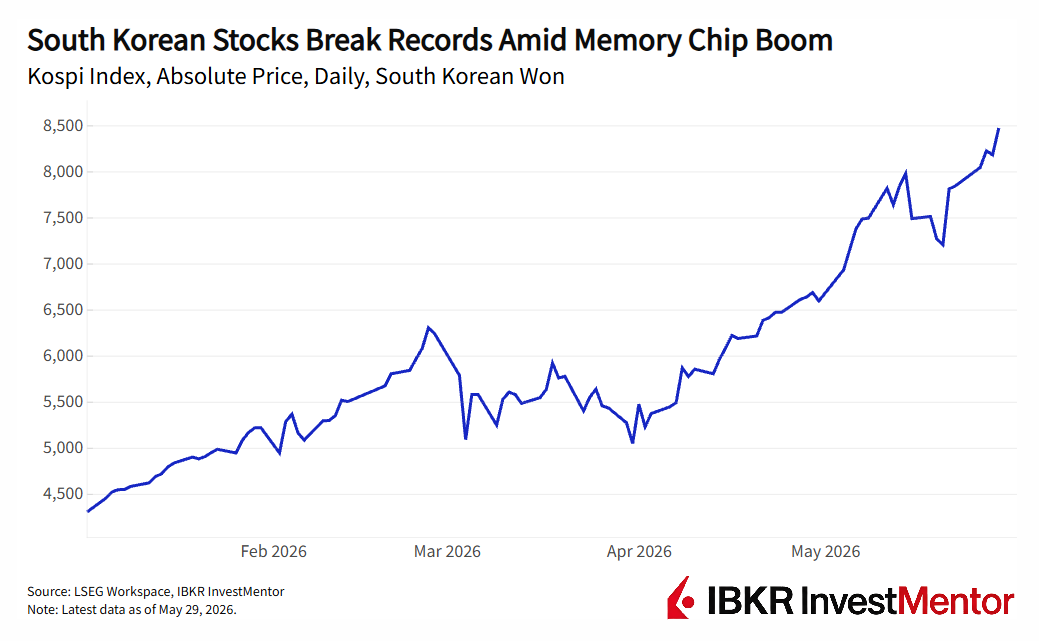
The workers have a solid case to ask for more. Samsung, SK Hynix, and their American rival Micron all exceeded a one-trillion-dollar market cap this month.
Demand for memory, especially ultra-fast DRAM used in data centers, has surged alongside spending by big tech, including Microsoft, Google, Amazon, OpenAI, and Anthropic. Nvidia gets most of the AI press, but it doesn’t make memory chips and buys them from the likes of Samsung and SK Hynix. Samsung’s operating income surged 750% year-on-year last quarter.
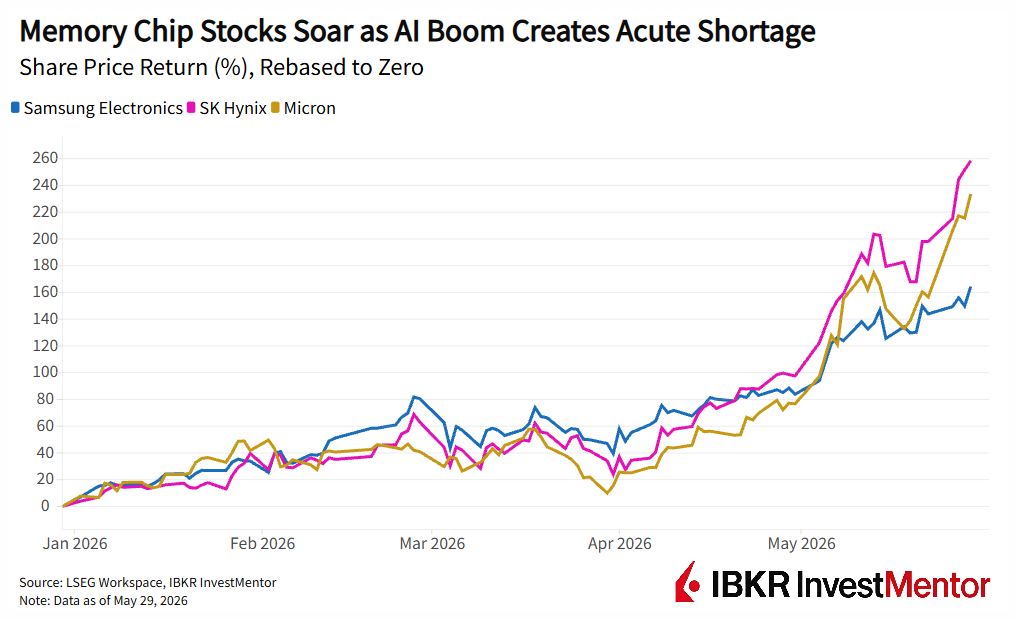
And as the AI boom swallows a lion’s share of the memory chips in the market, some consumer electronics manufacturers are struggling to secure enough for their devices. Companies like Sony and Nintendo, for example, have already hiked up prices for their gaming consoles.
In this environment, labor is not easily replaceable. Memory production is concentrated, technical, and tied to global supply chains already under strain. 48,000 workers threatening to strike during a global shortage is a potential global market shock. This is why Samsung shares ticked up after the pay deal announcement, despite the unprecedented terms.
The irony is that this windfall has not united the Samsung workforce.
The bonuses are concentrated in the chip division, particularly the lucrative memory unit. Workers in smartphones, TVs, and home appliances are getting far less. A minority union representing about 13,000 of those employees is trying to block the deal in court, arguing the structure is fundamentally unfair.
Samsung Electronics is effectively a two-speed company. One side is tied to the AI boom, sharing profits at levels that rival Wall Street investment bankers. The other operates in mature, slower markets, where margins are tighter and bargaining power weaker.
There is also a third group that does not have a seat at the table at all. Subcontractors are currently excluded from the windfall. That matters in South Korea, where large conglomerates rely heavily on extended networks of smaller firms and subcontracted labor. Recent legislative changes have expanded subcontractors’ rights and increased strike protections. More industrial action may yet come.
What makes this deal consequential is not just its size. It is the structure.
Bonus scheme linked directly to operating income, before government gets its slice of tax revenue, challenges how corporate earnings are usually distributed. Shareholders are typically paid from net income, after costs and taxes. Here, workers have moved up the queue.
This may have just opened a Pandora’s box. South Korean workforce is not particularly organized, with only about 13% of workers belonging to a union in 2024. That’s less than the OECD average. But the unions in the country are active and strike-prone, and they are now pushing for similar profit-sharing schemes across different sectors.
Workers at companies like Kakao, LG Uplus, HD Hyundai Heavy Industries, and Samsung Biologics want their own share of operating profits, with some proposals reaching as high as 30%.
Samsung’s deal shows what happens when three conditions line up: extraordinary profits, a supply squeeze, and organized labor willing to play rough. And once one employee group secures a direct claim on profits, others will ask for it too — even if they’re working for a telco or a shipbuilding company.
If you want to make sense of the economy and financial markets, download IBKR InvestMentor for free, interactive lessons, videos, and news explainers.
IBKR InvestMentor (dba “InvestMentor”) is a service of Interactive Academy LLC, an affiliate of IB LLC and majority-owned by IBG LLC. All content provided by InvestMentor is for informational and educational purposes only and should not be interpreted as implying any sponsorship, partnership, endorsement, recommendation, or approval by IB LLC or its affiliates.
Information posted on IBKR Campus that is provided by third-parties does NOT constitute a recommendation that you should contract for the services of that third party. Third-party participants who contribute to IBKR Campus are independent of Interactive Brokers and Interactive Brokers does not make any representations or warranties concerning the services offered, their past or future performance, or the accuracy of the information provided by the third party. Past performance is no guarantee of future results.
This material is from InvestMentor, an affiliate of Interactive Brokers LLC, and is being posted with its permission. The views expressed in this material are solely those of the author and/or InvestMentor and Interactive Brokers is not endorsing or recommending any investment or trading discussed in the material. This material is not and should not be construed as an offer to buy or sell any security. It should not be construed as research or investment advice or a recommendation to buy, sell or hold any security or commodity. This material does not and is not intended to take into account the particular financial conditions, investment objectives or requirements of individual customers. Before acting on this material, you should consider whether it is suitable for your particular circumstances and, as necessary, seek professional advice.
IBKR InvestMentorSM is a service of Interactive Academy LLC, an affiliate of IB LLC and majority-owned by IBG LLC. All content provided by IBKR InvestMentorSM is for informational and educational purposes only and should not be interpreted as implying any sponsorship, partnership, endorsement, recommendation, or approval by IB LLC or its affiliates.
Related Articles

















Join The Conversation
For specific platform feedback and suggestions, please submit it directly to our team using these instructions.
If you have an account-specific question or concern, please reach out to Client Services.
We encourage you to look through our FAQs before posting. Your question may already be covered!