
- Solve real problems with our hands-on interface
- Progress from basic puts and calls to advanced strategies
Interactive Options Course
Posted August 22, 2025 at 9:09 am
1/ It Matters if You Trade Breakouts or Reversals
2/ Reversals Win When the Trend is Weak
3/ It Matters What You Are Trading
Investopedia is partnering with CMT Association on this newsletter. The contents of this newsletter are for informational and educational purposes only, however, and do not constitute investing advice. The guest authors, which may sell research to investors, and may trade or hold positions in securities mentioned herein do not represent the views of CMT Association or Investopedia. Please consult a financial advisor for investment recommendations and services.
It Matters if You Trade Breakouts or Reversals
I used myedgefinder.com (a machine-learning, back-test and forward-test tool) to develop over 100 successful algorithmic breakout trading systems and compared their results in a three-year out-of-sample period to another set of 100 successful trading systems based on reversal signals. TLDR: breakouts won, though there IS more to the story.
This article isn’t specific to markets right now, but it is specifically intended to make you aware of your strategy for approaching any trading opportunity—especially those you might be looking at right now. Whether you are a short-term trader, or an investor who likes to manage a DIY portfolio, you can benefit from understanding the difference between trading with breakouts or reversals. You can choose to believe it doesn’t matter, but research says otherwise.
Simply defined a breakout describes a day when prices close above the highest price previously traded within a reasonable period of time (imagine a month if you need something specific). If you were to buy only at times when the price made a clear breakout, you’d often be buying at a short-term high. That seems to fly in the face of the old saying that successful traders aim to “buy low and sell high.” Indeed, trading breakouts is an exercise in buying high and selling higher. It sounds counterintuitive, but it tends to be a decent strategy (see chart).
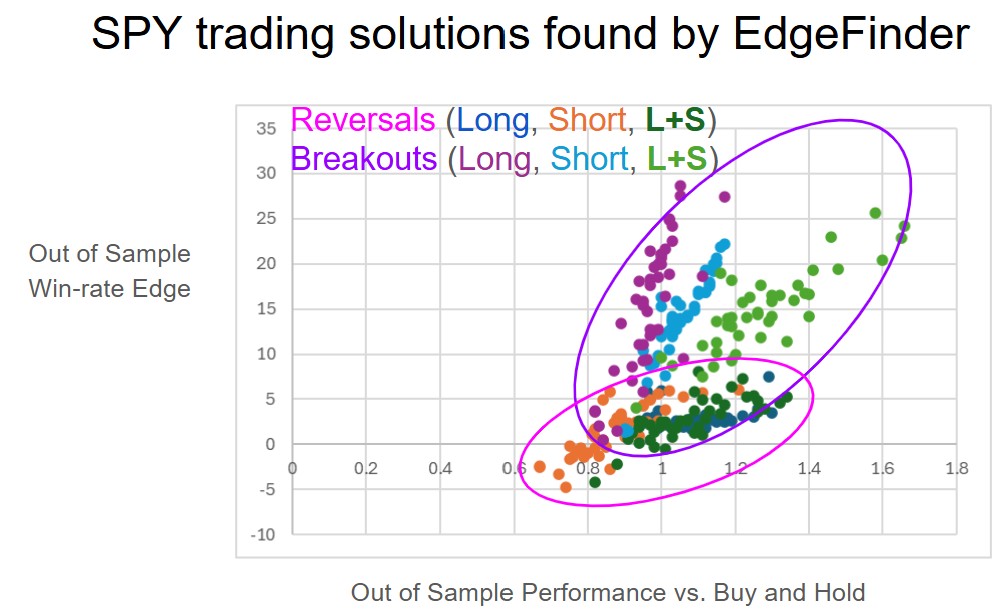
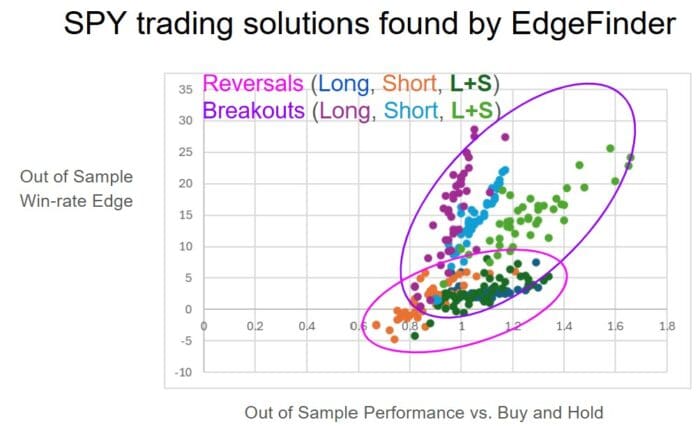
Each dot in the chart represents the final performance of a trading system during the out-of-sample period. Each of these trading systems were implemented strictly on State Street’s S&P 500 ETF (SPY). As you can see, the breakout systems show significantly stronger performance over the reversal systems.
Reversals Win When the Trend is Weak
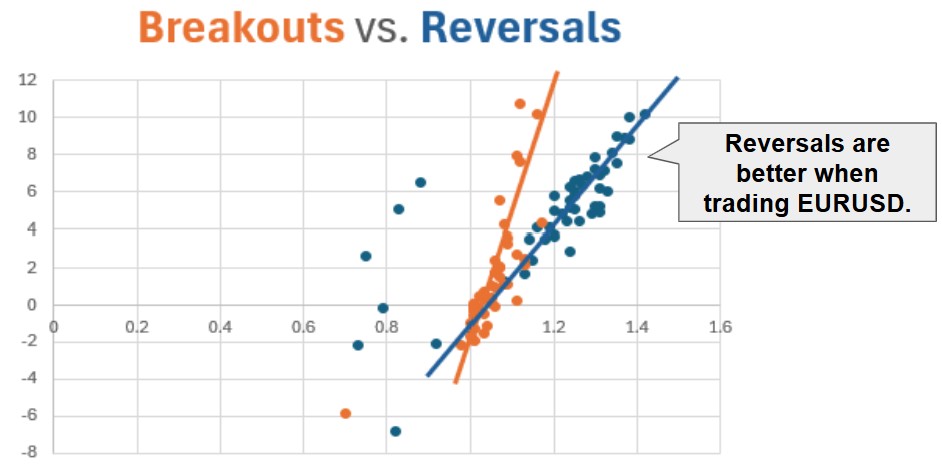
I didn’t stop researching there, because I recognize that different markets behave differently. Most notably the stock market and the forex markets hold surprisingly different dynamics. I also evolved over 50 breakout solutions for the EURUSD forex pair, and 50 reversal-based trading solutions using technology from myedgefinder.com. The results were dramatically different.
A reversal-based trading solution is what your typically think of when envisioning a way to buy low and sell high. You have to define something that qualifies as low (for example a price below a moving average), and then define something that works as a definition for relatively high. It isn’t hard to imagine that both kinds of trading systems could be profitable, but it was surprising to find that when trading with U.S. stocks, a solution is likely to be more successful if it is based on breakout signals compared to reversal signals.
It was even more surprising to find that the opposite was true when trading the Euro in the forex market. But a closer look at the data made it clear. First the EURUSD pair hasn’t had more than one major move of greater than 15% during the past three years. Compared to the stock market, the most popular forex trading instrument is flat as a Stroop waffle. The other key element is that reversal system tend to generate double or triple the number of entry signals during a given year. Where short-term trading is concerned, frequency matters.
It Matters What You Are Trading
But not all forex markets are equal—not by a long shot. The USDJPY forex pair has had more than seven trending moves greater than 15% over the past three years. That makes it a great vehicle for catching trends and profiting from them. So it shouldn’t have been a big surprise to see that a comparison of data points generated by 50 breakout systems and 50 reversal systems delivered opposing results.

The surprise came in the clear distinction between these styles. Even the best of the reversal systems still underperformed the worst of the breakout systems when applied specifically to the USDJPY forex pair.
These results should give traders and DIY investors pause. The stark differences in results indicate that it matter both what you are trading as well as how you trade it.
—
Originally posted 22nd August 2025
Investopedia.com: The comments, opinions and analyses expressed herein are for informational purposes only and should not be considered individual investment advice or recommendations to invest in any security or to adopt any investment strategy. While we believe the information provided herein is reliable, we do not warrant its accuracy or completeness. The views and strategies described on our content may not be suitable for all investors. Because market and economic conditions are subject to rapid change, all comments, opinions and analyses contained within our content are rendered as of the date of the posting and may change without notice. The material is not intended as a complete analysis of every material fact regarding any country, region, market, industry, investment or strategy. This information is intended for US residents only.
Information posted on IBKR Campus that is provided by third-parties does NOT constitute a recommendation that you should contract for the services of that third party. Third-party participants who contribute to IBKR Campus are independent of Interactive Brokers and Interactive Brokers does not make any representations or warranties concerning the services offered, their past or future performance, or the accuracy of the information provided by the third party. Past performance is no guarantee of future results.
This material is from Investopedia and is being posted with its permission. The views expressed in this material are solely those of the author and/or Investopedia and Interactive Brokers is not endorsing or recommending any investment or trading discussed in the material. This material is not and should not be construed as an offer to buy or sell any security. It should not be construed as research or investment advice or a recommendation to buy, sell or hold any security or commodity. This material does not and is not intended to take into account the particular financial conditions, investment objectives or requirements of individual customers. Before acting on this material, you should consider whether it is suitable for your particular circumstances and, as necessary, seek professional advice.
Any discussion or mention of an ETF is not to be construed as recommendation, promotion or solicitation. All investors should review and consider associated investment risks, charges and expenses of the investment company or fund prior to investing. Before acting on this material, you should consider whether it is suitable for your particular circumstances and, as necessary, seek professional advice.
There is a substantial risk of loss in foreign exchange trading. The settlement date of foreign exchange trades can vary due to time zone differences and bank holidays. When trading across foreign exchange markets, this may necessitate borrowing funds to settle foreign exchange trades. The interest rate on borrowed funds must be considered when computing the cost of trades across multiple markets.
Spot currencies are not available at IBKR Singapore.
Related Articles


















Join The Conversation
For specific platform feedback and suggestions, please submit it directly to our team using these instructions.
If you have an account-specific question or concern, please reach out to Client Services.
We encourage you to look through our FAQs before posting. Your question may already be covered!