
- Solve real problems with our hands-on interface
- Progress from basic puts and calls to advanced strategies
Interactive Options Course

Posted January 29, 2026 at 10:45 am
Markets are broadening despite the incessant noise from ongoing geopolitical maneuvering and Fed independence.
We maintain our view that investors will gradually diversify away from US assets, suggesting continued US dollar weakness.
Artificial intelligence has challenges that require thoughtful regulation, but the potential benefits may be extraordinary.
Hall of Fame football coach Bill Parcells, during the New York Giants’ 1986 title run, was asked by a reporter if he was scared to play Washington for the third time. Parcells replied, “Let me tell you what I’m scared of: Snakes, spiders, and the IRS.”
I’m so often asked what scares me about the ongoing market advance that I’ve been tempted to borrow Parcells’ line.
Venezuela? A small economy.1 Iran? Same.2
Federal Reserve (Fed) independence? It’s critical, but I won’t be concerned unless inflation expectations break meaningfully above current levels.3
Greenland? Tariffs? It’s not ideal, but we’ve navigated tariffs before. Following Liberation Day, a “yippie” bond market had the Trump administration pausing tariffs, and the S&P 500 Index posting its third-best one-day return in 30 years.4
It’s not snakes and spiders. I’ll be concerned when signs emerge of excessive leverage building across the US economy, inflation expectations drifting meaningfully outside the Fed’s comfort zone, a clear rollover in economic activity, credit spreads blowing out, and bankers tightening lending standards.5
None of that’s happening today.
Until it does, I remain bullish on stocks, despite the incessant noise in the headlines and the ongoing geopolitical maneuvering.
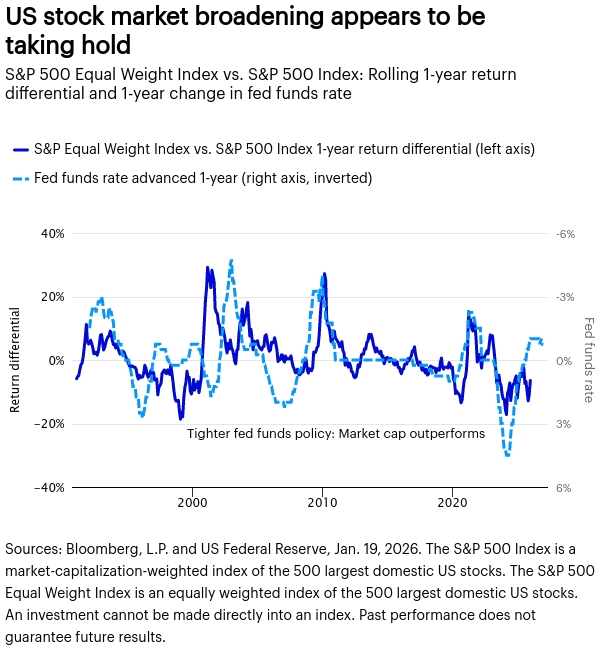
… the much‑anticipated broadening of the US stock market does appear to be taking hold. This pattern is typical as the Fed eases policy and economic activity improves. Historically, during easing cycles, the equal‑weight S&P 500 Index (a proxy for broader market participation) has tended to outperform the market‑cap‑weighted index. (See chart below.) Early signs suggest this dynamic is emerging. Market cap has still outperformed equal weight over the past year, but that gap has been narrowing.6
“Kevin’s too good on television to send to the Fed.”
—President Donald Trump7
President Trump’s recent comments about Kevin Hassett, long viewed as the perceived front‑runner for the Fed Chair role, effectively reopened the competition for the top job, with candidates such as Kevin Warsh and Christopher Waller emerging as leading contenders. Alas, my name still hasn’t appeared on any lists. I’m beginning to think I’m not in the running for the final rose!
As we’ve incessantly said, Fed independence remains critical. It has been modestly concerning to see inflation expectations drift higher in January, even if they’re within the Fed’s comfort zone.8 Investors should remember that the next Fed Chair will not wield unilateral control, because the governors generally lack deep political ties, the Biden‑appointed members remain in place, and Trump appointees like Waller and Michelle Bowman have been voting in line with the current Fed. This bears watching (pun intended!), as rising concerns over Fed independence represent the primary downside risk to our outlook. Nonetheless, we continue to expect the institution’s integrity to hold.
“Europe owns Greenland, it also owns a lot of Treasuries.”
—George Saravelos, Deutsch Bank FX Strategis9
George Saravelos makes an interesting argument. There’s $3.5 trillion of US Treasury debt held in Europe, which is 9.8% of US outstanding debt.10 In fact, Europe owns far more than China, even though Chinese ownership of US debt has long been viewed as a powerful potential geopolitical tool.
It’s important to keep this in perspective, however. There’s not going to be a mass sale of US assets by European governments.
The conclusion is that the current debate over Greenland doesn’t point to a sudden liquidation of US Treasuries. Instead, we maintain our view that investors will likely gradually diversify away from US assets, which suggests continued weakness in the US dollar. This supports our expectation that international assets will likely outperform in 2026.
Think: Geopolitical events have a meaningful impact on the stock market.
Rethink: The average one-year return of the S&P 500 Index following a peak in the Geopolitical Risk Index is 15.40%.12
Why are Japanese bond yields surging, and should investors be concerned? I posed the question to Rob Waldner, Chief Strategist and Head of Macro Research for Invesco Fixed Income. His response:
“Japanese bond yields13 have jumped on the back of a much larger‑than‑expected fiscal package and fears that the Bank of Japan (BoJ) has been too slow to raise rates, despite the December rate hike. Prime Minister Sanae Takaichi’s stimulus, equivalent to nearly 3% of gross domestic product (GDP),14 raised concerns about increased bond issuance and future fiscal expansion, pushing yields higher.
Markets now view the central bank as behind the curve, a perception reinforced by the unusual combination of rising rates and a weak currency.15 This dynamic is likely to be resolved, but will likely entail increased market volatility, including further increases in Japanese bond yields, until the BoJ is forced to tighten more aggressively. That would then likely be followed by stabilization and a rally in the yen.”
My travels took me to Phoenix, where I was on an agenda with the technology and science writer and CBS News Correspondent David Pogue. David’s session focused on artificial intelligence (AI), and while he acknowledged the many concerns surrounding tech, he reminded us that society has always feared new innovations. Remember when it was believed that traveling 50 miles per hour on a steamship would drive a person mad?
David made clear that although AI will bring challenges that require thoughtful regulation, the potential benefits are likely to be extraordinary. He delivered on his promise to end with mind-blowing examples, ranging from AI interpreting a confusing parking sign to David Beckham appearing in an advertisement speaking multiple languages he doesn’t know.
But the example that truly struck me was Google AI releasing structural predictions for nearly 200 million proteins known to science. When you know the structure of a protein thought to be involved in disease, it increases the probability of discovering a drug molecule that will bind to it and alter its behavior, hopefully curing or mitigating the disease. Before this breakthrough, it’s estimated that scientists had known the structure of only 0.085% of all known proteins. David believes this development will unlock transformational medical breakthroughs, including treatment and cures for many of the most debilitating illnesses.
—
Originally Posted January 20, 2026
Above the Noise: Look beyond distracting headlines by Invesco US
Important information
NA5144967
Image: Sarah Ehlen / Stocksy
All investing involves risk, including the risk of loss.
Past performance does not guarantee future results.
Investments cannot be made directly in an index.
This does not constitute a recommendation of any investment strategy or product for a particular investor. Investors should consult a financial professional before making any investment decisions.
Artificial intelligence (AI) technology companies are sensitive to specific risks such as small markets, business cycle changes, economic growth, technological progress, obsolescence, and regulation. These companies may have limited products, markets, resources, or personnel, making their securities more volatile, especially for smaller start-ups. Rapid technological changes can adversely affect their results. AI companies often rely on patents, copyrights, trademarks, and trade secrets to protect their technology, but there’s no guarantee these protections will be sufficient. Significant research and development (R&D) spending doesn’t ensure product or service success.
The Bloomberg US Corporate Bond Index measures the investment grade, fixed-rate, taxable corporate bond market. It includes US dollar-denominated securities publicly issued by US and non-US industrial, utility, and financial issuers.
The Conference Board Leading Economic Index (LEI) is an economic indicator used for forecasting changes in the business cycle based on a composite of 10 underlying components.
Credit spread is the difference in yield between bonds of similar maturity but with different credit quality.
Diversification does not guarantee a profit or eliminate the risk of loss.
Fixed income investments are subject to the credit risk of the issuer and the effects of changing interest rates. Interest rate risk refers to the risk that bond prices generally fall as interest rates rise and vice versa. An issuer may be unable to meet interest and/or principal payments, thereby causing its instruments to decrease in value and lowering the issuer’s credit rating.
The federal funds rate is the rate at which banks lend balances to each other overnight.
The Geopolitical Risk Index measures adverse geopolitical events based on a tally of articles covering geopolitical tensions from 10 different newspapers.
Gross domestic product (GDP) is a broad indicator of a region’s economic activity, measuring the monetary value of all the finished goods and services produced in that region over a specified period of time.
Inflation is the rate at which the general price level for goods and services is increasing.
Leverage measures a company’s total debt relative to the company’s book value.
Monetary easing refers to the lowering of interest rates and deposit ratios by central banks.
Option-adjusted spread (OAS) is the yield spread that must be added to a benchmark yield curve to discount a security’s payments to match its market price, using a dynamic pricing model that accounts for embedded options.
The risks of investing in securities of foreign issuers, including emerging market issuers, can include fluctuations in foreign currencies, political and economic instability, and foreign taxation issues. Review.
The Senior Loan Officers Opinion Survey (SLOOS) is conducted by the US Federal Reserve to provide qualitative and limited quantitative information on bank credit availability and loan demand, as well as on evolving developments and lending practices in the US loan markets.
Spread represents the difference between two values or asset returns.
In general, stock values fluctuate, sometimes widely, in response to activities specific to the company as well as general market, economic, and political conditions.
Tightening monetary policy includes actions by a central bank to curb inflation.
Treasury Inflation-Protected Securities (TIPS) are US Treasury securities that are indexed to inflation.
The opinions referenced above are those of the author as of Jan. 21, 2026. These comments should not be construed as recommendations, but as an illustration of broader themes. Forward-looking statements are not guarantees of future results. They involve risks, uncertainties, and assumptions; there can be no assurance that actual results will not differ materially from expectations.
This does not constitute a recommendation of any investment strategy or product for a particular investor. Investors should consult a financial advisor/financial consultant before making any investment decisions. Invesco does not provide tax advice. The tax information contained herein is general and is not exhaustive by nature. Federal and state tax laws are complex and constantly changing. Investors should always consult their own legal or tax professional for information concerning their individual situation. The opinions expressed are those of the authors, are based on current market conditions and are subject to change without notice. These opinions may differ from those of other Invesco investment professionals.
NOT FDIC INSURED
MAY LOSE VALUE
NO BANK GUARANTEE
All data provided by Invesco unless otherwise noted.
Invesco Distributors, Inc. is the US distributor for Invesco Ltd.’s Retail Products and Collective Trust Funds. Institutional Separate Accounts and Separately Managed Accounts are offered by affiliated investment advisers, which provide investment advisory services and do not sell securities. These firms, like Invesco Distributors, Inc., are indirect, wholly owned subsidiaries of Invesco Ltd.
©2024 Invesco Ltd. All rights reserved.
Information posted on IBKR Campus that is provided by third-parties does NOT constitute a recommendation that you should contract for the services of that third party. Third-party participants who contribute to IBKR Campus are independent of Interactive Brokers and Interactive Brokers does not make any representations or warranties concerning the services offered, their past or future performance, or the accuracy of the information provided by the third party. Past performance is no guarantee of future results.
This material is from Invesco US and is being posted with its permission. The views expressed in this material are solely those of the author and/or Invesco US and Interactive Brokers is not endorsing or recommending any investment or trading discussed in the material. This material is not and should not be construed as an offer to buy or sell any security. It should not be construed as research or investment advice or a recommendation to buy, sell or hold any security or commodity. This material does not and is not intended to take into account the particular financial conditions, investment objectives or requirements of individual customers. Before acting on this material, you should consider whether it is suitable for your particular circumstances and, as necessary, seek professional advice.
Related Articles

















Join The Conversation
For specific platform feedback and suggestions, please submit it directly to our team using these instructions.
If you have an account-specific question or concern, please reach out to Client Services.
We encourage you to look through our FAQs before posting. Your question may already be covered!