
- Solve real problems with our hands-on interface
- Progress from basic puts and calls to advanced strategies
Interactive Options Course
Posted March 9, 2026 at 12:45 pm
In recent weeks, energy markets have once again moved to the center of investors’ attention. Natural gas prices in Europe have surged, storage levels remain below historical averages, and geopolitical tensions in the Middle East are raising concerns about global LNG supply.
While headlines often focus on the risks facing European energy markets, a closer look at global pricing dynamics reveals an interesting divergence. Natural gas prices in Europe have risen sharply, while U.S. natural gas prices remain relatively subdued. For investors, this discrepancy may create opportunities worth examining.
According to data from Gas Infrastructure Europe, the European Union’s natural gas storage facilities are currently filled to roughly 30% of their total capacity. This level is significantly lower than both last year’s levels and the historical five-year average for the same period, which typically stands around 40%.
Some countries are facing particularly tight conditions. Germany, for example, has storage levels close to 27%, far below historical averages. The Netherlands is even lower relative to its long-term norm. Italy is currently in a somewhat better position, but still below the typical seasonal average.
This situation means Europe is approaching the end of the winter season with gas reserves that are significantly lower than usual. The issue becomes even more important when considering that EU regulations require storage facilities to be filled to 90% capacity by November 1st, forcing countries to replenish large quantities of gas during the coming months.
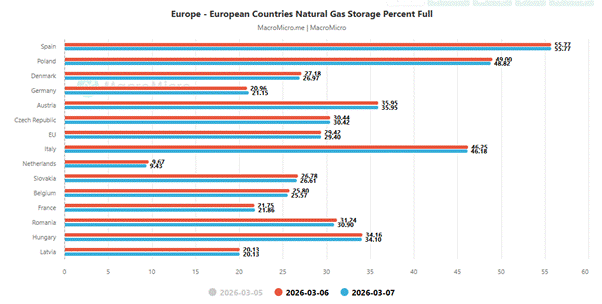
European natural gas storage levels remain significantly below historical averages across several key countries. According to recent data, EU storage facilities are currently filled at around 30% of capacity, with particularly low levels in countries such as Germany and the Netherlands. This tight supply situation is contributing to increased volatility in European gas prices and raising concerns about the region’s ability to rebuild inventories ahead of the next winter season. Source:MacroMicro
Beyond the storage issue, geopolitical developments are also contributing to rising uncertainty in the energy market.
Recent tensions in the Middle East have increased risks for global LNG supply routes. Qatar, one of the world’s largest exporters of liquefied natural gas, accounts for roughly 20% of global LNG supply. Any disruption in production or shipping from the region can quickly affect global energy markets.
One of the most sensitive points in global energy logistics is the Strait of Hormuz, through which a significant portion of global LNG shipments passes. If shipping activity in the region becomes constrained—even temporarily—the impact on prices can be immediate.
As a result, the European benchmark for natural gas, the Dutch TTF futures contract, experienced a rapid price surge. Prices briefly approached the €65 per megawatt-hour level before stabilizing closer to €50/MWh, still significantly higher than levels seen before the latest geopolitical tensions.
Perhaps the most striking development in the global gas market today is the growing price gap between Europe and the United States.
In Europe, the Dutch TTF benchmark is currently trading around €50 per megawatt hour, which roughly translates to about $17–18 per MMBtu.
By contrast, in the United States the Henry Hub natural gas benchmark is trading near $3 per MMBtu.
In other words, European gas prices are roughly six times higher than U.S. gas prices.
This enormous spread is not simply the result of market inefficiencies. Instead, it reflects structural differences between the two markets.
The United States remains structurally long natural gas thanks to strong domestic production and relatively comfortable storage levels. According to projections from the U.S. Energy Information Administration (EIA), U.S. dry gas production is expected to continue growing into 2026, while domestic demand remains solid but not excessively tight.
In contrast, Europe relies heavily on imported LNG and is therefore more exposed to geopolitical risks affecting global shipping routes.
Another key structural shift occurred after the Russian invasion of Ukraine in 2022.
Before that event, most U.S. LNG exports were destined for Asia, including Japan, South Korea, and China. Europe accounted for roughly 28% of U.S. LNG exports.
After Russian pipeline gas supplies to Europe collapsed, the situation changed dramatically. Europe began purchasing LNG from wherever it could, with the United States becoming its largest supplier.
Between 2022 and 2023, more than 60% of U.S. LNG exports were directed to Europe, while Asia’s share declined significantly.
In the years that followed, this dynamic largely remained intact. In several recent quarters, more than half of Europe’s LNG imports came from the United States.
This new energy relationship means that European energy security is increasingly tied to U.S. gas production and export capacity.
Looking ahead, demand for American natural gas could continue to rise as new LNG export facilities come online.
Large export terminals such as Golden Pass and Port Arthur LNG are expected to expand the United States’ capacity to ship gas overseas. As these projects begin operations, the amount of U.S. gas available to international markets may increase significantly.
At the same time, Europe will need to refill its gas storage during the summer months. Estimates suggest the region may require hundreds of LNG cargoes to rebuild inventories before the next winter season.
This combination of structural demand and expanding export capacity is one of the reasons many analysts are closely watching the U.S. natural gas market.
Another important factor investors often consider when analyzing the natural gas market is seasonality. Commodity prices frequently follow recurring patterns driven by weather cycles, storage dynamics, and shifts in energy demand throughout the year. Tools such as the Forecaster Terminal’s seasonality analysis allow investors to study these historical patterns in detail and understand how natural gas prices have behaved across different months and market environments.
Using analytical tools such as the Forecaster Terminal, it is possible to visualize these seasonal patterns over multiple time horizons. When looking at long-term historical data, an interesting pattern emerges: natural gas prices often reach their seasonal lows between March and April before beginning a gradual recovery during the spring and early summer months.
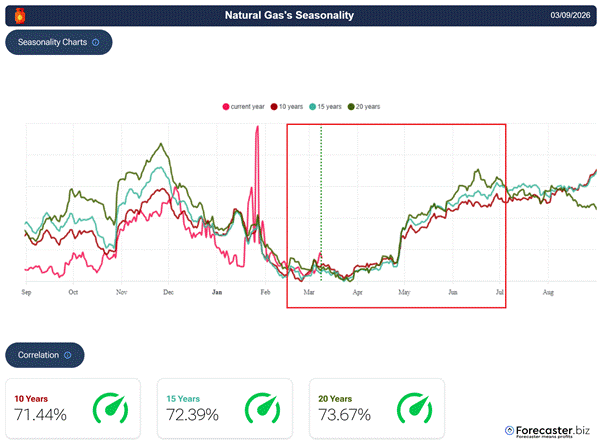
The chart above shows seasonal performance across several historical windows (10, 15, and 20 years). Despite short-term volatility, the broader pattern is quite consistent: the late-winter period typically marks a turning point where selling pressure tends to fade and prices begin to stabilize.
A deeper look at the monthly performance statistics reinforces this observation. When analyzing historical returns month by month, March and April often represent the transition period between winter demand and the summer storage rebuilding cycle.
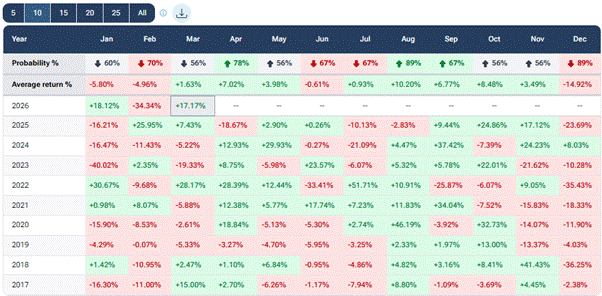
The data highlights how the market frequently begins to strengthen after the end of winter, as traders shift their focus from heating demand toward storage replenishment and future supply expectations. This seasonal behavior does not guarantee price increases, but it provides an additional layer of context when evaluating potential opportunities in the natural gas market.
As always, seasonality should be interpreted alongside macroeconomic conditions, geopolitical developments, and supply-demand dynamics rather than used in isolation.
For investors, the current situation raises an important question: could the gap between European and U.S. gas prices narrow over time?
The answer depends on several variables, including global LNG supply, geopolitical stability, weather patterns, and the pace of new LNG infrastructure coming online.
At the moment, Europe appears to be pricing natural gas based on geopolitical risk and supply concerns, while the U.S. market is still trading closer to domestic fundamentals.
If global LNG demand continues to grow and export capacity expands, the relative undervaluation of U.S. natural gas may attract increasing attention from investors.
The global energy market is once again facing a period of heightened uncertainty. Europe is dealing with lower-than-average storage levels and geopolitical risks affecting LNG supply, while the United States continues to benefit from strong domestic production and relatively stable pricing.
This divergence has created one of the largest price gaps between the European and American natural gas markets seen in recent years.
Whether that gap will eventually narrow remains uncertain, but it is a dynamic that energy investors will likely continue to monitor closely in the months ahead.
Information posted on IBKR Campus that is provided by third-parties does NOT constitute a recommendation that you should contract for the services of that third party. Third-party participants who contribute to IBKR Campus are independent of Interactive Brokers and Interactive Brokers does not make any representations or warranties concerning the services offered, their past or future performance, or the accuracy of the information provided by the third party. Past performance is no guarantee of future results.
This material is from Forecaster.biz and is being posted with its permission. The views expressed in this material are solely those of the author and/or Forecaster.biz and Interactive Brokers is not endorsing or recommending any investment or trading discussed in the material. This material is not and should not be construed as an offer to buy or sell any security. It should not be construed as research or investment advice or a recommendation to buy, sell or hold any security or commodity. This material does not and is not intended to take into account the particular financial conditions, investment objectives or requirements of individual customers. Before acting on this material, you should consider whether it is suitable for your particular circumstances and, as necessary, seek professional advice.
Futures are not suitable for all investors. The amount you may lose may be greater than your initial investment. Before trading futures, please read the CFTC Risk Disclosure. A copy and additional information are available at ibkr.com.
Related Articles

















Join The Conversation
For specific platform feedback and suggestions, please submit it directly to our team using these instructions.
If you have an account-specific question or concern, please reach out to Client Services.
We encourage you to look through our FAQs before posting. Your question may already be covered!