
- Solve real problems with our hands-on interface
- Progress from basic puts and calls to advanced strategies
Interactive Options Course
Posted August 11, 2025 at 10:15 am
Despite its meteoric rise over the past months, Nvidia continues to stand out as one of the most compelling investment opportunities in the market. Far from being overvalued, the company’s fundamentals reveal a story of strong growth, robust profitability, and a valuation that still leaves room for further gains.
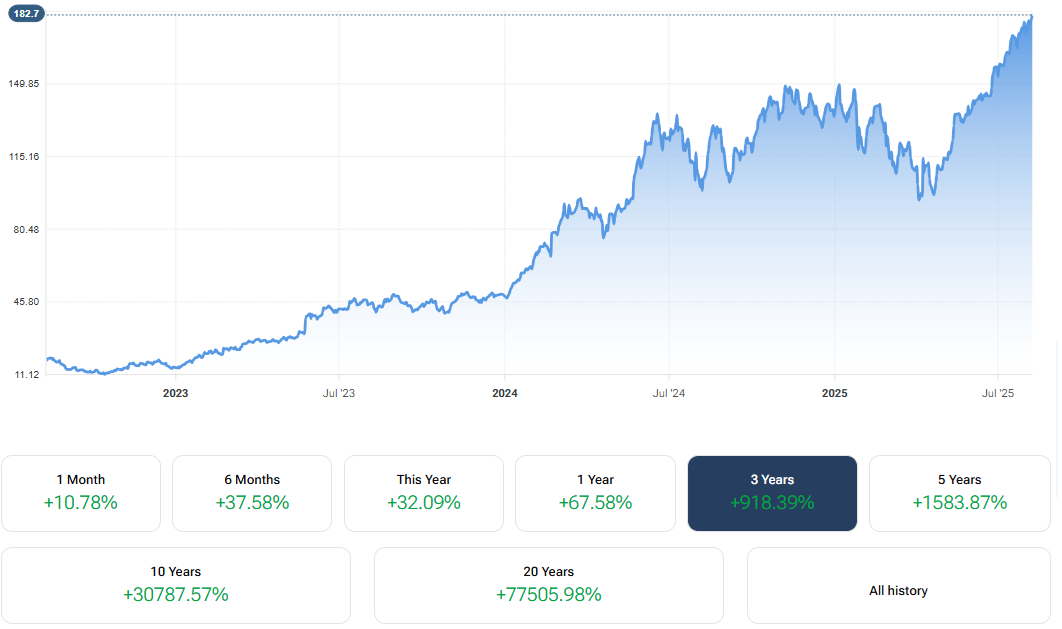
Nvidia’s staggering multi-year rally still leaves room for further growth. – Source: Forecaster Terminal
Nvidia’s revenue and net income growth over the past few years has been nothing short of extraordinary. According to Forecaster data, sales surged from $60.92 billion in 2024 to an impressive $130.50 billion in 2025 fiscal year, with net income expected to climb from $29.76 billion to $72.88 billion over the same period. This pace of expansion reflects the company’s dominant position in AI chips, data centers, and gaming GPUs — sectors experiencing exponential demand.
While some investors fear the stock’s rally has priced in all future gains, valuation models tell a different story. Forecaster’s average fair value estimate for Nvidia sits at $186.98, while the current market price of $182.70 is still 2.34% below this fair value. Even more striking, the Discounted Cash Flow (DCF) valuation places the stock at $292.17, implying significant upside potential.
Metrics like the Peter Lynch Fair Value ($191.99) and Economic Value Added ($107.76) reinforce the notion that the market has yet to fully capture Nvidia’s earnings power. The EV/Sales ratio of 155.98 might seem elevated compared to traditional industrial stocks, but for a high-margin tech leader with exponential growth prospects, it remains within reasonable bounds.
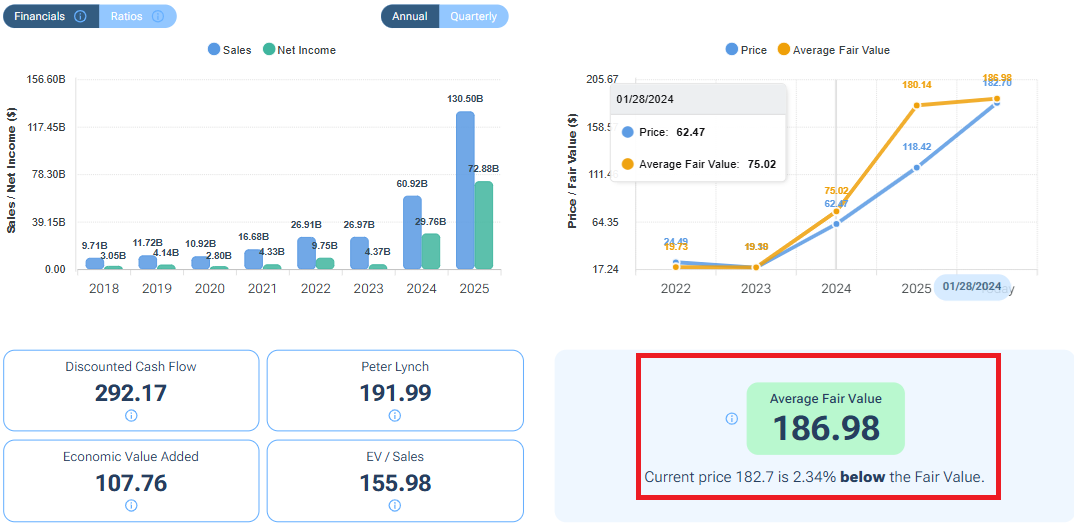
Multiple valuation models show Nvidia trading below fair value, despite its recent surge. – Source: Forecaster Terminal
When comparing Nvidia to AMD, the distinction in their AI businesses is striking. Nvidia’s data center revenue — $39.1 billion last quarter, up 69% year-over-year — is over 12 times larger than AMD’s and growing five times faster. Crucially, nearly 90% of Nvidia’s revenue is tied directly to AI accelerators, infrastructure, and software, whereas AMD’s is still heavily weighted toward CPUs and gaming. From a technology standpoint, Nvidia’s GPUs outperform AMD’s in most high-growth AI workloads — from multimodal inference (text, images, video, and audio) to real-time reasoning for chatbots, robotics, and autonomous vehicles. Proprietary innovations like NVLink, low-latency tensor cores, and the unmatched CUDA ecosystem give Nvidia a commanding lead in AI model training and latency-sensitive applications. With the AI market shifting toward speed, multimodality, and real-time performance — trends highlighted by GPT-5’s capabilities — Nvidia is positioned to capture the lion’s share of future AI infrastructure spending, leaving AMD a much smaller slice of the pie.
Another bullish signal for Nvidia comes from the trading activity of U.S. politicians, whose investment moves are often closely watched by the market. Forecaster’s data reveals that over the past several quarters, there have been substantial purchases of Nvidia shares by U.S. lawmakers, with buying volumes reaching into the millions of dollars in multiple periods. This sustained accumulation — even during periods of market volatility — suggests that well-informed insiders with access to high-level economic and technological briefings see continued upside in Nvidia’s stock. While political trades alone shouldn’t dictate an investment decision, their alignment with Nvidia’s explosive growth story and dominant position in AI infrastructure reinforces the conviction that the stock’s long-term trajectory remains upward.
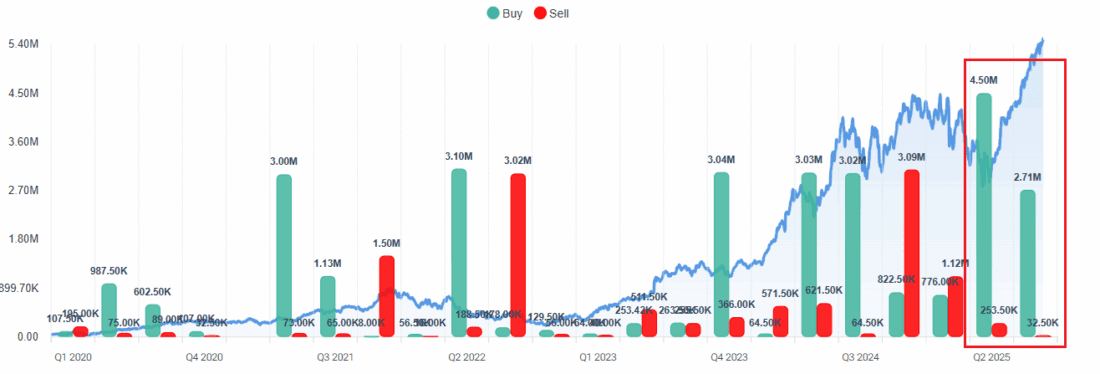
Multiple valuation models show Nvidia trading below fair value, despite its recent surge. – Source: Forecaster Terminal
Representative Cleo Fields, a Democratic U.S. Representative currently serving Louisiana’s 6th Congressional District, has been an active buyer of Nvidia shares in recent weeks, with multiple transactions in July 2025 alone. According to public disclosures compiled in Forecaster, his purchases range from $15,000 to $250,000 per trade, adding up to a total estimated value between $3.56 million and $11.07 million. The frequency and scale of these acquisitions — spread across several days and consistently in substantial amounts — suggest a deliberate, high-conviction investment strategy. This pattern of repeated buying, rather than a single large trade, further reinforces the view that Fields sees meaningful long-term upside in Nvidia’s stock.

Representative Cleo Fields made multiple high-value Nvidia purchases in July 2025, totaling an estimated $3.56M–$11.07M. – Source: Forecaster Terminal
August Seasonality Points to More Upside for Nvidia
Another factor supporting a bullish outlook for Nvidia in the short term is its strong historical seasonality in August. Forecaster’s data shows that over the past 15 years, Nvidia’s stock has posted gains in 87% of Augusts, with an impressive average return of 8.67% during the month. This consistent pattern of positive performance suggests that August 2025 could once again deliver solid returns for investors, especially when combined with the company’s robust fundamentals and current market momentum.
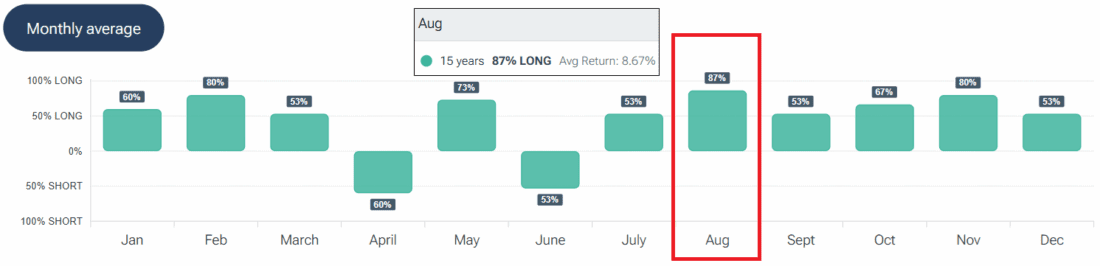
In 87% of the past 15 years, Nvidia shares gained in August, averaging an 8.67% monthly return. – Source: Forecaster Terminal
While short-term volatility is inevitable, Nvidia’s long-term investment case remains exceptionally strong. With fundamentals pointing to sustained earnings growth, a fair value still above current levels, and unmatched leadership in the AI hardware market, Nvidia’s rally might just be getting started. For long-term investors, the current price could be a strategic entry point into one of the defining companies of the decade.
—
Originally Posted on August 11, 2025
For specific platform feedback and suggestions, please submit it directly to our team using these instructions.
If you have an account-specific question or concern, please reach out to Client Services.
We encourage you to look through our FAQs before posting. Your question may already be covered!
Information posted on IBKR Campus that is provided by third-parties does NOT constitute a recommendation that you should contract for the services of that third party. Third-party participants who contribute to IBKR Campus are independent of Interactive Brokers and Interactive Brokers does not make any representations or warranties concerning the services offered, their past or future performance, or the accuracy of the information provided by the third party. Past performance is no guarantee of future results.
This material is from Forecaster.biz and is being posted with its permission. The views expressed in this material are solely those of the author and/or Forecaster.biz and Interactive Brokers is not endorsing or recommending any investment or trading discussed in the material. This material is not and should not be construed as an offer to buy or sell any security. It should not be construed as research or investment advice or a recommendation to buy, sell or hold any security or commodity. This material does not and is not intended to take into account the particular financial conditions, investment objectives or requirements of individual customers. Before acting on this material, you should consider whether it is suitable for your particular circumstances and, as necessary, seek professional advice.



















Most of the software developers are developing to the CUDA standard which is Nvidia. There are thousands of AI Apps available on HuggingFace which use CUDA. Also their basic software is in C/C++ which makes it super fast. AMD has its own standard and their fundamentals are written in Python which is very slow.
yep, we can say Nvidia is the new Apple 🙂 thanks for your comment