
- Solve real problems with our hands-on interface
- Progress from basic puts and calls to advanced strategies
Interactive Options Course

Posted July 30, 2026 at 1:37 pm
A blockbuster earnings report from Microsoft paired with robust economic data has Wall Street recovering from yesterday’s deep losses, which were driven by a relentless climb in long-end bond yields. The surge was bolstered by a lift in inflation expectations caused by Fed Chair Kevin Warsh preferring to leave rates unchanged for his second consecutive meeting despite attempting to maintain an unwavering focus on price pressures. It’s specifically the chief’s unwillingness to want to raise, even as oil prices have jumped significantly this month, that has market participants doubting that he will follow through on taking the required, brave action to bring cost forces back to 2%. Meanwhile, reporters were pressing him during the Q&A on what he was waiting for to tighten financial conditions amidst heavy inflation, strong growth and stable employment, all of which were confirmed in this morning’s elevated PCE figures, a healthy Q2 GDP print and subdued unemployment claims. Notwithstanding rallies in the four major equity benchmarks, however, 9 of the 11 sectors are retreating, with just tech and consumer discretionary advancing today. Treasuries are gaining, too, on the heels of Wednesday’s Fed debacle, but the greenback is tanking further, as monetary policy credibility concerns rise following the controversial pause, which marks the seventh decision in a row by the central bank to make no change. Elsewhere, this Thursday’s risk-on winds are benefiting cryptocurrencies and commodities broadly, while prediction markets additionally catch bids. Volatility protection instruments are seeing lighter premiums in light of the offensive backdrop.
Second-quarter gross domestic product (GDP) reflected an ongoing US economic expansion, but inventory draws and heavy imports hampered progress. Indeed, those two categories shaved 0.67 and 1.51 percentage points from the 1.5% quarter-over-quarter (q/q) annualized headline figure that otherwise would have arrived north of 3%. The result was slower than the 2.1% expected, which would have been unchanged from the prior period. The fundamentals were robust, however, as consumer spending accelerated from 0.5% to 3.2% while investment decelerated from 7.9% to a still fast pace of 3%, with both business and residential capital expenditures contributing positively. It was the first time housing boosted performance in a year and half.

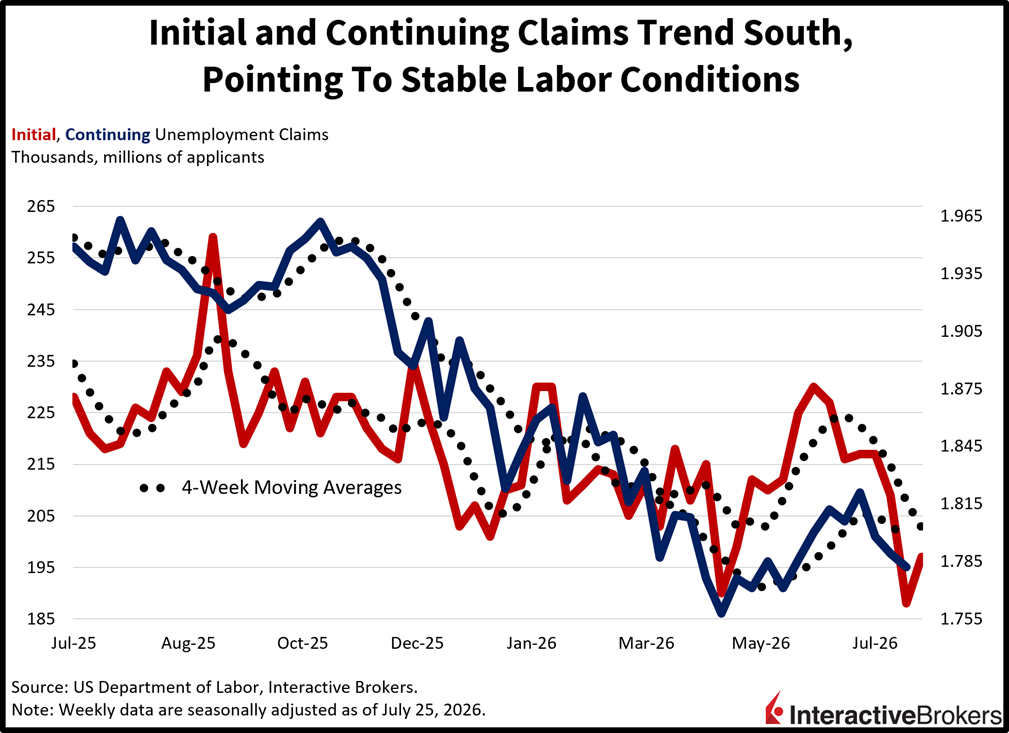
Unemployment claims continue to trend lower as corporate appetites for labor remain robust. First-time and continuing applications came in at 197k and 1.782 million during the seven-day periods ended on July 25 for the former and July 18 for the latter. The results were near expectations of 200k and 1.8 million as well as the previous intervals, which printed at 188k and 1.789 million. Four-week moving averages dipped to 202.75k and 1.798 million from 207.75k and 1.804 million.
The Personal Consumption Expenditures (PCE) price indices, which are accompanied by spending and income data, came in largely as expected. Headline and core June PCE costs reflected -0.1% and 0.1% month-over-month changes (m/m), while the year-over-year (y/y) numbers arrived at 3.7% and 3.3%. Services and food became 0.1% and 0.3% more expensive m/m but gasoline got a lot cheaper at -9.2% and durable goods were unchanged. Separately, shopping volumes on goods trumped outlays on services, although transaction gains were broad. Consumers’ disbursements, however, expanded at faster rates than incomes, causing a four-year low in the household savings rate of 2.7%.
The greatest surprise from yesterday’s meeting was when viewers realized that the three dissenters preferring a hike were by definition adopting positions that were more hawkish than the chief himself. Fed Chair Warsh seemed to be the most unwavering member of the committee regarding inflationary pressures in the earliest days at the organization’s helm, however, he appeared far too patient in raising rates for the audience’s liking at Wednesday’s presser. Indeed, his previous mentions of the Powell group that preceded him and how it was relaxed when it came to prices amidst over five years of costs running ahead of the central bank’s target were framed in a way that had market watchers believing Warsh was bringing real change to the institution, especially as growth and employment have remained robust. Meanwhile, his reference to only being on the job for a few weeks in response to what he’s doing to make things better signaled to some analysts that he was looking to kick the can down the road on a rate increase for when it was more convenient. The reluctance to lift generated short-term credibility damage that drove a dramatic steepening across the Treasury curve as bond vigilantes stood up and said wait a minute, resulting in purchases at the shorter tenors alongside selling at the long-end. Additionally, the greenback weakened materially on widening differentials, a move that is continuing today against the backdrop of other monetary policy institutions, like those in Europe and Japan, already having lifted this year in light of heavy cost forces and seen as increasingly disciplined relative to their US policymaker counterparts at this specific juncture.
The euro area’s GDP during the April to June period grew 0.4% and 1% quarter over quarter (q/q) and year over year (y/y), pointing to improving economic conditions, according to a flash estimate from Eurostat. The gains followed the flat q/q result and 0.5% annual growth in the preceding timespan, and they exceeded the economist consensus estimate for q/q and y/y expansions of 0.2% and 0.5%.
Ireland, Lithuania and Sweden led the expansion with q/q growth of 3.9%, 1.7% and 1.4%. No countries reported decline, although Austria’s economy was flat.
The June euro area 6.3% unemployment rate was unchanged from May’s 2026, but the result was higher than the economist consensus estimate of 6.2%, according to Eurostat. The number of employed individuals in the euro area climbed by 71k from May to 11.13 million. It was also by 43k when compared to the year-ago period
The Bank of England (BoE) left its key interest rate unchanged at 3.75% this morning, a level set in December. In doing so, it joined a handful of other central banks, including the Federal Reserve and the European Central Bank, that have recently paused rate changes while explaining they are waiting to better assess the impact of the escalating US-Iran war on energy prices and overall inflation.
In reaching the decision, three of nine BOE policymakers dissented, having stumped for a 25 basis-points hike. In a statement after the meeting, the BoE said all nine members believe that the risks regarding energy costs are skewed toward price increases and that the organization is willing to hike its benchmark if crude fuels higher inflation. Dissenters, however, pointed to inflation exceeding the organization’s target of 2% for five years. Last month, inflation fell to a 15-month low of 2.6%, which had supported expectations that the BoE would hold its key rate during today’s meeting.
Japan’s Consumer Confidence Index climbed from 33.8 in June to 34.9 for July and surpassed the economist consensus estimate of 34.2, according to the Cabinet Office.
Improvements in consumers’ perceptions of the economy when compared to June were broad as follows:
Additionally, the percentage of survey respondents who expect prices to go up in the year ahead fell 0.5 percentage points to 92.8% and the portion that said prices will stay the same increased by 0.4 percentage points to 2.9%. The portion of survey individuals who said they expect prices to fall climbed 0.3% to 2.5%.
Import prices in Australia climbed 5.7% q/q during the second quarter, a strong acceleration from the 0.1% ascent during the first three months of the year and substantially above the economist consensus estimate for no change, according to the Australian Bureau of Statistics. Meanwhile, export prices were up only 1.1% following the first quarter’s 0.5% gain.
Information posted on IBKR Campus that is provided by third-parties does NOT constitute a recommendation that you should contract for the services of that third party. Third-party participants who contribute to IBKR Campus are independent of Interactive Brokers and Interactive Brokers does not make any representations or warranties concerning the services offered, their past or future performance, or the accuracy of the information provided by the third party. Past performance is no guarantee of future results.
This material is from IBKR Macroeconomics, an affiliate of Interactive Brokers LLC, and is being posted with its permission. The views expressed in this material are solely those of the author and/or IBKR Macroeconomics and Interactive Brokers is not endorsing or recommending any investment or trading discussed in the material. This material is not and should not be construed as an offer to buy or sell any security. It should not be construed as research or investment advice or a recommendation to buy, sell or hold any security or commodity. This material does not and is not intended to take into account the particular financial conditions, investment objectives or requirements of individual customers. Before acting on this material, you should consider whether it is suitable for your particular circumstances and, as necessary, seek professional advice.
Futures, event contracts, and forecast contracts are not suitable for all investors. Before trading these products, please read the CFTC Risk Disclosure. For a copy, visit our Warnings and Disclosures Page.
Trading in digital assets, including cryptocurrencies, is especially risky and is only for individuals with a high risk tolerance and the financial ability to sustain losses. Eligibility to trade in digital asset products may vary based on jurisdiction.
Related Articles















Join The Conversation
For specific platform feedback and suggestions, please submit it directly to our team using these instructions.
If you have an account-specific question or concern, please reach out to Client Services.
We encourage you to look through our FAQs before posting. Your question may already be covered!