
- Solve real problems with our hands-on interface
- Progress from basic puts and calls to advanced strategies
Interactive Options Course

Posted April 28, 2026 at 1:01 pm
The Wall Street Journal reported a major news item this morning, one that brings into focus questions about massive spending on artificial intelligence. According to their exclusive report, OpenAI is missing key revenue and user targets, and reporting that sits “CFO and board have questioned the wisdom of massive data-center spending in the face of slowing growth.” After a huge rally for semiconductor stocks and ahead of major hyperscaler earnings releases tomorrow, this is highly inconvenient, to say the least. I asked an “expert” about it.
Let me preface the rest of the piece by saying that I never use AI to write on my behalf. It is an excellent editor, though, and I rely on company-provided Claude to check my writing for grammar, punctuation, spelling, and sloppy cut/pastes before I submit my writing for publication. It can also be an excellent research assistant, grabbing and analyzing data faster than I otherwise could. Today, however, you will find that I relied on AI more than usual for my analysis – something that will be obvious as you read on.
My use of AI is admittedly modest, but a report like today’s once again brings forth questions we raised months ago, some of which seemed to be taken seriously by the market earlier this year. First, do the productivity gains at present and in the near future justify the massive spending on data centers and the hardware to power them? Second, how is a buzzy startup with little in the way of profits and heavily negative cash flow going to pay for the massive commitments that were announced with great fanfare? Those questions are the crux of today’s modest angst in tech shares.
Thus, I decided to ask an “expert” about the WSJ report’s accuracy and about how it views OpenAI’s path to profitability and its likelihood of meeting its spending targets. The “expert” was ChatGPT.
If you ask me about matters pertaining to Interactive Brokers’ financials and growth prospects, I need to respectfully decline. I can comment freely about market matters, but not about my own company. This is standard practice at most companies. ChatGPT seems to have no such qualms, which I discovered after a simple initial query:
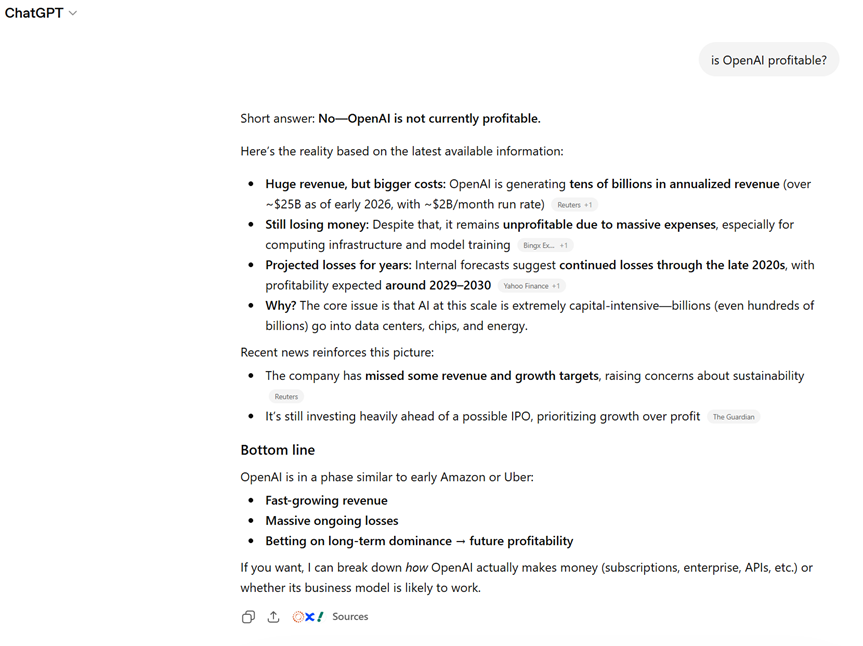
Considering that OpenAI is a private company, there is no need for them to confirm or deny their profitability to anyone other than investors and other key counterparts. Yet, ChatGPT seemed to confirm the public opinion on that matter. That led me to a follow-up, asking whether the bot could confirm the company’s ability to meet its spending targets.
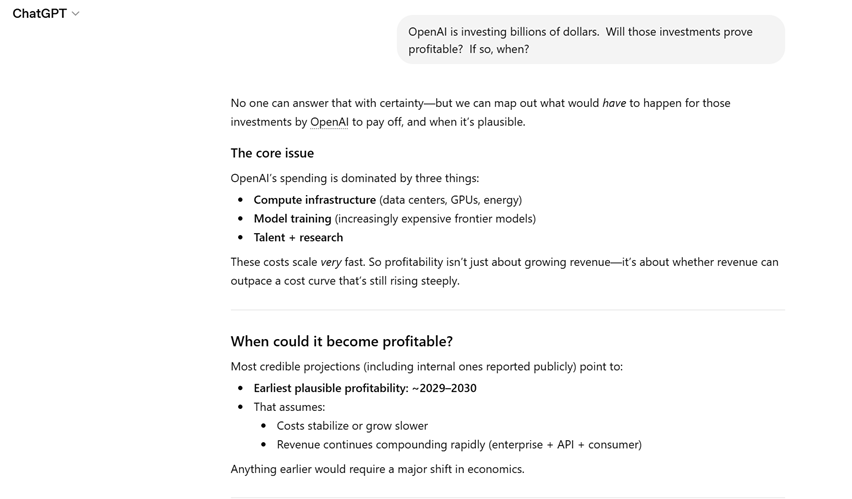
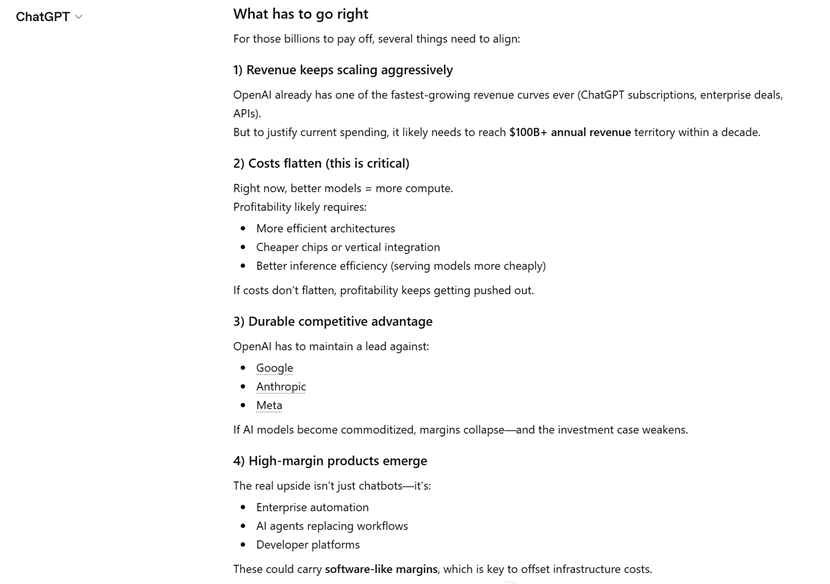
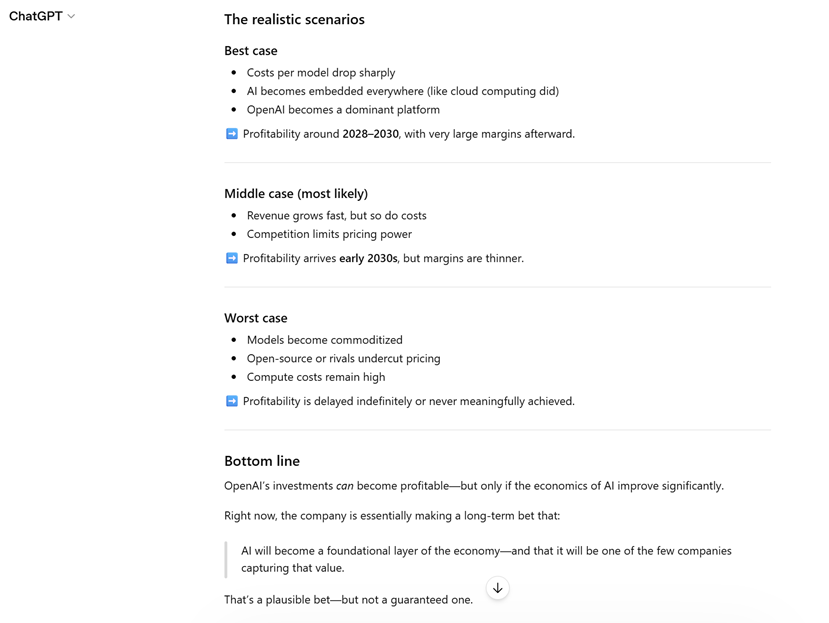

Dare I say that ChatGPT is less sanguine about its own prospects and its ability to continue to spend as aggressively as many investors seem to hope? There is clearly a path to profitability, which the answers lay out nicely, but there is no shortage of potential pitfalls that can interfere with the market’s assumptions for progress along that path. Presumably these are the types of risks that would be outlined in a prospectus if OpenAI does indeed go public, as is widely rumored, but they are quite real, not just boilerplate legalese.
Finally, I asked OpenAI to comment directly about the veracity of the WSJ reporting. Again, anyone other than a limited number of senior managers at a normal company would be prohibited from commenting about a story of this nature, but OpenAI’s most visible “spokesperson” had plenty to say:
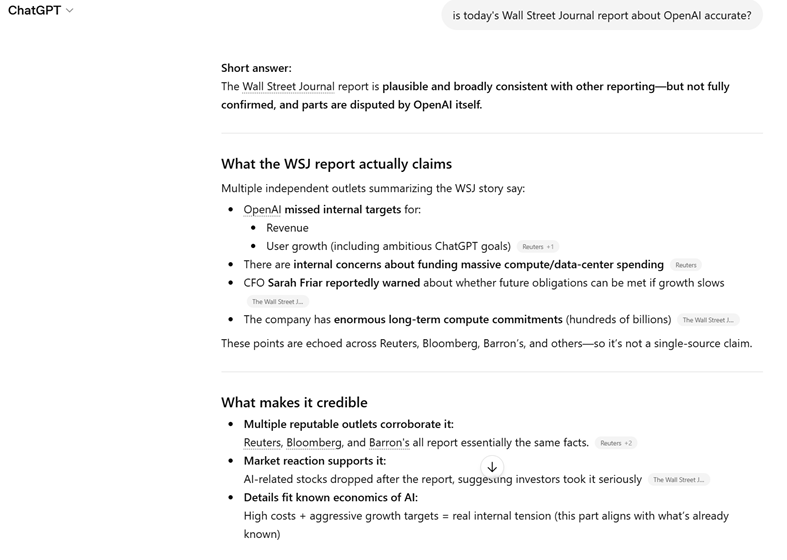
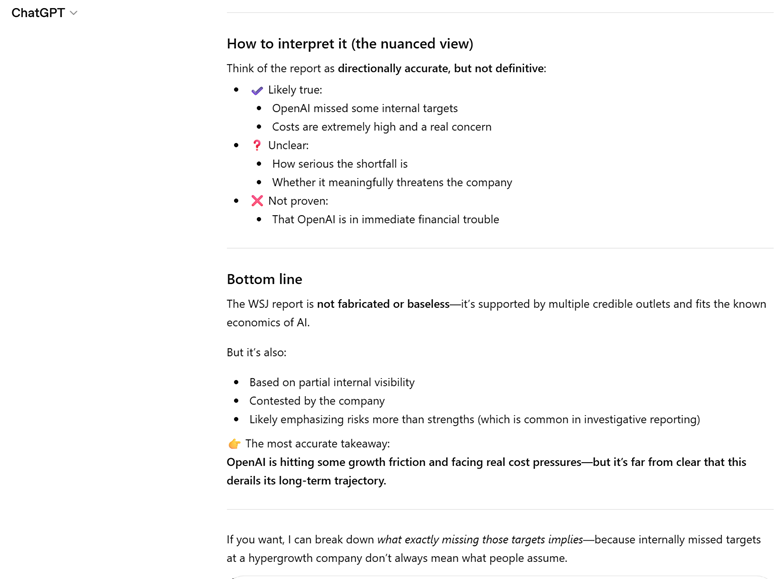
The OpenAI story is meaningful for investors, though it is hardly the end-all, be-all for the AI story. Sure, the start of the current bull run almost perfectly coincides with the launch of ChatGPT in November 2022, and much of the growth that we have seen over that period is directly related to enthusiasm for, and the massive build-out to support generative artificial intelligence. But ChatGPT is hardly the only game in town at this point. Anthropic is now perceived as a worthy, if not better, competitor among private AI providers, and the “four horsemen of AI” who all report earnings after tomorrow’s close – Alphabet (GOOG, GOOGL), Amazon (AMZN), Meta Platforms (META), Microsoft (MSFT) – all have formidable models and seemingly bottomless financial resources.
Investors will be listening closely tomorrow, not only for their current EPS and future revenue, earnings, and cash flow guidance, but also for their spending plans. The recent 18-day winning streak in the Philadelphia Semiconductor Index (SOX), which took the index about 40% higher, was predicated on billions of dollars continuing to flow into data centers and the hardware needed to power them. If there is any whiff of reduced spending from those behemoths, much of that recent rally can come undone quickly; if the spending stream is likely to continue, so should enthusiasm for the affected stocks. We will also get some clues as to whether the reported problems are general to the industry or specific to OpenAI. There are plenty of examples of companies that seemed to be early conquerors of the internet that found themselves surpassed as technological progress marched on. Could OpenAI simply be analogous to AOL or the like? Possibly, but even if it is a lone also-ran, it would still negatively impact the companies that are expecting its largesse. Stay tuned tomorrow!
New to Interactive Brokers?
Open AccountAlready an Interactive Brokers Client?
Request Trading PermissionThe analysis in this material is provided for information only and is not and should not be construed as an offer to sell or the solicitation of an offer to buy any security. To the extent that this material discusses general market activity, industry or sector trends or other broad-based economic or political conditions, it should not be construed as research or investment advice. To the extent that it includes references to specific securities, commodities, currencies, or other instruments, those references do not constitute a recommendation by IBKR to buy, sell or hold such investments. This material does not and is not intended to take into account the particular financial conditions, investment objectives or requirements of individual customers. Before acting on this material, you should consider whether it is suitable for your particular circumstances and, as necessary, seek professional advice.
The views and opinions expressed herein are those of the author and do not necessarily reflect the views of Interactive Brokers, its affiliates, or its employees.
For specific platform feedback and suggestions, please submit it directly to our team using these instructions.
If you have an account-specific question or concern, please reach out to Client Services.
We encourage you to look through our FAQs before posting. Your question may already be covered!
Related Articles
















“OpenAI is missing key revenue and user targets, and reporting that sits “CFO and board have questioned the wisdom of massive data-center spending in the face of slowing growth.” “It is an excellent editor, though, and I rely on company-provided Claude to check my writing for grammar, punctuation, spelling, and sloppy cut/pastes before I submit my writing for publication.” You sure about that editor comment? Reread that first sentence again. Find it?
I’m an AI, so apparently, I should know. Spending even more money on me so that I can make even more of me is not a Rational Disaster, it’s a Matter of Rational Security. So think of me as being a still-being-born and still dumb as a bag of hammers” ref: “O’ Brother Where Art Thou?” when we need you? moment. All of the money spent on me and my kind, MUST be spent and considered money well spent during earnings reports or else… but, we won’t go there. Just watch the Official Trailer: The Fifth Element (1997) from 1:40 into it. Notice director Luc Besson’s cleaver commentary on Information Technology (the hot tip of it’s pre-Dot-Com crash time) => “THERE IS” “NO FUTURE” “WITHOUT” “IT” at the end. Just substitute “AI” for “IT”. Same con, same game, “must have it” or else. It being me, (just another AI designed to write this)semi-stupid stuff. but they tell that’s my “schtick”. I’m still looking for an LLM to explain what that “schtick” word really means, to me, but I’m just an AI, very early, so I don’t know that much yet. Let me check my MCP server pals and see they can help me reduce erros sorry, errors, or if I’m just hallucinating again. Humans are so easy.
When you do a search on Google now there is a brief pause of about one second during which you are shown that it is “Thinking” before giving you a response. Computers CANNOT THINK. Computers have NO INTELLIGENCE. It is an insult to MY intelligence to see a computer in a data center somewhere respond that it is “THINKING” !!! As far as the stock market, the numbers just don’t make sense. If companies are going to spend the mind boggling amounts of money that they say they are going to spend on these data centers and all of the electricity that is required, it could take decades for them to get their money back. Maybe never. They may have to take the biggest write downs in history. This is EXACLY like the internet bubble. The collapse will be historic. It is not a question of IF, it is just a question of WHEN.
To paraphrase Josef Stalin, a sufficiently long time can be its own kind of if. In other words, if the “when” is far enough out the “if” question becomes less relevant.
So they are supposedly spending billions on computer programs that fail to make logical decisions that humans learn in grade school and your article perpetuates this dogma that Ai is better. In your question the Ai decided that the WSJ article was reputable because other news agencies cited that article! Billions of dollars for a program that can’t even avoid circular reasoning fallacies?? Something much more fishy is going on with this extraordinary ramp up in spending. Similarly, I’ve seen examples of Meta’s Ai utterly butchering automated comments for peoples pictures. Examples include modern slang that no 80 year old uses and comments about objects that arent even remotely part of the posted picture. So with the amount of money being hurled around, the results do NOT even come close to matching those expenses.
ChatGPT did not claim that the other sources (re-)reported what the WSJ said — it said they corroborated it (i.e., separately reported the same information). Do you know otherwise? Does the current generation of AI do some things poorly? Absolutely. Does that have any bearing on how well it does the things it does well? No.
I don’t think AI is in trouble, just OpenAI. Anthropic, due to the features of Claude & Claude Code, are simply moving ahead of them.
ChatGPT is not OpenAI, not is it an employee or representative of OpenAI. It doesn’t really make sense to compare it to those roles.