
- Solve real problems with our hands-on interface
- Progress from basic puts and calls to advanced strategies
Interactive Options Course

Posted November 20, 2025 at 12:18 pm
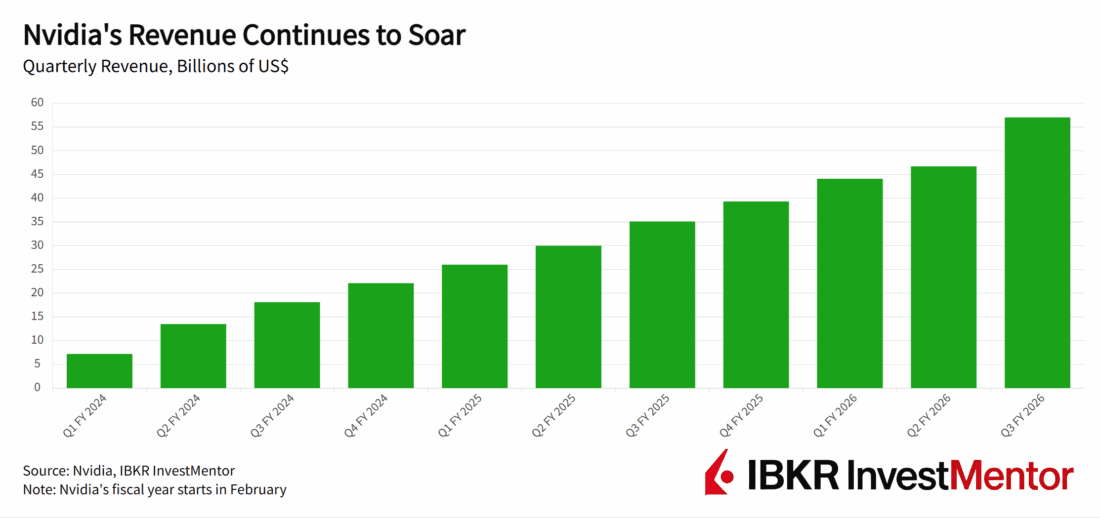
Nvidia’s latest earnings underline its extraordinary market position: fiscal third‑quarter revenue of $57 billion, up 62% year-on-year, and net income of around $32 billion. Revenue guidance for $65 billion in the final quarter surprised even many bullish analysts, sending shares higher.
Behind the blockbuster results lies the question: how has Nvidia, of all companies, emerged as the world’s most valuable public firm and the architect of the global AI boom.
Nvidia doesn’t run chip factories. Taiwanese TSMC manufactures its chips, while Dutch ASML supplies the lithography tools. Both are indispensable in the chip supply chain. Yet they sit on the lower‑margin side of it.
Nvidia owns the architecture and the customer relationships, which is where value concentrates. Its GPUs are paired with CUDA, a programming layer Nvidia has quietly been building since 2006. It has become the standard for AI development. Developers write for CUDA, not for “GPUs in general,” making Nvidia’s hardware the default choice.
Switching to AMD or Intel would require rewriting code and retraining engineers — a costly slowdown. Nvidia isn’t just selling chips; it’s selling the entire AI infrastructure system. Owning the software layer makes Nvidia’s moat deeper than hardware alone.
That turns Nvidia from a chip vendor into the owner of the AI “operating system”, capturing margins above 70%, levels unheard of in semiconductors. Historically, the biggest profits go to whoever controls the standard — think Windows in the 1990s or iOS in the 2010s.
Microsoft, Alphabet, Meta, and Amazon are locked in an arms race to build the most capable models, pouring billions into data centers.
Regardless of who wins, Nvidia profits. Demand for its high‑end chips is currently so intense that customers pay almost any price.
CEO Jensen Huang described demand for the new Blackwell systems as “off the charts.” Nvidia’s role is less about choosing sides and more about supplying the technology. Its fortunes could rise as long as the race continues.

Nvidia’s story is not risk‑free, especially at a sky-high valuation. More than 60% of Nvidia’s revenue depends on just four clients, likely the usual suspects from big tech. This leaves Nvidia exposed to their budgets and strategies.
Nvidia’s key customers are not happily paying huge margins for Nvidia’s semiconductors. Alphabet has already designed its own, and Microsoft and Amazon are preparing their chips too — aiming to reduce reliance on Nvidia’s stack over time.
Circular investments in partners like OpenAI and Anthropic blur independence and complicate demand signals. Nvidia is also spending billions renting back its own GPUs through partner companies, raising questions about how much of the demand is organic versus financed.
For now, scarcity, software, and scale explain Nvidia’s extraordinary valuation. But whether this marks a lasting transformation or the peak of a bubble remains the debate investors cannot ignore.
To learn more about stock investing, download IBKR InvestMentor app. No jargon, just practical lessons for aspiring investors.


Learn more about InvestMentor
Information posted on IBKR Campus that is provided by third-parties does NOT constitute a recommendation that you should contract for the services of that third party. Third-party participants who contribute to IBKR Campus are independent of Interactive Brokers and Interactive Brokers does not make any representations or warranties concerning the services offered, their past or future performance, or the accuracy of the information provided by the third party. Past performance is no guarantee of future results.
This material is from IBKR InvestMentor, an affiliate of Interactive Brokers LLC, and is being posted with its permission. The views expressed in this material are solely those of the author and/or IBKR InvestMentor and Interactive Brokers is not endorsing or recommending any investment or trading discussed in the material. This material is not and should not be construed as an offer to buy or sell any security. It should not be construed as research or investment advice or a recommendation to buy, sell or hold any security or commodity. This material does not and is not intended to take into account the particular financial conditions, investment objectives or requirements of individual customers. Before acting on this material, you should consider whether it is suitable for your particular circumstances and, as necessary, seek professional advice.
Related Articles


















Join The Conversation
For specific platform feedback and suggestions, please submit it directly to our team using these instructions.
If you have an account-specific question or concern, please reach out to Client Services.
We encourage you to look through our FAQs before posting. Your question may already be covered!