
- Solve real problems with our hands-on interface
- Progress from basic puts and calls to advanced strategies
Interactive Options Course

Posted February 19, 2026 at 1:10 pm
Weaker-than-expected forward guidance from retail juggernaut Walmart combined with growing uncertainty related to potential military action in Tehran is hurting markets today. Stocks are surrendering some of yesterday’s gains after the largest US retailer expressed concerns about worker availability, input costs and tariff policies, which added a dose of skepticism to the buoyant economic outlook. Meanwhile, recently released hawkish Fed minutes alongside jumping oil prices are weighing modestly on the Treasury complex. Certain officials were open to hiking if cost pressures fail to cooperate, and that’s raising the short end of the curve, while heavier inflation expectations derived from Middle East angst are curbing the recent advance in duration. A five-week low in unemployment claims signaling stable labor conditions also dampened rate-cut prospects, even as pending home sales took another dive to a 12-month low, with subdued inventories, lofty values, restrictive mortgages and immigration restrictiveness hampering residential real estate deals. Lumber, a critical building material, is down as a result of worsening construction projections, even as all the other commodity majors appreciate. Elsewhere, the greenback is progressing, volatility levels are ticking higher, crypto is mixed and forecast contracts are catching bids.
Unemployment claims remained in the safe zone throughout the past two weeks as employers continued to express limited desire to shrink headcounts. Initial filings dropped to 206k during the week ended Jan. 14, the lowest in the past five prints, and well below the median estimate of 225k and the prior period’s 229k. Continuing applications rose slightly, however, to 1.869 million, above the expected 1.860 million and the previous interval’s 1.852 million. Four-week moving averages were quite flat on both fronts at 219k and 1.845 million compared to the preceding results of 220k and 1.844 million.

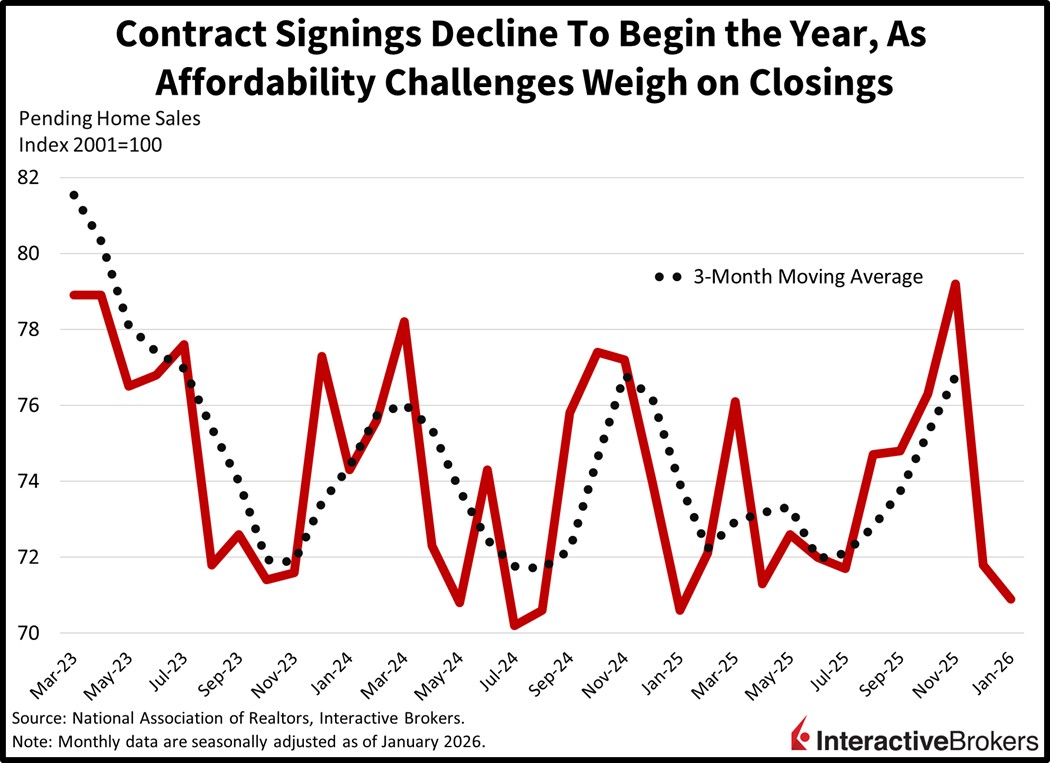
Inventory challenges, lofty valuations, heavy mortgage rates and immigration restiveness continue to weigh on real estate sales. Contract signings for homes dove to a 12-month low to start the year, dropping 0.8% month-over-month (m/m), a much worse result than the 1.3% increase projected. The subtraction was much shallower, however, when compared to the 7.4% drop in December. Despite the headline weakness, the Midwest and South regions saw expansions of 5% and 4.5% m/m, but those positives weren’t enough to offset contractions of 5.7% and 4.3% in the Northeast and West. There is an expectation that a move below 6% on the 30-year fixed will bring prospective buyers off the sidelines although challenging supply conditions may bolster price growth in that scenario, as one solution potentially generates the resurgence of an equity lift, which would be a separate problem.
Hawkish comments from Fed officials released yesterday from policymakers’ last meeting and mounting geopolitical tensions between Washington and Tehran have weighed on Treasury performance in the past few days. The potential for the central bank to reverse from easing towards tightening, as certain committee members alluded to, has quelled fixed-income enthusiasm as it relates to three cuts in 2026 and lifted yields on the shorter tenors as a result. Duration has faced the headwind of rising oil prices in light of a possible dispute in the Middle East leading to disruptions in energy supplies, which has prevented the 10-year from dropping below the psychologically important 4% level. But with new Chair Kevin Warsh set to take the helm of the monetary policy institution this summer, inflation in the low 2s, the federal deficit shrinking and risks of labor market slowing, there’s a lot of room for bonds to gain from here and outperform stocks. Equities, meanwhile, are poised to benefit from a reaccelerating economy, however, the sluggish mood on Wall Street after three years of spectacular gains point to a valuation adjustment in 2026, as broadening participation is likely to fail to offset waning appetites for AI capital expenditures amidst heavy index concentration in the Magnificent Seven names.
Breakneck demand for AI products and electric vehicles has helped South Korea generate a strong year-over-year (y/y) increase in exports, but the country’ January trade surplus nevertheless sank from $12.17 billion in December to $8.72 billion, narrowly missing the economist consensus estimate of $8.74 billion. On a y/y basis, however, the country’s exports leaped 33.8%, just a tad below the estimate of 33.9%. In December, the value of exports was up 13.3%. January’s success was driven, in larger part, by a stellar 102.7% gain in semiconductor exports for AI. Purchases of memory chips, furthermore, strengthened. Also, during the first month of the year, strong demand for electric vehicles and hybrid cars pushed automobile exports up 21.7%. It was the second-highest level for any January.
Meanwhile, purchases of foreign items were 11.6% higher than in the year-ago period, a tad below the estimate of 11.7% but up considerably from the 4.6% y/y gain in December.
Australia’s payrolls grew by 17.8k in January, missing the economist consensus estimate of 20k and decelerating from 68.5k in December but the unemployment rate remained unchanged at 4.1%. Economists anticipated that the rate would rise to 4.2%. Regarding payrolls, the number of full-time wage earners grew by 50,500 to 10,155,500 while part-timers declined by 32,700 to 4,548,400. The participation rate, or the portion of working age individuals either working or seeking work, remained unchanged at 66.7%.
Canada’s trade deficit shrank from $2.59 billion in November to $1.31 billion in the final month of 2025, a better result than the $2.1 billion shortfall anticipated by economists. December exports climbed from $63.95 billion in December to $65.63 billion with the value of goods shipments up 2.6% while imports grew from $66.53 billion to $66.93 billion.
Tomorrow’s Core PCE Price Index, the Fed’s preferred inflation gauge, is expected to reflect an increase of 2.8% according to the Interactive Brokers prediction market. At the moment, there are 87%, 33% and 8% odds of a number north of 2.7%, 2.8% or 2.9%, as well as 90%, 60% and 13% chances of a figure that fails to exceed 2.9%, 2.8% or 2.7%.
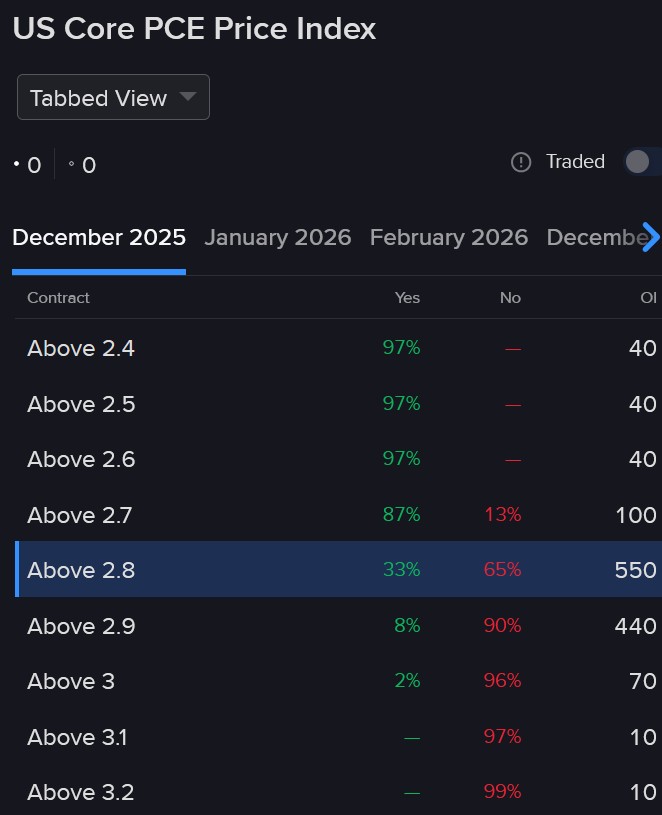
Source for image: ForecastEx.
Note: Prices are highest bids as of the morning of Feb. 19, 2026.
To learn more about ForecastEx, view our Traders’ Academy video here
New to Interactive Brokers?
Open AccountInformation posted on IBKR Campus that is provided by third-parties does NOT constitute a recommendation that you should contract for the services of that third party. Third-party participants who contribute to IBKR Campus are independent of Interactive Brokers and Interactive Brokers does not make any representations or warranties concerning the services offered, their past or future performance, or the accuracy of the information provided by the third party. Past performance is no guarantee of future results.
This material is from IBKR Macroeconomics, an affiliate of Interactive Brokers LLC, and is being posted with its permission. The views expressed in this material are solely those of the author and/or IBKR Macroeconomics and Interactive Brokers is not endorsing or recommending any investment or trading discussed in the material. This material is not and should not be construed as an offer to buy or sell any security. It should not be construed as research or investment advice or a recommendation to buy, sell or hold any security or commodity. This material does not and is not intended to take into account the particular financial conditions, investment objectives or requirements of individual customers. Before acting on this material, you should consider whether it is suitable for your particular circumstances and, as necessary, seek professional advice.
Interactive Brokers LLC is a CFTC-registered Futures Commission Merchant and a clearing member and affiliate of ForecastEx LLC (“ForecastEx”). ForecastEx is a CFTC-registered Designated Contract Market and Derivatives Clearing Organization. Interactive Brokers LLC provides access to ForecastEx Forecast Contracts for eligible customers. Interactive Brokers LLC does not make recommendations with respect to any products available on its platform, including those offered by ForecastEx.
This is commentary on economic, political and/or market conditions within the meaning of CFTC Regulation 1.71, and is not meant provide sufficient information upon which to base a decision to enter into a derivatives transaction.
Trading in digital assets, including cryptocurrencies, is especially risky and is only for individuals with a high risk tolerance and the financial ability to sustain losses. Eligibility to trade in digital asset products may vary based on jurisdiction.
Related Articles

















Join The Conversation
For specific platform feedback and suggestions, please submit it directly to our team using these instructions.
If you have an account-specific question or concern, please reach out to Client Services.
We encourage you to look through our FAQs before posting. Your question may already be covered!