
- Solve real problems with our hands-on interface
- Progress from basic puts and calls to advanced strategies
Interactive Options Course

Posted October 1, 2025 at 12:48 pm
Several hours after the government officially shut down, investors grew worried that a prolonged standoff could weigh on consumer spending and labor conditions. With Republicans and Democrats remaining at odds over healthcare issues, President Trump is threatening to permanently dismiss certain employees of specific agencies to reduce federal outlays, an endeavor reminiscent of Tesla CEO Elon Musk’s goals of pursuing efficiency and lowering expenditures in the earlier days of the administration. The slowdown concerns drove stocks deep into the red in early trading, but participants are aggressively buying the dip, pushing equities to modest gains, as traders replace Capitol Hill anxiety with monetary policy easing enthusiasm. Driving expectations of a looser Fed was ADP signaling the sharpest job losses in 30 months, which retreated further after August’s decrease and extended the momentous Treasury rally that began last night. Indeed, Washington angst and payroll reductions are leading fixed-income watchers to pencil in cuts in October and December with 90% confidence and that’s generating a fierce bull-steepening move across the yield curve, as the shorter tenors lead the aggressive descent. Cheaper borrowing costs are contributing to a depreciating greenback though, while crude oil, lumber and copper commodities experience lighter prices. Bitcoin is soaring, meanwhile, and forecast contracts are catching interest as well. Silver, natural gas and gold are also higher, and volatility protection instruments, which saw strong bids close to the opening bell, are experiencing declining premiums at the moment, as hedging demand has dissipated throughout the session.
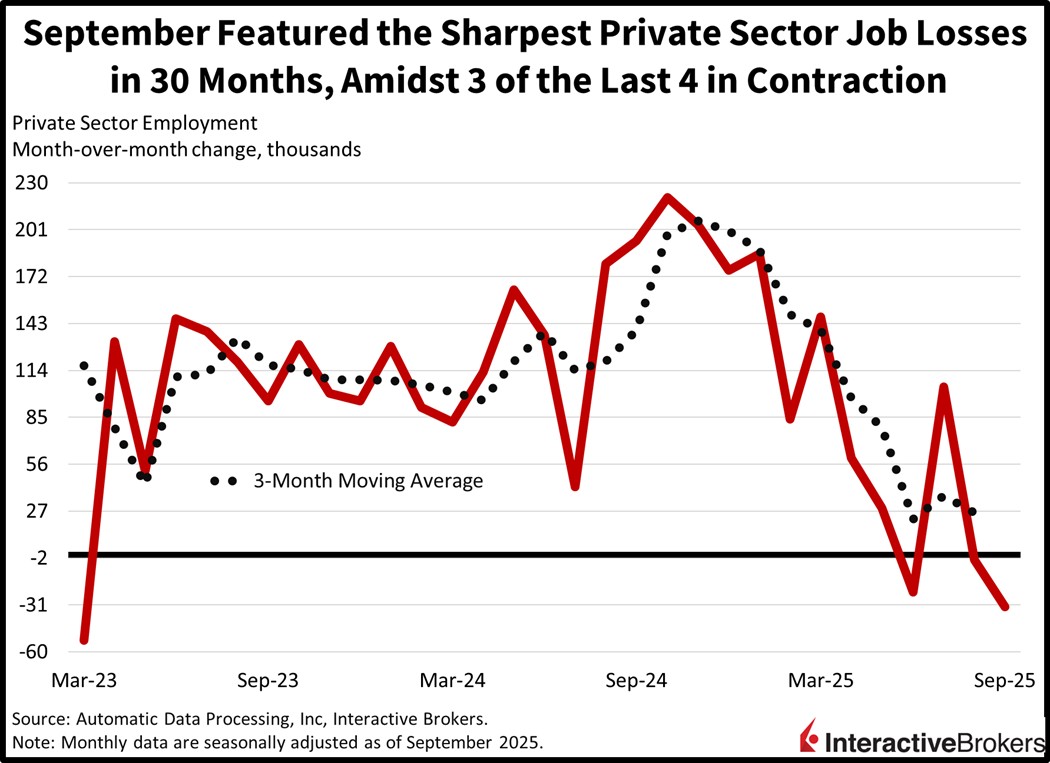
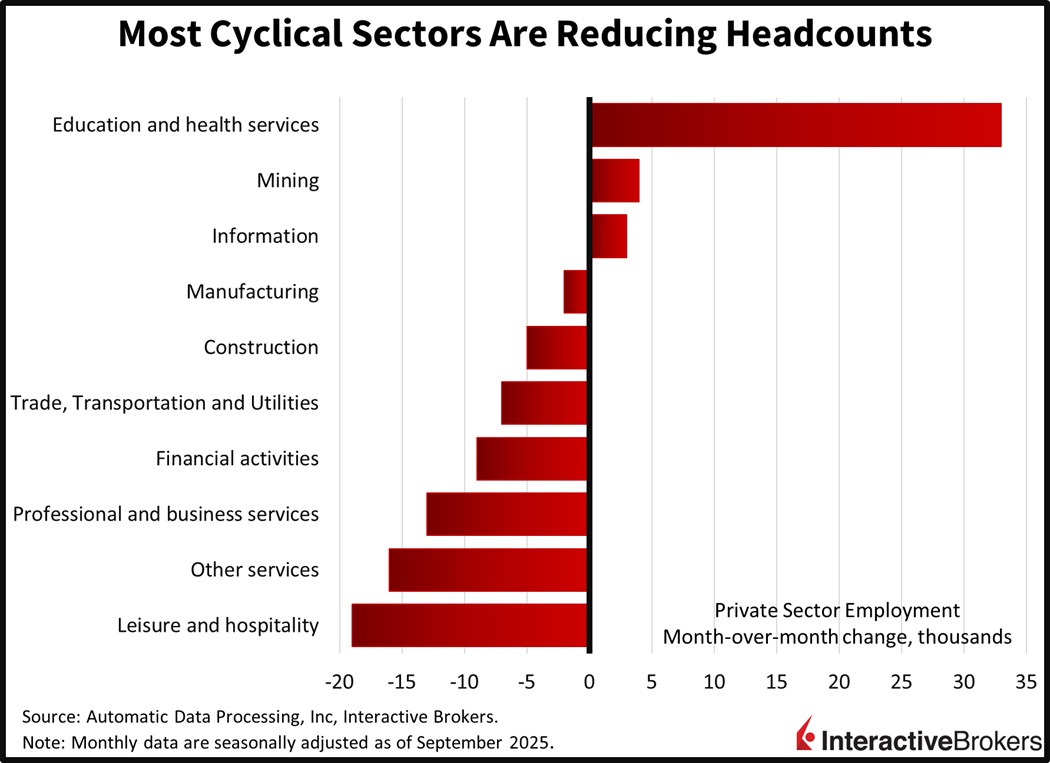
The US private sector lost jobs in September, the third month of contraction during the past four. The 32k drop in payrolls, the sharpest since March 2023, was much weaker than the expected 50k expansion and worse than August’s 3k decrease. Economically sensitive areas led the headline miss. Sectors that lost positions and the amount of the changes were as follows:
The non-cyclical education/health services segment offset some of the weakness with a 33k gain, while information and mining increased by 4k and 3k. Similarly, small and mid-sized establishments, which have rosters below 49 employees and between 50 and 499 workers, lost 40k and 20k, but large firms, which are less vulnerable to shifts in activity, grew by 33k. Meanwhile, compensation trends shifted in bifurcated fashion, as the median year-over-year (y/y) change in annual pay dropped from 7.1% to 6.6% for employment changers, while climbing from 4.4% to 4.5% for stayers.
The manufacturing sector contracted for the seventh consecutive month as weak ordering and employment declines continued to weigh on conditions. The Institute for Supply Management’s (ISM) September Purchasing Managers’ Index, at 49.1, narrowly beat the median estimate of 49 and climbed from 48.7 in August. Still, it failed to exceed the contraction-expansion threshold of 50. Backlogs, exports, imports, and inventories also hurt results, but production posted a 51 figure, although the improvement was not supported by transaction volumes, which were soft. Price pressures remained elevated; however, they decelerated from 63.7 to 61.9.
My call for a second-half reacceleration hit a hurdle this morning with the one-two punch of a government shutdown amidst the heaviest payroll job losses in two and a half years. While an odd combination of strengthening consumer expenditures coinciding with a weakening labor market has manifested in the past few months, today’s developments spark concerns of a slowdown. But the most significant variable at play relates to how lengthy the government funding lapse will be. Having Washington closed for seven days or less wouldn’t be too damaging, although a longer standoff would begin to materially weigh on household sentiment, personal outlays and employment conditions, which are already fragile. Another drawback may arrive from an uptick in general uncertainty, which could create risks of shoppers curtailing their spending, businesses delaying investment decisions and investors relaxing their enthusiasm. For now, however, soaring odds of an increasingly accommodative Federal Reserve are offsetting unemployment worries as Wall Street bets that the central bank can come to the rescue with deep cuts and save the jobs picture just in time.
Euro area inflation in September matched July’s pace of 0.1% on a month over month (m/m) basis, but the y/y metric accelerated, according to the Harmonized Index of Consumer Prices (HICP). For September, the gauge was up 2.2% y/y compared to 2% in August. It matched the economist consensus estimate.
When excluding energy, food, alcohol and tobacco, the HICP was up 0.1% m/m and 2.3% y/y. The major components of the headline index recorded the following y/y changes:
Sentiment among Japanese goods producers during the third quarter strengthened in response to easing fears about US tariffs, according to the Tankan indices. The organization, however, found little, if any change, among service providers. For the quarter ended in September, the Large Manufacturers Index climbed to 14, up one point from the second-quarter print and in-line with the economist consensus estimate. The Small Manufacturers gauge, with a result of 1, was unchanged from the second quarter and lower than the economist estimate of 2.
Within the services sector, the Large Non-Manufacturers Index, at 34, was one point higher than the consensus estimate but unchanged from the second quarter. The Small Non-Manufacturers Index, however slipped from 15 to 14.
New to Interactive Brokers?
Open AccountInformation posted on IBKR Campus that is provided by third-parties does NOT constitute a recommendation that you should contract for the services of that third party. Third-party participants who contribute to IBKR Campus are independent of Interactive Brokers and Interactive Brokers does not make any representations or warranties concerning the services offered, their past or future performance, or the accuracy of the information provided by the third party. Past performance is no guarantee of future results.
This material is from IBKR Macroeconomics, an affiliate of Interactive Brokers LLC, and is being posted with its permission. The views expressed in this material are solely those of the author and/or IBKR Macroeconomics and Interactive Brokers is not endorsing or recommending any investment or trading discussed in the material. This material is not and should not be construed as an offer to buy or sell any security. It should not be construed as research or investment advice or a recommendation to buy, sell or hold any security or commodity. This material does not and is not intended to take into account the particular financial conditions, investment objectives or requirements of individual customers. Before acting on this material, you should consider whether it is suitable for your particular circumstances and, as necessary, seek professional advice.
Futures are not suitable for all investors. The amount you may lose may be greater than your initial investment. Before trading futures, please read the CFTC Risk Disclosure. A copy and additional information are available at ibkr.com.
Trading in digital assets, including cryptocurrencies, is especially risky and is only for individuals with a high risk tolerance and the financial ability to sustain losses. Eligibility to trade in digital asset products may vary based on jurisdiction.
Related Articles















Join The Conversation
For specific platform feedback and suggestions, please submit it directly to our team using these instructions.
If you have an account-specific question or concern, please reach out to Client Services.
We encourage you to look through our FAQs before posting. Your question may already be covered!