
- Solve real problems with our hands-on interface
- Progress from basic puts and calls to advanced strategies
Interactive Options Course

Posted August 11, 2026 at 1:19 pm
Treasuries are recovering from yesterday’s losses after Pakistan disclosed that the US and Iran are nearing an agreement concerning the Strait of Hormuz. The remarks are providing only a modest effect on Wall Street as bonds are benefiting separately from a deceleration in ADP’s weekly hiring numbers and a slower pace of existing home sales. Conversely, fixed-income gains are being limited by oil prices rising slightly and to a lesser extent by a beat on small business sentiment as supply concerns triggered by the Middle East conflict are still prevalent despite Islamabad expressing optimism about the two countries potentially striking an accord. Investors have been awaiting a deal for a few weeks, and tangible progress is likely required for yields to fall significantly and stocks to rally further at this juncture. As a result of the ongoing tensions, equities are trading south against the backdrop of a complicated geopolitical situation, although 5 of the 11 principal sectors are advancing today. Elsewhere, the greenback, cryptocurrencies and volatility protection instruments are unchanged, non-energy commodities are slipping and prediction markets are catching bids.
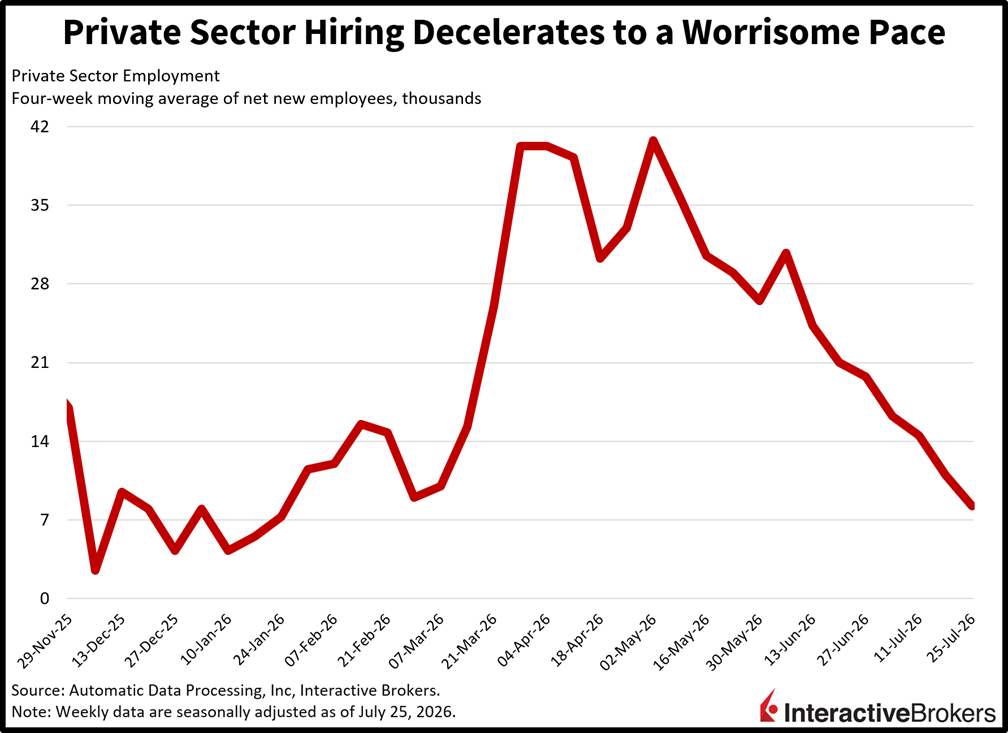
Private-sector hiring decelerated to an even more worrisome pace at the end of July, according to this morning’s update from ADP, which marked the seventh consecutive period of slower payroll gains. Indeed, the 8.3k headline figure that depicts the average roster increases in each of the four weeks during the period that ended July 25 was the weakest since January. The ongoing sluggishness raises the risk that job losses could become more common and pronounced, similar to last Friday’s nonfarm payrolls report.
Existing home sales sank in July, the second straight monthly contraction because high and rising mortgage rates alongside the 37th consecutive month of year-over-year (y/y) price increases worsened affordability. The 4.06 million seasonally adjusted annualized units (SAAU) marked a 1.7% month-over-month (m/m) decline from June’s 4.13 million but arrived slightly above the expected 4.05 million. The weakness was driven by single-family, which declined 1.9% m/m while the cooperative/condominium segment was unchanged. Among regions, the South and West slipped 3.1% and 2% m/m, the Midwest was flat and the Northeast rose 2% during the period. Valuations gained 2% y/y while inventories were down 1.9% m/m and 0.6% y/y, presenting an asset class with heavier costs amidst less availability.

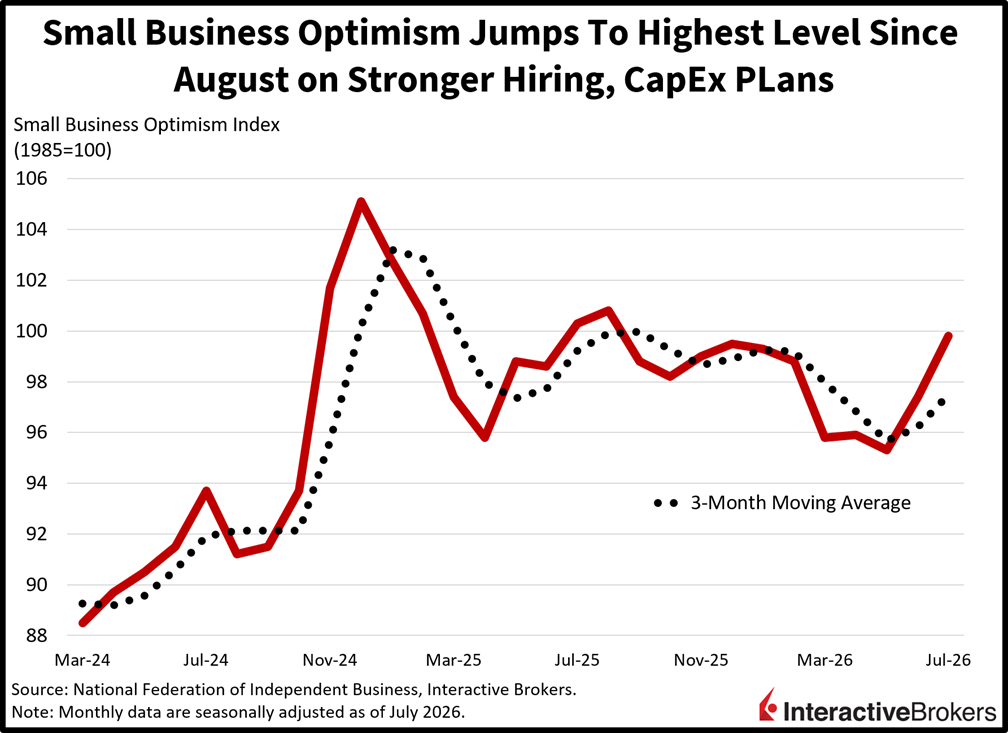
Small business sentiment jumped to its strongest level since last August as firms reported stronger hiring and capital expenditure appetites amidst a favorable economic backdrop. The July result of 99.8 surpassed both the forecast for 97.5 and June’s 97.4, as plans to increase employment, expand operations and growing inventories supported a better outlook. Additionally, improving earnings and more job openings bolstered performance. Meanwhile, when survey respondents were asked about their most-important problem, 27% said quality of labor, 16% cited taxes and 14% mentioned inflation.
Core inflation could post a 63-month low tomorrow if it comes in slightly below expectations at 2.4%, which is emblematic of how cooling cost pressures are being masked by geopolitical tensions. Indeed, the headline Consumer Price Index (CPI) is projected to come in almost 1% north of its version that excludes food and energy, and the wide difference signals the significant disinflationary progress that would ensue if President Trump can strike a lasting Middle East peace deal. In my view, a resolution to the grapple will quickly remove rate hikes from the conversation, as the Fed’s 2% target would be within arm’s reach by year-end and the focus would rapidly turn to sparing the labor market from further deterioration. Meanwhile, with core inflation already in the mid 2s and the overall figure potentially getting there in a few months, buying Treasuries with a 5+ coupon presents an attractive risk-reward possibility that could pay off heavily, in my opinion, from a US-Iran agreement or from more job losses. Finally, yields can’t go much higher from here as they’ll cure themselves because loftier rates would cause slowdown risk to be increasingly considered across the curve.
The Reserve Bank of Australia held its current key interest rate at 4.35% this morning and explained that the disruption in the global oil supply is adding directly to inflation and that the higher costs of energy and other inputs are being passed onto to customers through higher prices. These price pressures, therefore, are likely to remain high for some time. Economists anticipated that the central bank would maintain its current key rate. Inflation during the 12 months to June fell from 4% in the preceding period to 3.8%, according to the Australian Bureau of Statistics. With the print substantially exceeding the central bank’s 2% to 3% goal, policymakers are focused on preventing excessive price pressures from becoming embedded in the economy. To achieve that goal, aggregate demand growth needs to remain subdued to ease capacity pressures. The central bank also noted that financial conditions have tightened and the economy appears to be decelerating as expected.
The NAB Business Confidence gauge fell 1 point to -6 in July, a reversal from three months of gains with Middle East uncertainty and higher oil price volatility hurting sentiment, according to the National Australia Bank. A 1-point improvement in profitability and a 2-point gain in employment, nevertheless, pushed the business climate indicator from 3 to 4. The survey also found that capacity utilization rose 0.9 points to 83%, but forward orders retreated 3 points to -3 and overall activity slowed from the start of the year.
Singapore’s second-quarter gross domestic product (GDP) climbed 1.4% quarter over quarter (q/q), which exceeded the economist consensus estimate for a 1.1% expansion and the preceding period’s positive 1.2% result, according to the Ministry of Trade and Industry (MTI). On y/y basis, the MTI updated its preliminary estimate of 5.7% to 5.9%. The quarterly y/y pace moderated from 6.3% in the first quarter but was still stronger than economists’ expectations for a 5.7% rate. In announcing the result, the Ministry also upgraded its 2026 GDP estimate. It now anticipates growth in the 4.5%-5% range. It previously forecasted an expansion of 2%-4%.
New to Interactive Brokers?
Open AccountInformation posted on IBKR Campus that is provided by third-parties does NOT constitute a recommendation that you should contract for the services of that third party. Third-party participants who contribute to IBKR Campus are independent of Interactive Brokers and Interactive Brokers does not make any representations or warranties concerning the services offered, their past or future performance, or the accuracy of the information provided by the third party. Past performance is no guarantee of future results.
This material is from IBKR Macroeconomics, an affiliate of Interactive Brokers LLC, and is being posted with its permission. The views expressed in this material are solely those of the author and/or IBKR Macroeconomics and Interactive Brokers is not endorsing or recommending any investment or trading discussed in the material. This material is not and should not be construed as an offer to buy or sell any security. It should not be construed as research or investment advice or a recommendation to buy, sell or hold any security or commodity. This material does not and is not intended to take into account the particular financial conditions, investment objectives or requirements of individual customers. Before acting on this material, you should consider whether it is suitable for your particular circumstances and, as necessary, seek professional advice.
Related Articles


















Join The Conversation
For specific platform feedback and suggestions, please submit it directly to our team using these instructions.
If you have an account-specific question or concern, please reach out to Client Services.
We encourage you to look through our FAQs before posting. Your question may already be covered!