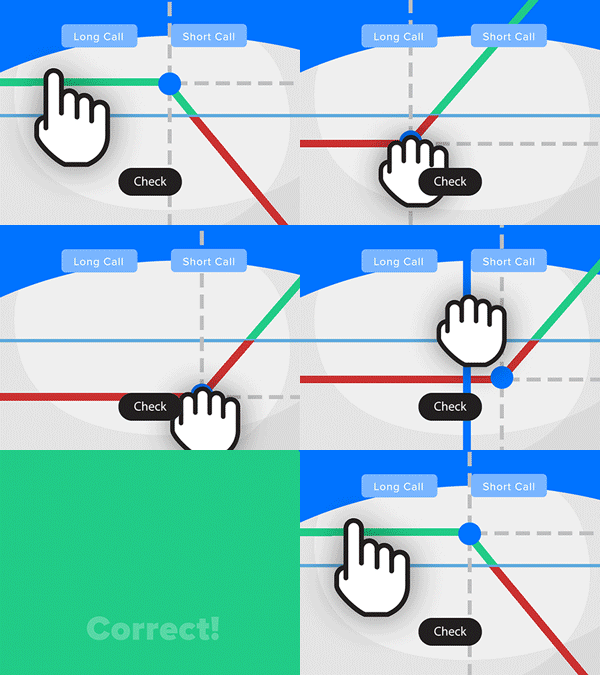
- Solve real problems with our hands-on interface
- Progress from basic puts and calls to advanced strategies
Interactive Options Course

Posted September 10, 2026 at 1:32 pm
The global bond market meltdown is intensifying today after a hotter-than-anticipated PPI coincided with WTI crude jumping to a three-month high of nearly $103. The upside surprise on wholesale inflation was almost entirely due to heavier fuel costs, and there’s no expectation for a reprieve anytime soon with Washington and Tehran appearing committed to ongoing physical aggression. President Trump even communicated that he doesn’t expect relief at the pump until the midterm elections are behind us, effectively signaling a prolonged battle with the Persian country. Fiscal concerns are additionally weighing on the Treasury complex because of worries of excessive military expenditures and separately, the US head of state announced that all adult citizens would receive a $5,000 dividend check if the Republicans win a majority in both chambers of Congress this November, a proposal that would cost roughly $1.2 trillion. Yields are responding by leaping to their highest levels in decades for the 20- and 30-year maturities, while 10s climb closer to a frightening 5-handle, a number last reached 35 months ago. Nevertheless, the curve is rising in bear-flattening fashion with the monetary policy sensitive short-end suffering the sharpest losses, as the odds of a Fed hike in six days have soared to 70%, which is strengthening the greenback while derailing non-energy commodities and cryptocurrencies. A hawkish 25-bp increase from the ECB paired with subdued US unemployment claims dished out additional pain to fixed-income assets.
The increasingly restrictive liquidity environment amidst soaring oil prices has US stocks marching toward a fourth consecutive session of declines, with the four major equity benchmarks, all sectors and sub-categories retreating minus consumer staples and communication services. As a result, investors are adding hedges as premiums on volatility protection instruments jump, and participants are also engaging with prediction markets. Contracts regarding tomorrow’s CPI and next week’s Fed rate decision are generating particularly vibrant trading.
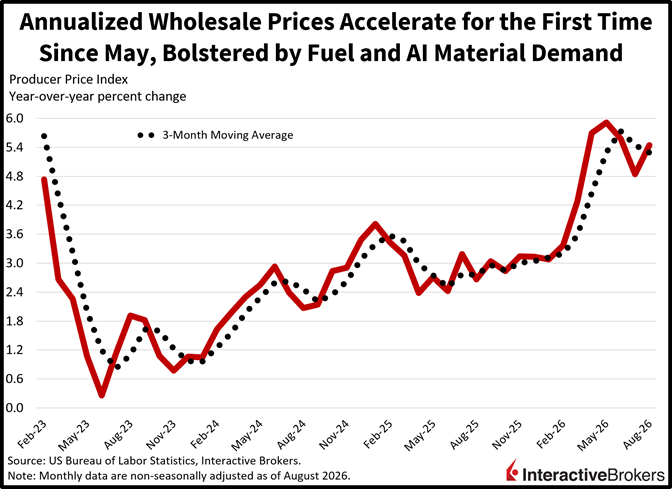
Annualized wholesale inflation accelerated for the first time since May last month, as jumping fuel costs and to a lesser extent heavy demand for AI materials drove an upside beat. August’s Producer Price Index (PPI) rose 0.4% month over month (m/m) and 5.4% year over year (y/y), arriving in-line on the former but coming in ahead of the 5.3% median estimate on the latter. The results were much worse than July’s 0.1% and 4.8%. Energy and transportation/warehousing services were the categories that generated the lift, as they soared 4.2% and 2.3% m/m. Core goods, which exclude food and energy, became 0.4% more expensive m/m, while food saw a 0.1% increase. Conversely, other services were flat while trade services got 0.2% cheaper during the period. The return to a 5-handle is emblematic of the existing risk that consumer cost gauges could soar back to 4% if geopolitical developments don’t cool soon, justifying multiple rate hikes from the Fed at that point.
Existing home sales fell to a 14-month low in August while inventory levels swelled to their loftiest territory in more than a decade, as elevated valuations and rising mortgage rates widened the bid-ask spread between buyers and sellers. The transaction pace plunged 2% m/m to 3.98 million seasonally adjusted annualized units from 4.06 million; however, the result matched expectations. The Northeast, Midwest and South experienced m/m declines of 4%, 3.1% and 1.6%, although the Western region was unchanged. The median closing price was $429.1k, a 1.6% year-over-year (y/y) increase, while the months’ supply indicator soared to 4.9 from 4.6, its greatest figure in more than 10 years.

Unemployment claims remained subdued in the past two weeks as labor conditions continue to signal stability. Initial and continuing filings were little changed, coming in at 206k and 1.774 million, compared to the 207k and 1.775 million from the prior period and the median expectations of 205k and 1.780 million. Four-week moving averages fell on both fronts, sinking to 206k and 1.779 million from 207.5k and 1.781 million in the previous interval.

Fighting Iran is overwhelming Washington’s bond buyback efforts as soaring inflation expectations are too much of a burden that a mere $6 billion in repurchases can’t offset. The White House and the Treasury itself want lower interest rates, but intensifying its clash with Tehran is proving adverse for oil price stability and the country’s budget, because the violent attacks in the region are disrupting crude supplies while widening the fiscal shortfall, all else equal, via heavier military expenditures. Furthermore, it places Fed Chair Kevin Warsh between a rock and a hard place, as the fixed-income complex is effectively demanding that the committee hike to quell these accelerating pricing forces. Indeed, the monetary policy sensitive 2-year yield, at 4.55%, is more than 100 basis points (bps) north of the bottom of the US central bank’s target range. This large spread illustrates that the vigilantes are punishing the government and the Fed for tolerating well above-objective cost pressures for an unacceptably prolonged period amidst a Middle East conflict and a national deficit that are offering no light at the end of their respective tunnels.
Bonds in Europe sold off this morning after the monetary policy authority for countries that use the euro justified its widely expected rate hike—its second of the year—by warning that the Middle East conflict and the Ukraine-Russia war have created a path for energy prices to soar. After raising the benchmark from 2.25% to 2.5%, the European Central Bank said it anticipates that inflation will stay well above its 2% target for an extended period. In August, the Consumer Price Index (CPI) was up 3.3% y/y, roughly a three-year high.
Consumers’ inflation expectations this month remained unchanged from August’s 4.9% outlook, according to the Melbourne Institute. The print, which is based on the trimmed mean, is below April’s spike but is no longer falling after it had eased in the May through July period. The 4.9% outlook, nevertheless, is still considerably higher than in the year-ago period. Consumers this month also said they expect year-ahead pay growth of 1.2%.
New to Interactive Brokers?
Open AccountInformation posted on IBKR Campus that is provided by third-parties does NOT constitute a recommendation that you should contract for the services of that third party. Third-party participants who contribute to IBKR Campus are independent of Interactive Brokers and Interactive Brokers does not make any representations or warranties concerning the services offered, their past or future performance, or the accuracy of the information provided by the third party. Past performance is no guarantee of future results.
This material is from IBKR Macroeconomics, an affiliate of Interactive Brokers LLC, and is being posted with its permission. The views expressed in this material are solely those of the author and/or IBKR Macroeconomics and Interactive Brokers is not endorsing or recommending any investment or trading discussed in the material. This material is not and should not be construed as an offer to buy or sell any security. It should not be construed as research or investment advice or a recommendation to buy, sell or hold any security or commodity. This material does not and is not intended to take into account the particular financial conditions, investment objectives or requirements of individual customers. Before acting on this material, you should consider whether it is suitable for your particular circumstances and, as necessary, seek professional advice.
Futures, event contracts, and forecast contracts are not suitable for all investors. Before trading these products, please read the CFTC Risk Disclosure. For a copy, visit our Warnings and Disclosures Page.
Trading in digital assets, including cryptocurrencies, is especially risky and is only for individuals with a high risk tolerance and the financial ability to sustain losses. Eligibility to trade in digital asset products may vary based on jurisdiction.
Related Articles
















Join The Conversation
For specific platform feedback and suggestions, please submit it directly to our team using these instructions.
If you have an account-specific question or concern, please reach out to Client Services.
We encourage you to look through our FAQs before posting. Your question may already be covered!