
- Solve real problems with our hands-on interface
- Progress from basic puts and calls to advanced strategies
Interactive Options Course

Posted March 18, 2026 at 8:54 am
As the war in the Middle East rages for the third week, financial markets continue to fixate on the oil and natural gas prices. Fair enough. Many can already cite this statistic in their sleep: about a fifth of the world’s oil and liquefied natural gas moves through the Strait of Hormuz. Iran has effectively shut that narrow passage, leaving most tankers and cargo ships unable, or unwilling, to pass. The crude is zigzagging around a $100 per barrel.
But the strait is also a crucial shipping route to helium, bromine, and fertilizer chemicals. As prices for these lesser-known materials of the global economy soar, the impact is felt across sectors. Combined with the oil shock, this turns a regional conflict into a global supply-chain squeeze that feeds into agriculture, metals, technology, and, ultimately, consumer prices.
The closure of the Strait of Hormuz is a textbook grey swan: a disruptive event that is foreseeable but routinely underestimated and not priced in by the markets. That sets it apart from a black swan, which shocks because no one expects it — except maybe in hindsight.
Analysts, war‑gamers, and policymakers had warned for decades that Iran could choke the strait. But markets grew used to the threat never quite materializing, and when investors did think about it, the focus was almost always on crude oil. Even after the COVID-19 shock taught important lessons about the fragility of global supply chains, there has been little appreciation of the wider role that the Strait of Hormuz plays in the global economy.
Modern agriculture runs on chemistry. Large, reliable harvests depend on fertilizers and pesticides that keep yields high and food comparatively cheap. Many of these chemicals are produced in the Gulf region, often as a by-product of oil and gas refining, and then shipped through the Strait of Hormuz.
When shipping of these materials slows or stalls, supplies tighten, and prices rise.
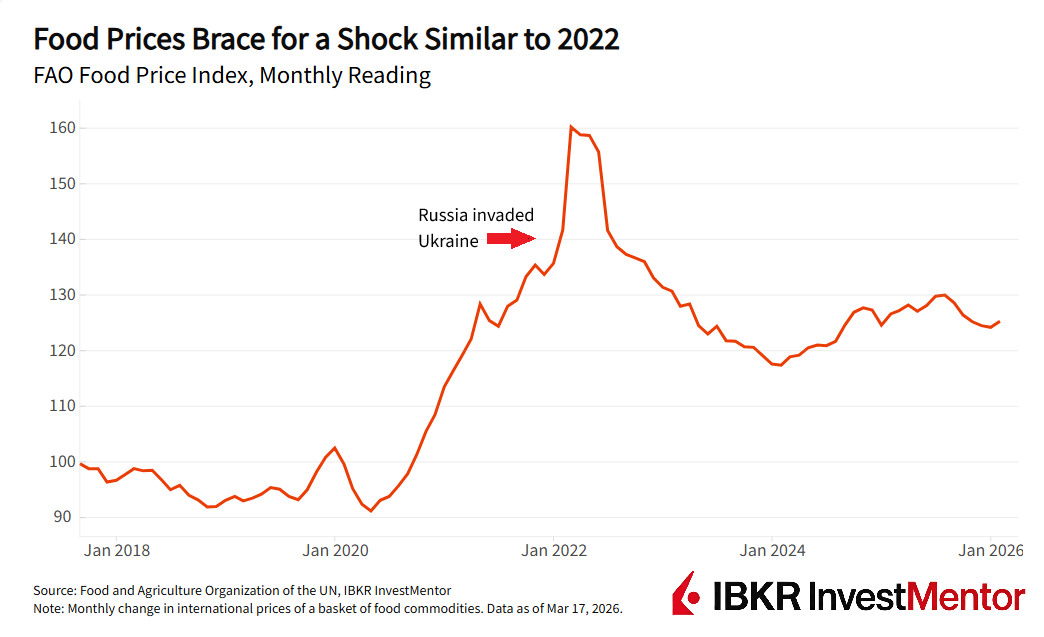
Farmers feel this pressure first. Higher fertilizer prices raise planting costs. At the same time, more expensive fuel and gas push up the cost of transporting crops and heating greenhouses. Food prices rarely jump overnight. Instead, the costs creep higher across the supply chain over the months, eventually showing up on supermarket shelves.
By the time consumers notice, the disruption at sea could already be old news. But if the Strait of Hormuz remains closed or heavily disrupted, the resulting squeeze on farmers risks turning into a much more severe and persistent food‑price shock.
A similar dynamic played out in 2022 after Russia’s invasion of Ukraine disrupted global energy, fertilizer, and grain flows, pushing food prices sharply higher.
In addition to being an important fertilizer ingredient, sulfur has other critical industrial uses. The vast majority of the world’s supply is refined into sulfuric acid, which is used for everything from pesticides and batteries to medicine and detergents.
Miners use sulfuric acid to leach and separate metals such as copper, nickel, uranium, and zinc. It’s also widely used in extracting rare earths, vital elements used in renewable energy systems, electric vehicles, and smart devices.
Many producers depend on sulfur imports from the Gulf. Sulfur can be mined, but the majority of the world’s supply originates from oil and gas refining. That makes it especially vulnerable when energy production and shipping are disrupted at the same time.
Mining companies can absorb the shock for a while using stockpiles. But those buffers are limited. Once they run down, extraction becomes more expensive or slows altogether.
The timing is painful. Copper prices were already hovering near all-time highs before the war. According to the International Energy Agency, copper mines aren’t yielding as much high-quality ore as before, and new mining projects are increasingly complex, resulting in a supply deficit that could hit 30% by 2035. Simultaneously, the demand is pushed up by the AI boom, which hungers for more data centers and power-grid updates.
A chemical bottleneck in the Gulf could push copper prices even higher.
The semiconductor industry may seem far removed from Middle Eastern shipping lanes, but it is deeply exposed to them.
Chip manufacturing relies on a fragile ecosystem of materials. Helium is used to cool equipment and prevent unwanted chemical reactions. Sulfuric acid cleans silicon wafers to extreme levels of purity. Bromine, much of it found in the Dead Sea, is used to etch microscopic patterns onto chips.
About a fifth of the world’s helium is used by the semiconductor companies. Other uses include cooling superconducting magnets in MRI machines and, of course, party balloons. More than a third of the world’s helium is supplied by Qatar as a by-product of LNG processing.
Helium squeeze shows how technology inflation can start far from the tech itself.
The Strait of Hormuz has never been this thoroughly impassable during modern times.
Advances in drones, missiles, mine warfare, and electronic disruption have made it easier, cheaper, and faster for Iran to render the strait shut for commercial shipping. The threat alone sends insurance costs soaring, making shipowners hesitate to even attempt a crossing. For cargo already inside the Gulf, there is no alternative sea route at all.
Pipelines offer some relief for oil exports, but cannot replace the sheer volume that moves through the strait, and won’t help with other materials that are disrupted. Helium, for example, requires highly specialized transport conditions involving cryogenic liquid containers.
US and Israeli efforts to reopen the strait by force have so far failed. While the US has called on Nato allies to help police the waterway, most have refused to send naval assets into a narrow, mine‑threatened chokepoint to help with a war they had no say in.
Over the coming months, as inventories thin and contracts reset, the Strait of Hormuz could assert itself as a source of persistent global inflation far beyond energy markets.
Download the free IBKR InvestMentor app if you want to learn more about commodities and other asset classes through fun, interactive lessons and explainers.
IBKR InvestMentor (dba “InvestMentor”) is a service of Interactive Academy LLC, an affiliate of IB LLC and majority-owned by IBG LLC. All content provided by InvestMentor is for informational and educational purposes only and should not be interpreted as implying any sponsorship, partnership, endorsement, recommendation, or approval by IB LLC or its affiliates.
Information posted on IBKR Campus that is provided by third-parties does NOT constitute a recommendation that you should contract for the services of that third party. Third-party participants who contribute to IBKR Campus are independent of Interactive Brokers and Interactive Brokers does not make any representations or warranties concerning the services offered, their past or future performance, or the accuracy of the information provided by the third party. Past performance is no guarantee of future results.
This material is from InvestMentor, an affiliate of Interactive Brokers LLC, and is being posted with its permission. The views expressed in this material are solely those of the author and/or InvestMentor and Interactive Brokers is not endorsing or recommending any investment or trading discussed in the material. This material is not and should not be construed as an offer to buy or sell any security. It should not be construed as research or investment advice or a recommendation to buy, sell or hold any security or commodity. This material does not and is not intended to take into account the particular financial conditions, investment objectives or requirements of individual customers. Before acting on this material, you should consider whether it is suitable for your particular circumstances and, as necessary, seek professional advice.
Related Articles
















Join The Conversation
For specific platform feedback and suggestions, please submit it directly to our team using these instructions.
If you have an account-specific question or concern, please reach out to Client Services.
We encourage you to look through our FAQs before posting. Your question may already be covered!