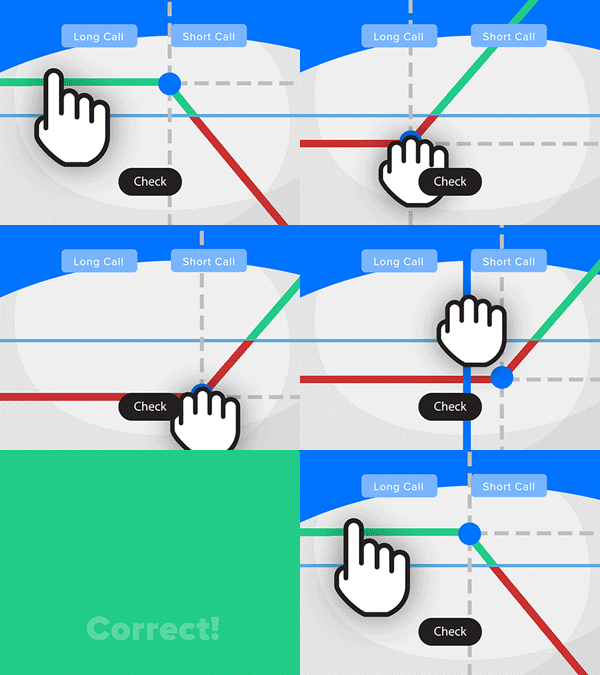
- Solve real problems with our hands-on interface
- Progress from basic puts and calls to advanced strategies
Interactive Options Course
Posted February 2, 2026 at 12:01 pm
In this episode of the IBKR Podcast, Steve Sosnick, Chief Strategist at Interactive Brokers, and Jose Torres, Senior Economist, break down the market reaction to Kevin Warsh’s Fed nomination. They examine whether Warsh is a policy hawk, a political pragmatist, or something in between, and what his potential influence means for interest rates and investor expectations heading into the second half of the year.
Note: We taped this podcast on Monday, February 2nd, around 10 AM ET. Shortly after noon ET, we learned that the partial government shutdown will delay the release of the January employment report, originally scheduled for Friday, February 6th.
The following is a summary of a live audio recording and may contain errors in spelling or grammar. Although IBKR has edited for clarity no material changes have been made.
Welcome to the latest edition of the IBKR Economics Podcast. Our usual host, Andrew Wilkinson, is out today, so, I’ll be taking over. I’m Steve Sosnick, chief strategist at Interactive Brokers, and I’m joined today as usual by my colleague and friend, Jose Torres, our Senior Economist. Hi Jose.
Hi Steve. Great to be here.
Great to see you. Well, there’s a 500-pound gorilla in the room, and that is the Kevin Warsh nomination from Friday. It’s amazing the range of opinions that there are out there.Is he a hawk? Is he a dove? Is he a hawk in dove’s clothing? Is he a dove in hawk’s clothing? Is he just a political animal? I really would like your opinions on this, please.
Well, Steve, it’s definitely been confusing, especially with the trading, but I think on balance, the highest probability nominee that would stand up to a commander in chief that wants to pursue overly loose policy would be Kevin Warsh, and that’s why we’re seeing a stronger dollar. We’re seeing sell offs in precious metals. Historically, Steve, Warsh is a hot one of the classic Republicans as it relates to monetary policy. He prefers higher real rates. He prefers a Federal Reserve that doesn’t have an overly large balance sheet that interferes with the natural market forces of supply and demand in the treasury complex.
And of course, Steve, that’s not necessarily what President Trump wants. However, leading up to the nomination — and here’s where the confusion increases significantly — leading up to the nomination, Kevin Warsh talked about wanting to pursue a policy with lower rates and he delivered some talking points that were essentially music to the ears of the President.
So that’s really where all the confusion is coming from and where the wide range of comments that different experts are making, throughout the weekend.
I mean, that’s fair grounds for confusion though. I mean, I remember during, during his term as Governor, he was actually not in favor of Bernanke’s helicopter money and was concerned about lowering rates too much being an inflationary pressure, despite the fact that actually the problem at the time was deflation.
It is, I think, a fair question to ask: Has he changed his stripes or is it just that he knows that he’s got to, at least in the short term, appease an audience of one. Do you feel that some of the criticism or some of the questioning is justified?
I think so, definitely. But another important dynamic is that so many years have passed since that’s roughly 15, 16 years ago. So, there is an allowance for economists and for Fed officials to change their opinions, as years go by. Obviously, our debt numbers are way higher. The composition of our economy is much different with, for example, the manufacturing and real estate sectors continuing to suffer under restrictive financial conditions for those sectors, but not necessarily for the broader economy as it relates to consumer spending or labor markets or artificial intelligence investment or for the stock market.
So, those ideas and those standpoints have changed over time, so it’ll be interesting to see what happens. Wall Street’s still expecting roughly around two cuts into year end, starting in June and one probably around September or November. So, we’ll see what happens. Of course, crude oil prices have risen significantly. Housing is a disinflationary force, so we’ll see what kind of inflation numbers we get in the next few months.
You actually channeled Keynes in there with, “What do you do, madam, when the facts change, I change my mind. What do you do?” Or whatever. I think that that’s been the classic ever since. But you did actually hit on one of the things that I took away from Powell’s press conference. I mean at this point, a lame duck, we know this, but his comment, it’s something I’ve been thinking for some time, which is that we’re around neutral, we’re at the higher end of neutral, but there’s nothing from the asset markets that seems to imply that we’re restrictive.
Do you feel that Warsh has that viewpoint, or do you feel that even if the committee has that viewpoint, he can get them around? Powell was also very clear to say that the majority of the committee was in no mood to cut rates right now. You’ve got two dissents. One was Stephen Miran who we knew was going to dissent and Chris Waller did what I interpreted as his last ditch effort to stay relevant in the “Apprentice Fed Edition.” But do you think that Warsh can really move the needle in terms of the thinking of the other committee members ’cause it he’s one of, he is the most important voice in a room full of other smart people?
Yeah, so you know, the GOP talking point as it relates to monetary policy recently has been that the productivity enhancements that artificial intelligence is bringing, and is going to continue to deliver, provides a supply side disinflationary effect. While also the immigration restriction measures that President Trump has pursued also really weigh on housing both via prices and rents.
And with that component, comprising 45%, roughly, of the consumer price index, those two factors could very well land us in the low twos of inflation. If you look at the Cleveland Fed’s Inflation Nowcasting, we’re already kind of at 2.3%, 2.4% for last month. So, those numbers could start helping.
I think that if he starts to focus on those two dynamics and those conversations,he could win over the committee and could maybe get that third interest rate cut that the doves would want to see this year and then start getting fed funds, roughly in the high twos.
Well, that doesn’t really gibe with what we saw this week,certainly in the dollar rising and metals crashing. Let me be very clear: a lot ofpeople are saying, “Oh, they, they crashed because of Warsh.” They didn’t really, they were already on a downspin before the nomination was announced.
They were already getting whacked overnight before, I think it was around seven o’clock in the morning that we learned it was gonna be Warsh. So, I do take that with a grain of salt, but do you feel there’s any real economic message in the moves that we’ve had? Obviously, oil ran up largely because of concerns about Iran. It didn’t really move on the Venezuela news. but it did move on the saber rattling in Iran. It has made a difference, but that’s come off. But we’re seeing these big run ups and now the big declines, gold, silver, copper and aluminum had the run ups to some extent, not to the same degree, they’re coming off.
Bitcoin of course, got whacked over the weekend, but that’s sort of a world of its own. Do you see any economic message coming out of these runups and pullbacks, or do you just feel that’s market noise and let the markets deal with them?
I do see an economic message on the way up. There are someglimpses of the “Sell America” trade wanting to diversify into other currencies, other bonds, as well as other metals because when you consider other currencies and other fixed income instruments, they’re also controlled by governments.
So, the same part of the same bid that drove Bitcoin higher over the years, folks wanting to hedge away from fiat money and put more into an ecosystem that governments can’t control. I think that those same bids more from an institutional audience drove the run-ups in gold and silver.
Now, why don’t I see an economic message on the crash lower?
Because these assets, these metals, they don’t yield anything. So, it’s hard, and you can’t really price them off of fundamentals like earnings. So, it’s hard to really see where the risk-free rate is and how far gold and silver can run. We can do that dynamic on equities and say, “You know what” — and of course equities are hardly a sober mechanism — but we can say, “You know what? Equities are probably not gonna go up 30% this year because of where the 10-year is and what the recent years have done.” So, a lot of gains are built in, but with gold and silver we really lack that kind of comparison with the risk-free rate. So, it’s really all speculation, even though it’s a lot of institutions buying, it’s a lot ofcentral banks buying.
It’s still all speculation in my view.
I would debate you on this, but I don’t disagree. I mean, I think, that there were the fundamental reasons on, in my theory, I would skew it a little bit from a trading dynamic and say, I think it was as central banks started to buy gold and de-dollarize some of their reserves, it was around the same time that the Bitcoin trade was petering out.
And I think a lot of your momentum investors moved from Bitcoin into gold and then into silver, being sort of the easier, cheaper one to trade. And that became a parabolic mania in and of itself. Gold was actually not parabolic until pretty much three, four weeks ago. Silver’s been parabolic for months.
Parabolic trades, end in a nasty, unpredictable way. I’ll quibble with you very slightly on the causation. I mean, we generally agree. I think it’s just slight margin, but I have no disagreement with you on the fact that there is no lasting economic message from this.
I guess finally, from an economics point of view we’ve got jobs numbers on Friday. What are you looking for in that key indicator?
Yeah, I think that the Unemployment Rate stays flat. I think wage pressures are gonna stay pretty strong. They’re gonna grow 0.3% month over month. And I think on the yearly, that’ll take our yearly number on wages down to 3.6% annualized just to the unfavorable base effects that were particularly high.
But for the overall number, I’m expecting a modest beat. Expectations are at 70,000, I think we’re gonna get a number around 90,000. Remember folks with the immigration restrictions and with the challenging demographics that we have, it’s gonna be hard to get those numbers above 100,000, like what we’ve been getting in previous years post COVID.
So, we’re in this new normal where job games will be between 20,000 and 90,000 for the most part, even as we expand.
Well, thank you, Jose, for very much for that. And I guess obviously to me jobs numbers are always important because when you think about the Fed dual mandate, you get price data every day. We just have to look at your screen, and you have price data. You don’t, we don’t get, as we, we don’t get as much jobs data.
Although it’s interesting because I believe it was, I forget which one it was. I think it was Dr. Miran, but I’m not sure exactly, who said that we actually have more clarity on the jobs data than they do on price data. Can you just explain, does that make sense to you, since we don’t get as many readings on labor, on the labor economy as we do on prices, which again, are continuous?
Yeah, I mean, I think I’m more in the middle. I think that we have real time measures of inflation. Of course, that side of the aisle has been pointing to this new measure called Truflation, Steve, I don’t know if you’ve seen it on Twitter and X and it’s trending really a lot lower.
So, we have that real time price measure. And then we also have, we have Indeed’s job openings, but a more comprehensive number that’s been now added to our economic calendar. On weeks where the ADP monthly report isn’t due, you have every Tuesday you have an ADP weekly number on payrolls, that with the claims and then with ADP.
As economists we’re kind of shifting, and strategists like yourself as well, we’re kind of shifting into like not focusing as much on one data or two data points but more looking at the buffet of data and kind of just getting clues from each dish.
Yes. I did know that the ADP was coming weekly. I do forget about it. It’s not in my mindset to the same degree that some of the others are. And one of the things I’ve always said was, people say, oh, ADP is a lousy indicator of the bigger employment number. And we don’t have enough time to, to fully debate that, and I don’t know if I have all the economic data to, to refute or agree with it. But I’ve always felt that ADP is good on direction over time. It’s not, it may not necessarily be good week-to-week because quite frankly they have a subset of large companies, but not necessarily as good of a reach into the small economy.
Just in like the short time we have left, does that comment make any sense? Or you could just tell me if I’m talking out my talking out my… talking out the wrong way.
No, I think I think part of the reason why I’m offering a little more weight to ADP these days, Steve, because the response rates in the government have just been really terrible. These are voluntary surveys. I wrote on Traders Insight back in 2023 roughly, that I thought that these responses to these government surveys should be mandatory because they filter through monetary policy decisions as well as market impacts.
I know obviously it’s the US and we were built on principles of freedom and ability to choose, but I think that those dynamics should be bucketed, sort of how taxes are, you must pay your taxes.
On that note.
Oh, sorry, Steve. Just on ADP really quick. They have good data. They don’t necessarily depend on responses, they just have the data there and it’s a pretty large sample size, so I’ve been adding some weight to it.
Got it. On that note, we’re gonna have to call it because we try to keep these tight and limited. Thank you so much to my colleague, Jose Torres. I’ve been your host today on an impromptu basis, Steve Sosnick. And thank you very much for listening. Obviously, you know where to find IBKR Podcasts if you’re listening to this, but if you don’t normally subscribe, please do through the podcast channel of your choice and we look forward to talking to you again soon.
Thanks everybody.
The analysis in this material is provided for information only and is not and should not be construed as an offer to sell or the solicitation of an offer to buy any security. To the extent that this material discusses general market activity, industry or sector trends or other broad-based economic or political conditions, it should not be construed as research or investment advice. To the extent that it includes references to specific securities, commodities, currencies, or other instruments, those references do not constitute a recommendation by IBKR to buy, sell or hold such investments. This material does not and is not intended to take into account the particular financial conditions, investment objectives or requirements of individual customers. Before acting on this material, you should consider whether it is suitable for your particular circumstances and, as necessary, seek professional advice.
The views and opinions expressed herein are those of the author and do not necessarily reflect the views of Interactive Brokers, its affiliates, or its employees.
Investments in certain commodities (precious metals) may be subject to significant price volatility and often involve risks related to market fluctuations, liquidity constraints, geopolitical events, and changes in global economic conditions that could adversely affect their value.
Trading in digital assets, including cryptocurrencies, is especially risky and is only for individuals with a high risk tolerance and the financial ability to sustain losses. Eligibility to trade in digital asset products may vary based on jurisdiction.
TRADING IN BITCOIN FUTURES IS ESPECIALLY RISKY AND IS ONLY FOR CLIENTS WITH A HIGH RISK TOLERANCE AND THE FINANCIAL ABILITY TO SUSTAIN LOSSES. More information about the risk of trading Bitcoin products can be found on the IBKR website. If you're new to bitcoin, or futures in general, see Introduction to Bitcoin Futures.
U.S. Spot Gold trading through IB LLC accounts is only available to legal residents of the United States that do not reside in Arizona, Montana, New Hampshire, and Rhode Island.
For specific platform feedback and suggestions, please submit it directly to our team using these instructions.
If you have an account-specific question or concern, please reach out to Client Services.
We encourage you to look through our FAQs before posting. Your question may already be covered!










“What do you do, madam, when the facts change, I change my mind. What do you do?” in the case of market manipulation, you change the ways you cheat and prop up prices using dark pools, or whatever else is required. No one cares, and as always, “As needs must”. The AI bubble must be preserved and kept alive at all costs, after all, it’s a matter of National In-Security. Still, Pump and Dump is alive and well on Wall St., and Wall St. loves a bubble, even if when it pops, it plays out over time.
Once the Gold and Silver run up subsides, how do you think the Bitcoin scenario will resume its rise, albeit somewhat slower. There has been a reversion to the mean sort of