
- Solve real problems with our hands-on interface
- Progress from basic puts and calls to advanced strategies
Interactive Options Course
Posted December 18, 2025 at 11:04 am
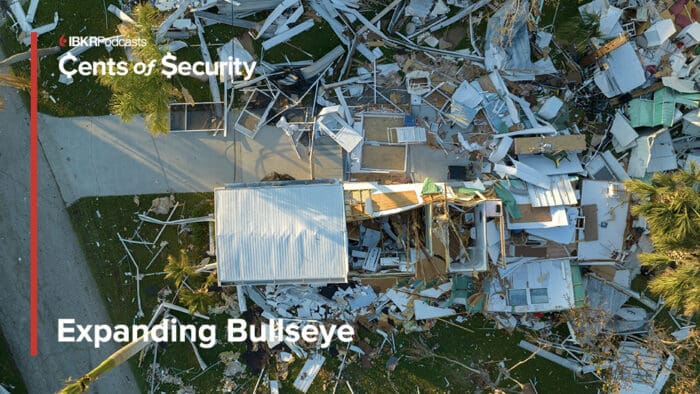
Cents of Security host Mary MacNamara digs into why disaster losses keep breaking records—even when many hazards aren’t skyrocketing—with Patrick Brown, Head of Climate Analytics, at Interactive Brokers. They break down the disaster-risk equation (hazard × exposure × vulnerability), the “expanding bullseye” effect, why mortality from extreme events has fallen, and where adaptation and smarter zoning can move the needle.
The following is a summary of a live audio recording and may contain errors in spelling or grammar. Although IBKR has edited for clarity no material changes have been made.
Hello everybody and welcome to the Cents of Security Podcast. Today we’re talking about weather hazards and natural disaster risk with the Head of Climate Analytics, Patrick Brown. Hi Patrick. Good to see you. How are you?
I am good. It’s great to see you too. I’m doing very well.
Good, so what are the main factors that determine risk from natural disasters?
So, I think it’s important to get some terminology straight at the beginning. So, a natural disaster is the harmful impact on society caused by what we tend to refer to as natural hazards. So, the hazard is the physical weather or climate event. So that’s like the heat wave or the cold wave, or the flood, or the drought or the wildfire or the storm.
And for storms, we usually talk about three kinds of hazards. There are the tropical cyclones, hurricanes, there’s mid latitude cyclones, which your weather person will call a low-pressure system. And then severe thunderstorms, which bring, straight line winds and hail and tornadoes but the natural disaster risk.
Is not just the hazard. There are two other really important components. There are exposure and vulnerability. So, you take the hazard, and you multiply it by the exposure and you multiply it by the vulnerability. So, exposure is how many people or assets are in harm’s way of the hazard. And vulnerability is how susceptible those people or assets are to harm from the hazard. So, this makes sense when you think about it, that a hurricane out in the middle of the ocean is not a natural disaster because there’s no one exposed to that hurricane. And, if a hurricane hits a coastline with no one there, it’s also not a natural disaster.
If you could imagine, we don’t have this, but if a society was completely fortified against hurricanes, if the hurricane hit that society, that would also not be a natural disaster because the vulnerability would be zero. So maybe a more realistic example would be a very intense cold wave in Minneapolis in January.
Is not necessarily a natural disaster because you have a lot of acclimations to that thing. So, the risk of natural disasters is not just the hazard, it’s, you have to think about exposure and vulnerability to that hazard.
Yeah. Otherwise, it’s just storms, right? So how are extreme weather hazards changing due to climate change?
So, when we see natural disasters, this tends to be the question that’s asked most often. And we’ll talk about that. Maybe it’s not the most useful question necessarily to ask, but the easiest way to conceptualize contemporary climate change is that elevated greenhouse gas concentrations, which are primarily from burning fossil fuels are causing basically all temperatures everywhere to be warmer than they otherwise would be. And so that warming has to affect basically all hazards. It has to affect all weather to some degree. The question is just how much, and for some hazards it’s a lot.
And for many hazards though, it’s, the direction of change is even contested and, or at least it depends on the location or time of year and things like that. But the hazards that we can most confidently connect to elevated greenhouse gas concentrations are the ones that are directly related to temperature.
So, the warming of heat waves and the warming of cold waves. So, making cold spells less intense or less severe, and the numbers on that are overland in 2025 or by 2025 it’s warmed about four degrees Fahrenheit. So, if you had a heat wave that was 105 degrees Fahrenheit, that would’ve been closer to 101 degrees Fahrenheit in a pre-industrial climate.
And similarly for cold waves that, if you have a low temperature in Minneapolis of negative 15 degrees Fahrenheit, that would have been closer to negative 20 degrees Fahrenheit in a pre-industrial climate. So those are very confidently connected to increased greenhouse gas concentrations hazards slightly more.
Slightly less directly temperature related would be coastal flooding due to sea level rise. So, sea level is rising because it’s warming because the ocean expands when it warms and also because of ice melting from land and going into the ocean. So, there’s been nine inches of sea level rise since 1880.
And so that means that the coastal flooding increases and also extreme daily precipitation, a warmer atmosphere can hold more water vapor. And so we think. The warming that’s occurred to date. Has caused precipitation to increase by about 10% on these daily timescales. And then even further downstream, less directly connected to temperature are some of the more prominent hazards like floods, droughts, wildfires and storms. And those tend to be just much more complicated. Depends on the characteristic that you’re talking about for these things. And in a lot of cases, basically historical observations and projections don’t indicate a universal direction of change.
And it’s not a strong global change at least. So, we know that the signal to noise ratio on those is, is pretty small.
Yeah, you say that, but then I think about the fires, the atmospheric storms that we’re getting, that are just dumping all the rain. There’s got to be something to that with the fires, right? That those are definitely disasters. Huge vulnerability and they’ve definitely ticked up.
Yeah. So, if you look globally, actually wildfire activity has decreased both in terms of area burned and in terms of mass combusted. And if you look at, the kind of the high-profile areas like California and the US West, they have wildfire activity has increased substantially since about the 1980s.
But if you look at longer timescales, that’s a minimum of fire activity. So, we had this situation where we implemented this policy of putting out all fires as soon as they, as soon as they were lit. Yeah. The, yeah. Smokey the Bear, and that worked for about a century, and it caused the wildfire activity to decrease to this minimum in the 1980s.
But what that did is it like stretch, stretching a rubber band, it let all this additional fuel build up. And so, then when you do have fires, they’re much less controllable and they could be much more intense. And so then coming in on top of that, yes, it’s warming and warming means drying for a lot of these fuels.
And so that is a component of what the increase in welfare activity has been since the 1980s, the fact that welfare activity has decreased globally shows you that there’s a lot of other things going on, and so it’s not a high signal to noise ratio phenomenon that what’s going on the land surface, what’s going on with ignitions humans ignite 90% of wildfires. So changes in, in human population and distribution and changes in the fuel load make a huge difference as well. So, it’s not so simple as you can just look at a trend, and then attribute that to the elevated greenhouse gas concentrations.
All right, so good point. If many of these hazards aren’t dramatically increasing, why do we hear that? Economic losses and damages are constantly setting records.
This is a great question. It is true that we see strong upward trends in economic damages from natural hazards. But to explain that we have to remember that there are three components to the formula of natural disaster risk, and it’s not just hazards. So, hazards are just part of it. So, the other two are exposure and vulnerability and increases in economic losses and damages are driven primarily by increases in exposure. So, more people and stuff in harm’s way. Not these, not increases in hazards. So, a really nice visual conceptualization of this has been credited to professors Walker Ashley and Stephen Strader at Northern Illinois University. They call this the expanding bullseye effect.
Imagine a target for a game of darts and the bullseye is where most people or assets are. So, the darts are the natural hazards, the floods, droughts, wildfires, storms and you get the worst natural disasters when the darts hit the bullseye. Now the dart throwing frequency or the thickness of the point of the dart might be changing, over time.
But the main dynamic at play is that the bullseye is rapidly expanding. So, the same dart distribution, could be randomly all over the target is able to do much more monetary damage today than in the past because it hits the expanded bullseye much more often. Just some concrete numbers on that, when we look at changes in, hazards. In an extreme event attribution type science, they tend to calculate, changes in hazard like changes in intensity of hazards tend to be calculated to be like reduction of 10% to increase in 20 by 20% since the industrial revolution. So, in that range where if you look at changes in exposure to hazards, it tends to be like 10 to a hundred times larger than that.
So just taking like US population in the past century that’s increased three times over, so no hazard change in intensity is three times larger than since the industrial revolution. And so that would be people is population. But then when you’re talking about monetary damages, value, you have to basically include just the growth of the economy. So, us real GDP, so real meaning adjusted for inflation has increased by a factor of 21 over the past century. So, there’s just, the economy is constantly growing, so there’s just ever more value exposed and you also have disproportionate growth of both people and value in particularly high risk areas.
So, a great example of this is the South Florida coast that, that’s in the middle of Hurricane Alley. And if you think about it, a century ago, that’s basically a rural location. But today it’s just rows and rows of high-rise condos of very high value. So, the same hurricane in 1925 versus 2025 just is so much more monetary damage in 2025 compared to the past.
How has society’s vulnerability to hazards been changing?
Yeah. Vulnerability is how susceptible people and assets are to harm. And we usually look at two components, either the human component or the economic component. So, the human component is deaths as a proportion of people exposed to a hazard, and the economic component would be dollar damages as a proportion of the dollar value exposed to the hazard.
So, these are both, these are fractional attributes, and we’ve just talked about changes in exposure or bad news. There’s way more expanding bullseye is causing more and more people and assets to be exposed to hazards. But changes in vulnerability are pretty good news. So, both human and economic vulnerability are declining.
Global average mortality rates for exposure to natural hazards have dropped. The most rigorous study that I know of on this have shown that they’ve dropped by a factor of seven since the 1980s. So that’s great news. And economic loss rates so it was a proportion of value exposed, have dropped or remained constant depending on the hazard and the timeframe.
So, the vulnerability story is a happy story.
So I’m curious, is that because more people are hearing about it, we all have iPhones, the internet, et cetera, so it’s like we’re all up on the news, so if you have a boat, you have navigation systems, or you have your iPhone, the internet, and people are just more forewarned about, something that is occurring, there is more population, but you got to get out of there because hurricanes coming or there’s a fire and so forth.
So that, that’s going to make a difference too,
Absolutely. Weather forecasting and dissemination of that information is probably the number one component of the reduced lives lost to natural hazards that we, you think about with major hurricanes today a lot of times we have six, seven days ahead of time where you basically know where the hurricane is going to hit.
So that’s time to go to Home Depot and to fortify your home and then to get out of there and like that’s something that is a luxury that, that a lot of the world still doesn’t have. And we certainly didn’t have in the past especially at these long lead times, that’s only a development since the satellite era in the 1980s.
Yeah, it was fascinating. I think it was last year in Tampa a hurricane hit, and they were able, I don’t know, I can’t remember what it was called, but they were able to put up a fence around a hospital. A temporary fence to block out the water and that was amazing. And it did, it basically blocked out the water and the hospital was fine.
So, I’m sure a lot of new technology like that’s popping up as well.
Yeah. The difference between having no warning, no lead time and lead time is just immense.
It still means that we should work on, obviously reducing CO2 if we can right. It doesn’t mean like everyone’s going to buy the fence thing, and so we’re out of the woods. No, we’re not.
What can economic and technological development do to decrease vulnerability?
And we talked about that, but I’m sure, elaborate more if you can.
Yeah, this is really the crux of the issue is that the vulnerability component is really just an expression of society’s standard of living. As you experience economic growth over time or higher income countries compared to lower income countries. Just higher standards of living mean more resilience to natural hazards because you have stronger buildings, you can evacuate more effectively. More people have transportation. It’s better emergency systems, better healthcare systems et cetera. We see this across space today that mortality rates from floods, droughts and storms the same flood, drought, or storm is 15 times higher in low-income countries than in high income countries.
A salient example of this is the Dominican Republic in Haiti. Our two countries on the same island of Hispaniola and hurricane Matthew hit that island in 2016. 674 people were killed in Haiti and only four people were killed in the Dominican Republic. So, you have the same storm, same place, same time.
What’s the difference? The difference is the Dominican Republic basically has GDP per capita that’s seven times higher than Haiti’s. So that just, background economic development is manifested in all sorts of systems that make us more resilient to, to climate extremes and to these hazards.
That’s amazing. That’s an amazing statistic. Okay. So, GDP does matter, that’s for sure. So, should we think about exposure and vulnerability more, when we think about climate policy?
Yeah, so as you mentioned we can’t just ignore CO2 so climate policy does tend to be very focused on reducing greenhouse gas emissions. And the reason for that is CO2 in particular basically just accumulates in the atmosphere. So, you have to get emissions that’s the flux into the atmosphere per year.
You have to get emissions to net zero just to stop the accumulation of CO2 and to stop warming, to halt warming. So that’s where the, the emphasis comes from on reducing emissions. But if you’re going to focus on disaster risk policy trying to influence disaster risk via manipulating the hazard via global emissions, via energy policy is like incredibly indirect and delayed.
And you can, very much emphasize that in the long term you have to reduce cO2 emissions to net zero to stop global warming, to stop the world from warming. But if you care about affecting outcomes on the ground in the near term, exposure and vulnerability are much higher leverage levers to pull on so we can mitigate increases in exposure by more intelligent zoning laws. So don’t build in a hundred-year floodplains. Don’t build in areas that are known to have very large wildfire risk. Allow insurance premiums to reflect real risk so that there’s that price signal.
You don’t want to artificially suppress premiums and subsidize ill-advised decisions in terms of where people are building. So mitigating that increase in exposure and then trying to help facilitate, continue to facilitate the decrease in, in vulnerability. So globally from a economic development lens try to do what the World Bank does and increase economic development, especially in low-income countries. Because most of the decrease in vulnerability to hazards is a not directly intended side effect of increased standards of living. And obviously there’s a bunch of other benefits to that as well, apart from climate issues.
And then of course, you can pursue more direct adaptation efforts to decrease vulnerability. So, an example of that would be hurricane Katrina in 2005 killed 1,392 people in New Orleans, and after that, New Orleans invested in a very much enhanced levee system and taking into account sea level rise and projections like that.
And then Hurricane Ida hit in 2021 and that was a very similar storm to Hurricane Katrina. Very similar path, very similar strength. And that killed only 57 people because the levees held so 57 people versus 1,392. And by the way, this kind of goes to the, why you don’t necessarily hear about this or know about this, is that the lack of deaths is not news, right?
So, you don’t really get like a headline of, thousands of people saved by this. It’s more just oh, I guess this wasn’t that big of a deal type of thing. And so, you have this selective filter as to what you’re hearing there, but those things work, right?
Levies big infrastructure projects work.
Does it seem like we’re making some good advances with getting those greenhouse emissions down? Are we backpedaling or, I know there was just a big climate conference down south so give us kind of a heads up on that a little bit.
Yeah, so it’s never been emissions have never been coming down as fast as people in the climate movement would like them to. And we’ve had these COPS, they’re called conference of parties for 30 years, and it’s hard to see any type of direct relationship between various statements that come out of these things and actual emissions have been increasing.
We need emissions to plateau and emissions to decrease but as the people that kind of project energy systems out into the future, as those people update their models and their understanding of technology in the world, we tend to see projections of much less severe warming towards the end of the century than we used to than we used to think. So that’s basically a manifestation of various alternatives to fossil fuels becoming much less expensive. And also, that a lot of the previous projections had just implausible assumptions about how much fossil fuels we’d use and how much economic growth there’d be.
That a lot of the doomsday scenarios from the past imagined us basically finding all of the coal that was available and burning it like this century. And that’s just not considered plausible whatsoever anymore. The community has said, “Okay”. The really bad emission scenarios are not plausible in the future, but also the really stringent emissions reductions that would be entailed by like a 1.5 degree limit or a two degree limit in the Paris Agreement those are also not. There’s no reason to believe that we’re on those paths either. So, we’re in this middle path where we’ve seen 1.5 degrees Celsius of warming since the Industrial Revolution. And by 2100 we may be closer to 3 degrees Celsius, so halfway to, to where we are in 2100 and not not ending in 2100, but like getting closer to emissions. Getting closer to net zero. But it’s, it is very difficult to project that. because you’re projecting society out into the future. Will we live on Mars in 21, 25 years? We have no idea. So, it’s like you’re projecting all sorts of things and a big, lever on that would be like, will nuclear takeover will enhance geothermal takeover. It is all about this kind of future technological forecasting, which is obviously very fraught.
Wow. That’s very interesting. I feel a little bit better. I started the podcast thinking this isn’t that great of a subject. It totally is important and I want to cover it. But now, I feel a little bit better. I think you brought it a good conclusion there with what we know right now.
This is the data that we have. The thing is it changes all the time. And a year from now, we could have the same conversation, and we could be talking about it in a different way. So, it’s good, it’s moving. Even, just even hearing about the number of, fatalities decreasing, that’s huge.
That’s huge. And like you said, we don’t hear about it in the media so that’s really good news. All right, so Patrick Brown of Interactive Brokers, the head of climate Analytics, thank you so much for coming on the show today. We really appreciate your insights, and your research especially.
Thank you so much.
Yeah. Thanks. I appreciate you having me on.
Strader and Ashley 2015 WW.pdf
The analysis in this material is provided for information only and is not and should not be construed as an offer to sell or the solicitation of an offer to buy any security. To the extent that this material discusses general market activity, industry or sector trends or other broad-based economic or political conditions, it should not be construed as research or investment advice. To the extent that it includes references to specific securities, commodities, currencies, or other instruments, those references do not constitute a recommendation by IBKR to buy, sell or hold such investments. This material does not and is not intended to take into account the particular financial conditions, investment objectives or requirements of individual customers. Before acting on this material, you should consider whether it is suitable for your particular circumstances and, as necessary, seek professional advice.
The views and opinions expressed herein are those of the author and do not necessarily reflect the views of Interactive Brokers, its affiliates, or its employees.







Join The Conversation
For specific platform feedback and suggestions, please submit it directly to our team using these instructions.
If you have an account-specific question or concern, please reach out to Client Services.
We encourage you to look through our FAQs before posting. Your question may already be covered!