
- Solve real problems with our hands-on interface
- Progress from basic puts and calls to advanced strategies
Interactive Options Course
Posted August 27, 2025 at 2:23 pm
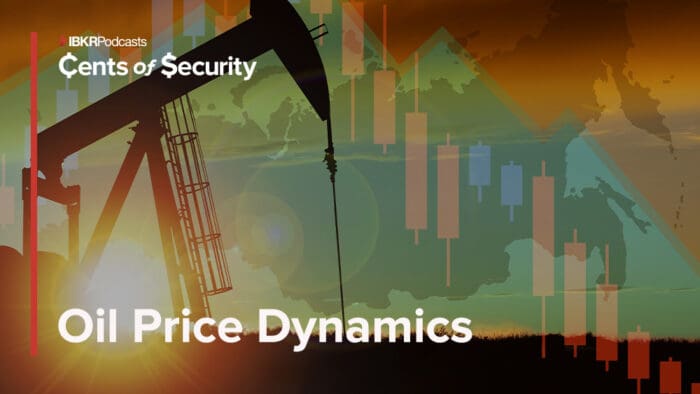
How does OPEC move oil markets—and what does it mean for U.S. energy and your heating bills? Mary MacNamara talks with IBKR Senior Economist Jose Torres about supply cuts, political pressures, and the future of fossil fuels in a changing energy landscape.
The following is a summary of a live audio recording and may contain errors in spelling or grammar. Although IBKR has edited for clarity no material changes have been made.
Welcome back to the Cents of Security Podcast. I’m Mary MacNamara, and I’m a Senior Producer at Interactive Brokers. Today we’re going to talk about OPEC. I’m joined with Jose Torres, our Senior Economist at Interactive Brokers. Thank you, Jose, for joining us today.
The pleasure.
What is OPEC and why do they have such a big influence on oil prices?
Sure. So, OPEC is the Organization for Petroleum Exporting Countries, and essentially, it’s several countries that have a significant interest in oil production and oil prices. So, they decided to get together and essentially begin to vote on what production quotas should be and how much oil production they should allow to occur.
They control roughly 40% of total oil supply—so almost half. In the extreme case, if they were to produce as much oil as possible, then that would lead to lower prices. Whereas as they were, conversely, if they were to produce minimal oil—let’s say no oil at all—then that would lead to, in the short run, to significantly higher prices.
Now these nations, they are focused on prices and revenues. So they’re looking to have oil prices be relatively high to maximize profitability. And generally speaking, that’s where they stand. But if production is way too elevated and prices are too low, then—like during COVID—what they’ll do is significantly bring production down because the world doesn’t need all that oil. They’d rather keep it in supplies and then produce more later when price dynamics are better and there’s more demand.
Also, sometimes there are disagreements within countries. Sometimes some nations, they want higher production because they need hard currency. So they’re not really that sensitive to prices at that particular moment in time. In fact, they just want as much money as possible because they’re dealing with problems at home. Whether that’s debt issues, social spending, or they are short on their social spending budget, they need money for infrastructure or investment, or for whatever. Some of those countries will vote to No, to not to reduce production because they want production to be higher. As again, their priority is cash.
But the bigger countries tend to have a better balance, and they tend not to suffer so much from the volatility of cash flows. And generally speaking, they like a high oil price environment with high demand and somewhat limited production.
So when they do a cut or a boost, how does this ripple through the U.S. market?
Sure. So when they do a boost, that means you have a lot more supplies. And of course, in the U.S., we also produce a ton of oil, albeit we’re not in OPEC. So, if they were to produce a ton of oil and there’s a lot more supply out there, the basic laws of supply and demand state that when you have abundant supply—so a lot of oil out there—then the prices come down.
So that affects the U.S. because oil producers here all of a sudden now they have less revenue. A lot of the big oil giants here in the U.S.—the two biggest ones are Exxon and Chevron. So, if OPEC were to significantly boost oil, then Exxon and Chevron’s revenues would be negatively impacted because the oil that they have, they can’t sell it at the maximum price because there’s too much supply out there.
Conversely, if oil production dampens sharply, then those big companies—Exxon, Chevron, and others—you have a lot of intermediate-size producers and a lot of small producers here in the U.S. as well. Then they would benefit from higher revenues, generally speaking, when you have lower production, because that would mean much higher prices.
Interesting. So what does OPEC actually care about—Is it profit, stability, or control? Or other things as well.
One more thing real quick. I forgot to mention in the last question. With oil producers, when there are high prices, you have a lot of new entrants coming into the market. They want to add supply. Wow, oil’s at $90 a barrel. How much does it cost us to produce? $60–$62? Okay, great. Let’s jump in and add oil supplies.
So that’s an important aspect too with OPEC. When production is low, there’s not a lot of supply. That incentivizes newer players to come in—small-time producers that maybe never even got into oil drilling. Now they want to start fracking because they see that prices are so high and they have wide margins.
Conversely, when prices come down a lot, you don’t have that much of an incentive to go out there and invest and to engage in oil-producing activities. Sometimes they care mostly about prices, and a lot of times they care about control too. And it depends a lot on what the non-OPEC countries are doing. Right—the other 60% of oil supplies—what are they doing? It’s a competitive dynamic. Of course, they care about market share. They want to maintain their dominance, but at the same time, they want to maximize revenue.
So, it’s really a balancing act, and there’s really no straightforward answer. Sometimes they favor lower prices and sometimes they want higher prices.
A lot of political influence too. Here in the U.S., we’re talking here in August of 2025. President Trump—has direct anecdotal evidence suggests that he’s been directly talking to some of his allies within OPEC, namely Saudi Arabia, to influence higher production levels because his domestic agenda is to have way lower gasoline prices. And that’s been happening in 2025. Political influences are also a huge driver.
So that brings up a good point. As December is coming up, January, the holidays, and we always talk about heating oil—why is heating oil, and oil in general, such a big thing in the Northeast compared to other places in the United States? And I also wanted to ask, with your prior question, when you were saying that a lot of the new guys come on board when they want to produce a lot of oil, is that the boom-and-bust cycle that occurs with some of these companies too? However you want to answer first, boom and bust or also the heating oil in the Northeast.
Sure. So we’ll go with the boom and bust first. So yeah, when you have a thriving industry and prices are through the roof, folks are going to realize, whoa, why is oil so expensive? How much would it cost us if we got into it? Maybe Mary and Jose said, hey, let’s start a business! We want to get into it too. Why not?
And that because a lot of times we don’t have experience in producing oil. At least I don’t think you do. I definitely don’t. But if prices are so high, right, maybe—at what price? This is the law, some laws of economics. At what price does it take for Mary and Jose to go out there and produce oil even though we don’t have experience? Because if we can theoretically produce oil at $65, $70, then if it goes to $200, $300, $400, the higher it goes—I’m throwing out extreme numbers to illustrate the motivation—the higher the numbers go, we know we can produce at $65. So if it’s going for $400, we can make that spread.
But of course, those extremes never happen usually, because folks that are much more experienced start diving in once it’s at $90, $95, $100. And then that usually—not necessarily a boom and bust every time—but if you have crazy enthusiasm and everyone is getting into it, then that’s a recipe for boom and bust. Especially when you have folks that aren’t experienced. They’re going into the space, they don’t have experience, and they’re only doing it because they want to make a margin.
But when you have more experienced players and stuff, they can come in, add supply in a more disciplined way, and then when prices come down, they can just stay where they are, and you can limit that kind of bust mentality.
Similar dynamic in the 2008 financial crisis with real estate, right? From 2003 up to 2007, everyone was just so enthusiastic. They wanted to become landlords. They wanted to have multiple properties. And that was certainly a boom and bust because it was much more than what folks could handle.
Heating oil in the Northeast—the Northeast, they built back when a lot of the buildings and properties were built back then, had much easier access to heating oil. So even though natural gas is more efficient, a lot of landlords and property owners alike just didn’t want to do the conversion. The expense of the conversion has been a significant hurdle in wanting to shift from heating oil to more efficient natural gas.
Yeah, it’s true, because even in our town we have natural gas pipelines, and we’re using oil in our house. So go figure, right? We’re like, why can’t we use some of this natural gas? But I think infrastructure is a huge part of that. They’re just not building it.
Okay, which brings up another point front and center. So why are heating bills so high? Do consumers pay more than companies per gallon? How does that work?
Yeah. So that’s just plain old economies of scale. Businesses do get lower costs because they’re buying a lot more to a specific location. So, they benefit from just the natural economies of scale. If you’re a bigger buyer of inventory, you can negotiate more, and you demand lower prices per unit. whereas if you’re a smaller player. You also have the municipalities involved more, and there are a lot of local taxes and local laws. Depending on where you are, that can also influence your heating bills and electricity bills alike significantly.
Yeah. So, in the winter months sometimes they’re saying we’re hitting peak demand. Is that just hype? Because once again you have this balancing act of keeping all the flows—high flow with OPEC, low flow—and then we’re at peak demand. So everything is more expensive. Is that true?
Yeah, generally speaking, because when you have peak demand it’s somewhat of a warning that if there’s any kind of disturbance, prices could go up significantly. Supplies could be impaired because everyone is using heating supplies at that particular moment in time. So, you know, you have risk that there could be a bad snowstorm that disturbs supplies and that things can go offline, and prices can increase as a result.
Of course, all that could occur to varying degrees, with the most extreme cases of course meaning that there’s no heating oil at all, or close to that level. Then prices really skyrocket, or there has to be some kind of rationing dynamic going on.
Of course, on the other side, when you have peak demand but there are no disturbances and maybe the weather doesn’t get that cold, then all of a sudden you can benefit from lower prices because there are abundant supplies and nothing adverse has occurred.
That’s a big question, because I know as a homeowner sometimes you can sign up for a heating contract with your provider, and so that’ll lock in a price. And so the big question in the spring and summer—you’re like, okay, I’ve got to call the oil company and lock in a price. But then you look at the prices, they’re low. And so, what do I do? Or just go with the market and we’ll see what happens. And then once again, if it’s a really cold winter, then you do get these huge bills in January and February. So, it’s a juggling act to lock it in or not lock it in.
We’re all trading futures, huh?
Trading futures. That’s right.
So, thinking about this peak oil demand, how should investors think about long-term exposure to fossil fuels? Wind it down, hedge it, or pivot to alternatives?
I think you’ve got to have a mix. Because when we look at the clean energy initiatives, that’s been mainly driven by the European Union and the United States. But when you look at the other major countries in the world, in terms of economic size as well as population—namely Russia, India, China—they don’t really care much about clean energy when you consider their initiatives and what they’re doing and their mandates.
So, you have that dynamic where the developed world wants to go green, but the emerging world can’t afford to go green because green is expensive. One exception to that is that the Chinese electric vehicles are extremely affordable. That’s one exception. But that’s more—I think the reason China is pushing the EVs is more from an affordability standpoint and to boost domestic manufacturing rather than alternative energy sources.
Now when you look at artificial intelligence—it’s been a big driver of the market rally and the enthusiasm in stocks globally—that’s going to need a lot of energy, a lot of computing power. And right now, it doesn’t look like there’s enough alternative energy supplies to be able to power that trend forward. So, fossil fuels—they’re here to stay, unfortunately.
On a little tangent here—we have our IBKR Forecast Trader. We have a lot of climate and energy contracts. And it’s really interesting in terms of looking at what’s going on with oil production, what’s going on with temperatures, what’s happening with EV adoption, electricity demand, etc. There are a lot of different series there for those folks that are interested in these topics. They can go in and spot probabilities and maybe make a trade or see an opportunity that they like.
But that’s really it, Mary. Do we have enough energy supplies to power the economy forward? Alternative energy supplies, that is—non-fossil fuel energy supplies. Do we have enough to power the economy forward, to keep transportation online, and to power these new trends of artificial intelligence and computing, which take up significant power source supplies?
Absolutely. When you think about the data centers being built, I want to do a whole separate podcast on that—data centers, electrical grid, how we are compared to China, that whole bit. So, we’ll save that conversation. But I’m very curious about that, and I think it’s worrisome a little bit. I think we’re underpowered. I’ll do some research on that, and then we’ll have a great podcast on that if you’d like.
I agree with you, Mary. Real quick—I just think that we have significant power needs. Like you said, we’re underpowered, but then we have these climate goals that really are in the crosshairs of our need for power. So, I’m just fingers crossed that the temperatures just go down.
In the past, that’s happened. We just got lucky, and temperatures went up a lot or temperatures went down a lot. Because back then you had problems with temperatures being too cold. Now, of course, we’re having some problems with temperatures being too hot. I’m just hoping that some force above just brings the temperatures down and we can continue without changing our lives drastically. Because that’s really what the most ambitious—and most optimistic, I should say—the most ambitious climate goals out there call for: humans to significantly change their lives.
Yep, that’s true. We’re going to be talking about that because I think it’s really important. Okay, good. Is there anything else, Jose, you want to talk about, or we’re good?
I think we’re good. It was a pleasure, Mary. Thanks so much. You’re the new host for the Cents of Security Podcast here at Interactive Brokers, and we’re really thrilled for the next few episodes.
Absolutely. And everybody, check out our show notes. They’ll be on the Campus website. And make sure you like it, add comments, share it. We’re so grateful to do this podcast. And thank you to our listeners. And thank you, Jose. Awesome. Love it.
My pleasure.
Okay, good. It’s a wrap.
The analysis in this material is provided for information only and is not and should not be construed as an offer to sell or the solicitation of an offer to buy any security. To the extent that this material discusses general market activity, industry or sector trends or other broad-based economic or political conditions, it should not be construed as research or investment advice. To the extent that it includes references to specific securities, commodities, currencies, or other instruments, those references do not constitute a recommendation by IBKR to buy, sell or hold such investments. This material does not and is not intended to take into account the particular financial conditions, investment objectives or requirements of individual customers. Before acting on this material, you should consider whether it is suitable for your particular circumstances and, as necessary, seek professional advice.
The views and opinions expressed herein are those of the author and do not necessarily reflect the views of Interactive Brokers, its affiliates, or its employees.
Futures are not suitable for all investors. The amount you may lose may be greater than your initial investment. Before trading futures, please read the CFTC Risk Disclosure. A copy and additional information are available at ibkr.com.








Join The Conversation
For specific platform feedback and suggestions, please submit it directly to our team using these instructions.
If you have an account-specific question or concern, please reach out to Client Services.
We encourage you to look through our FAQs before posting. Your question may already be covered!