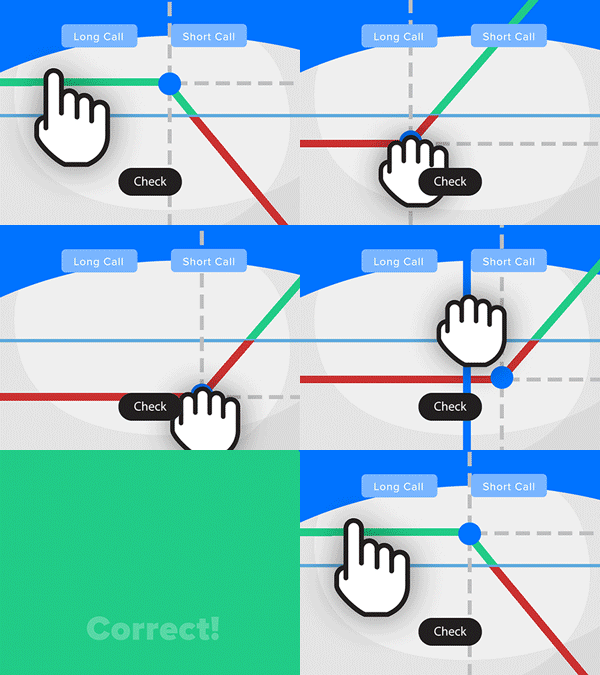
- Solve real problems with our hands-on interface
- Progress from basic puts and calls to advanced strategies
Interactive Options Course
Posted December 9, 2025 at 2:39 pm
Compounding favors the early starters. In this Cents of Security episode, Mary MacNamara sits down with James Yendrey—one of the creators of the InvestMentor app—to unpack starter portfolios, why Gen Z is learning faster via short-form content, and how strategies evolve through peak-earning years into decumulation, RMDs, and healthcare planning.
The following is a summary of a live audio recording and may contain errors in spelling or grammar. Although IBKR has edited for clarity no material changes have been made.
Hello everybody and welcome to the Cents of Security Podcast. I’m here with James Yendrey, one of the creators of the InvestMentorSM app. We’re going to be talking about investing from your twenties to your sixties, why Gen Z is starting earlier, and what the future of retirement may look like. Welcome, James. How are you?
I am doing good Holidays. Were good. What about yourself?
Oh, it was awesome. Thanksgiving it was a wonderful break, and now it’s the gauntlet, right?
So why are your twenties such a powerful decade for compounding, and what does a simple, realistic, starter portfolio look like for young investors?
Let’s say you start at 25 and you want to retire at 65. Every dollar you invest at 25 roughly has about 40 years of compound growth before retirement. That exponential growth that every dollar tends to become worth about 7 to 10 times more than one that would be invested when you were, say, starting at 35.
So, time by far is the greatest asset we all have when we’re young. Investing. It is going to be the key to benefit for your long-term self. And as far as a realistic portfolio, starter portfolio I would say maxing out your 401k match, it’s effectively free money. Then contribute to your basic Roth IRA, do a basic the 60 40 splits. Others like the 80 20 splits. When you’re very young, you have a greater risk appetite, and you can take a little bit more risk on. And then if you want some emerging markets, 10% of the emerging markets to widen the breadth of it, just keep it simple, keep fees very under the 0.2% and keep it simple.
Great. So, when you’re talking about compounding, you’re talking about just the interest or possible dividends. Expand on that a little bit for somebody who may not know what compounding is.
You’ll reinvest your dividend growth as well as the overall growth of your investment. So, if the market’s turning 10% year over year, that dollar is now continues to grow. But now at that point in time, year over year, as that capital grows, the capital that you earned will continue to grow as well.
When you continue to reinvest and reallocate funds to your portfolio, your dividends will work the same way.
So, the idea is like little by little over time it would be like if you’re siphoning off some of your money to a piggy bank, right? But this piggy bank, basically. Also grows too, even if you didn’t touch it, because it possibly has dividends, the stock has interest and so forth. Plus, if you put a little bit more in that piggy bank, everything grows, right?
You just leave it there no matter what happens to the market, right? The market could all go up and down over time.
Yeah. The good rule of thumb is to stay in the markets, not to really worry about the seasonal changes or the earnings calls. It’s for the long-term horizon and the betterment of yourself, right? You’re not a trader. You’re an investor in which there’s a difference between the two, and I think that kind of gets muddled with this generation and long-term investing is effectively going to be an income stream for you as you grow older.
So how is Gen Z changing the investing landscape? Can older generations also learn, the ways and how they approach making money and the markets and so on and so forth.
Gen Z is bringing a healthy skepticism about traditional institutions and embracing some more accessible technology, right? We didn’t have the global trader that we have on the phone now. We had to call somebody up and have them place these orders. They’re more comfortable with fractional shares, which we also didn’t have.
They’re social investing into communities like ESG concentrations. They’ve also witnessed a ton of economic instability, especially the younger millennials and the Gen Zs have gone through the 2008 crisis pandemic volatility. Which makes them both very cautious, but interestingly enough, also entrepreneurial.
So older generations, what they could effectively learn is more or less financial literacy should be democratized, not gated. Technology can reduce the barriers, and value-based investing isn’t just idealism anymore. It’s about aligning portfolios with long-term systematic strategies.
It’s so interesting. This generation, not only did they have 2008, they probably saw their parents go through, but also there’s the whole gig economy. So it’s like they’re thinking about many different things. You’re thinking about, okay, how can I make extra money on the side? Do my regular job, pay off my loans, also invest it out.
By the way, there are some tools I can use to even make it better. And the older generation’s, “okay, all right, great”. There’s new tools. What’s nice about that is like you said, the fractional shares, right? Why don’t you talk a little bit about that before we go on to our next question. What does that mean?
Sure. So, say you don’t have enough money to invest in a stock that’s trading about $600, $700. You can’t buy the full stock completely, but you want to participate in the upside growth. Fractional investing allows you to buy. Just a few dollar’s worth of that stock. So, as it continues to grow, you don’t need $600 anymore.
You can participate with $5, 10, $20 and then still participate in the growth of that company. And it’s an amazing thing.
Yeah. That’s why it’s interesting when you look at your statements, often, if you have a dividend payment that comes in and you have selected that you want to reinvest, what’ll happen is that dividend payment will trigger a buying of that stock, but only for a fractional amount. For instance, if you were going to buy one of the more costly stocks.
All right. So, what are some of the common beginner mistakes in your twenties and early thirties? And how can young adults build confidence while avoiding these mistakes if they can?
So, the biggest thing in your twenties is quite literally just waiting. People want to time the market. Holding too much cash can also be a negative thing. Chasing hot stocks, paying high fees, not necessarily capturing the employer’s matches.
Young people in their twenties might not be matching the 401k. They think that, okay I’ll do that later. And they kick the can down the road a little bit further.
So yeah, building confidence by starting small and learning by doing even $50, like we just said a month can teach basic market behaviors. You track one or two metrics. Your personal savings, your personal accounts, your net worth, rather than being obsessed with daily returns over time.
And I think the key here is remembering that investing is a skill that’s learned over decades and not quarters or earnings reports.
And as our legend, Warren Buffett always says, you want to buy a company. You’re not buying stocks. You want to buy the company what do you like? What are your favorite places to go?
So, let’s say you’re in your forties, right? Typically, what financial pressures and opportunities are out there? What do they look like and how should a portfolio strategy evolve in those peak earning years?
The forties are the peak earning years, but also with the peak expenses. You have mortgages, you have childcare education, but also you have aging parents, and this is called the sandwich generation. You’re in the area where you start to feel that squeeze from both sides. But these are also the years of your highest levels of productivity.
Strategies are going to be a lot different from your twenties. This is the decade that you should also, or you should accelerate, not necessarily coast. You still need growth because your retirement is about 20 to 25 years away.
But start diversifying risk at this point in time, capital preservation actually starts to become a little bit more prevalent. For this, you want to start de-risking things that are too frothy or too hot, we’ll call it. Maybe shifting from a 90-10 stocks bonds to a 70-30. Maximize tax advantage accounts like 401k high yield savings accounts and then focus on tax efficiencies since you are likely now in a higher tax bracket.
This is so important, this tax part. The reason is when you’re investing in your 401k, you’re not taxed. But if you have an individual account at a brokerage and you sell you do have to pay some capital gains tax on that. So, it’s something to keep in mind when you’re, and there’s a whole slew of strategies that people use to manage their tax lots, but we won’t even go into that.
So, this is a question that I often get asked is if someone reaches their forties or fifties and they feel behind, what does catching up actually look like in practice, especially when you’re juggling kids, college, aging parents and retirement?
That is actually a good question because sometimes catching up means adjusting expectations and not just saving more. I would say that the first thing that I would do is define what you mean by behind, realistically. Are you behind because you’re comparing yourself to other people, and in which case, the comparison trap comes into play and you
might necessarily be closer to your retirement than you actually think. The core focus here is to focus on your own trajectory, run your own numbers and do what you need to do for a modest retirement often it’s a lot less than you think. Catching up may mean prioritizing ruthlessly securing your own retirement first
because kids can borrow for college. You can’t borrow for retirement. Plain and simple. Maximizing catch up contributions if you’re over 50 that is going to be key because as you’re starting to wane, you’re getting closer into retirement contributions. The Roth IRA allow you to contribute a bit more into those accounts.
Cut low value expenses, that would be a huge one without sacrificing the quality of life. Or is there fat within your budget that you can trim? That is going to allow you to maintain the same level of lifestyle that you currently have. And if all that fails, maybe even potentially consider working for, a few extra years because that actually dramatically increases the retirement security.
When you’re looking at other people and seeing how much they’re spending, what size of a house they have, what cars they’re driving, keep it in the back of your mind keep it simple. Keep it really simple. If you have a lot of extra money and you can do that, great, but you want to keep your, your eye out and say, I remember like a while back, I forget what the percentage was that when you pay your mortgage or your rent, it should be like 25%?
It should be less than 20%,
It should be less than 20% of what you make that month, right? So that’s something to keep in mind, which is not easy to do because housing is such a big chunk, whether it’s your mortgage or you’re paying rent and so forth.
Okay, so here we get into the more, I would say the silver area timeframe. As investors enter their sixties, how should the mindset and strategy shift from pure accumulation towards income risk management and planning for things like social security and healthcare? And also, you could throw in RMDs required minimum distribution. So, let’s see if we can tackle some of that. That’s a lot.
In your sixties, this is. Transform, transforming from an accumulation to a deaccumulation phase. So, your twenties were your high growth area, your forties – you’re protecting that capital’s capital preservation. And in your sixties, you’re decumulating. And so that requires a totally different skillset.
You’re now managing longevity risk effectively. How can you outlive your money? Sequence of returns, market crashes, retirement, there’s inflation risk. So, the strategy shifts, maybe potentially do a bond build out a bond ladder income generating assets near, near term, expensive, about 3 to 5 years.
Delay social security, if possible, plan the required minimum distributions at 73. Keep 50 to 60% in stocks for long-term growth because you’re not done investing. You can take draws from it, but you want to maintain your positions within the marketplace. From there
seriously model healthcare costs because Medicare, Medicaid, they don’t cover everything. And at this point in time, you need to ensure health over wealth and make sure that your baseline is completely secured. This decade is about converting wealth into sustainable income streams like we just discussed about.
Like right now at 65, you’re supposed to go to some office in the United States of America and sign up for Medicare. And that is supposed to help out with your medical payments. And then they have part A, part B, part C, which is completely confusing, I think!
Bottom line, it’s really important, when you’re hit 60 to note. Okay,we have probably less in front of me and more behind me. And so, you start to really feel that when you’re in your forties, 30s, 40s, 50s, you’re, “okay, I got plenty of time”.
But then all of a sudden when you hit 60, you’re like, okay, wait a minute! And then that’s – what if I don’t have enough? And then why did I spend so much money on X? And I should have been saving it. So that’s why we’re doing this podcast is so you can hear it now and prepare and it doesn’t have to be a lot. It can just be little by little. So now in, in your research you are one of the creators of the InvestMentor app. How have you found that Gen Z prefers to learn about money and investing and all of the above?
So, Gen Z likes to learn through a lot of short format videos peer-to-peer communities, interactive tools. They’re steering away from lectures and textbooks. They value authenticity over authority, and they want to understand the why behind a financial decision, especially how the systems work or fail.
So, an example of this would be people moving away from things like traditional universities and gearing more towards online studies. It’s effectively where the individual is able to learn on their own, at their own time, at their own pace.
And they’re not sitting there being beat to death by a lecture. And they get the same amount of information that you would being present on their own time. They could be on a beach somewhere. Or they could be scrolling through TikTok and they look at these video formats as opposed to buying that a course.
Moving away from the lectures and they’re prioritizing the short and digestible pieces of content that are easily actionable, that aren’t going to take so long to actually yield a result. If I can watch this TikTok video, if I can watch this YouTube video and figure out how to do it now, why would I do that?
Why would I sit in a in a classroom and lecture and listen to it for six months when I can watch an hour video of it now?
Although I would say as a caveat is you want to make sure that the information you’re watching is reputable.
You’re getting some good advice.
And see what your interests are, what piques your interest? Is it growth investing? Momentum investing? Is it active or passive? Do you like to look at the international markets? And so, there’s a whole slew of things you can start to drill down into if you want to and then again, you don’t have to do that either. That’s why passive investing is so interesting.
On average broader benchmarks it exceeds about a 10% return. Inflation’s around 2 to 3% right now, so you’re looking at a 7%. Even if you did a 4% draw on all of retirement account, you’re still net positive.
That is why you don’t always want to keep all your money in cash, right?
You don’t necessarily want to have it fully in cash. That’s why high yield savings accounts are very enticing
Surveys often show that many Gen Zer’s do not expect social Security to fully support them and plan to find retirement through personal savings, side income gigs, or working later. How are things like pensions and cost of living technology and longer working lives reshaping what retirement will actually look like?
Traditional retirement is dying and pensions are being replaced by 401k contributions from companies. People are living longer and healthier lives, and technology is starting to enable more remote, flexible work alternatives for allowing many people to work later in life and enhancing their choice whether they want to work in their 70’s or by necessity but they have more control over the how and when. This means that building income streams, not just savings, investing in skills that, that remain valuable, prioritizing health embracing the phase retirement reducing work hours gradually rather than stopping cold saving aggressively, but also designing a life that you don’t desperately need to retire from.
Flexibility and adaptability matter more than a magic number in your 401k. Retirement is now becoming less a date and more financial state of where work becomes optional.
It’s interesting. I’ve also seen trends about people wanting to retire like at 40 or 35. So they’re trying to minimize all their expenses so they can retire that early. And then I think they get bored and they start to go back to work but there’s all types of timeframes for retirement,
There’s a lot of things that you start to think about whenever you’re approaching retirement and one of which is purpose. There, there have been studies where people have gone and paid off their mortgage, they’ve done the Ramsey strategies and they’ve knocked everything out.
They’ve officially become, a small money millionaire. you have zero DTI you have cash in the bank you’re maximizing all your investment strategies, and you’re a small money millionaire. Whatever the term is, people are actually starting to lose their purpose whenever they don’t have anything to wake up to.
And it’s a very interesting thing to realize that it isn’t necessarily a financial thing. It’s what drives you. And I think Gen Z is very much on top of it because they have the democratization of everything because they have the ease of access. The fractional investing, we’re moving away from pensions.
We’re now going at high yield savings account that are more readily available. We have 401k distributions; Roth IRA just extended the maximum amount in which you can deposit again for 2026. A lot of Gen Zs are starting to become well aware that, “Okay, I need to ensure that what I’m doing aligns with what I want to be doing”. I want to have the capital to retire, but love what I do so much so that I don’t need to. And I think that’s the, that’s a good mindset to continue to carry yourself into as you start thinking about the future.
I think that’s great. It’s so much more balanced. When I was growing up, I don’t think I ever used the word “aligned”. I want to be aligned with my purpose and, my growth potential. I was just, wow, just trying to get ahead. And so, it’s great that this generation is really thinking about that and I think it’s more balanced and it’s good you see it all over in the workplace too. The same type of concept they want their balance with life, I want to work hard, but I also want to go enjoy myself and do things I want to do too. Not just must produce all the time…
in the machine…
Exactly. Cog in the machine. So, is there anything else James, you’d like to add before we wrap up?
I would say figure out where you’re at in, in the phase of your life and build a plan around it. Build a system around it, because no matter what plan that you have, you will always fall to the effectiveness and the efficiencies of your systems, your automations, and your processes.
And they will ebb and flow. Once you get that foundation down and you find out that it actually works well for you, at that point in time, you can start building out different plans based off of where you want to allocate your assets next.
James Yendrey, one of the creators of InvestMentor App. Thank you so much for joining us today, and I…
Thank you.
for our next conversation. Thank you.
Looking forward to the next one. Thank you, Mary.
IBKR InvestMentor (dba “InvestMentor”) is a service of Interactive Academy LLC, an affiliate of IB LLC and majority-owned by IBG LLC. All content provided by InvestMentor is for informational and educational purposes only and should not be interpreted as implying any sponsorship, partnership, endorsement, recommendation, or approval by IB LLC or its affiliates.
Information posted on IBKR Campus that is provided by third-parties does NOT constitute a recommendation that you should contract for the services of that third party. Third-party participants who contribute to IBKR Campus are independent of Interactive Brokers and Interactive Brokers does not make any representations or warranties concerning the services offered, their past or future performance, or the accuracy of the information provided by the third party. Past performance is no guarantee of future results.
This material is from InvestMentor, an affiliate of Interactive Brokers LLC, and is being posted with its permission. The views expressed in this material are solely those of the author and/or InvestMentor and Interactive Brokers is not endorsing or recommending any investment or trading discussed in the material. This material is not and should not be construed as an offer to buy or sell any security. It should not be construed as research or investment advice or a recommendation to buy, sell or hold any security or commodity. This material does not and is not intended to take into account the particular financial conditions, investment objectives or requirements of individual customers. Before acting on this material, you should consider whether it is suitable for your particular circumstances and, as necessary, seek professional advice.
The information in this material is provided for informational purposes only and does not constitute tax advice and cannot be used by the recipient or any other taxpayer to avoid penalties under any federal, state, local or other tax statutes or regulations, or to resolve any tax issue.
Interactive Brokers does not provide tax advice, does not make representations regarding the particular tax consequences of any investments, and cannot assist clients with tax filings. Investors should consult with their tax professional about the tax implications of any investment.











Join The Conversation
For specific platform feedback and suggestions, please submit it directly to our team using these instructions.
If you have an account-specific question or concern, please reach out to Client Services.
We encourage you to look through our FAQs before posting. Your question may already be covered!