
- Solve real problems with our hands-on interface
- Progress from basic puts and calls to advanced strategies
Interactive Options Course

Posted July 23, 2026 at 12:00 pm
The article “Cashless Payment and Financial Inclusion” was originally published on Alpha Architect blog.
Digital payments are often viewed as simple payment technology: faster transactions, lower friction, and more convenience. But in reality, cashless payments generate something much more valuable: data. Every purchase reveals information about income stability, spending habits, liquidity, and financial behavior. This paper introduces a deeper perspective: digital payment systems are not just transaction infrastructure. They are information systems that can reshape credit markets.
Digital payment data expands credit access
The paper studies whether cashless payment activity causally increases consumer credit access. Using proprietary Alipay data and a novel instrumental variable strategy, the author shows that higher in-person digital payment activity significantly increases both the probability of receiving credit and the size of credit lines. The results suggest that payment flow data contains valuable information for credit evaluation.
The study identifies a causal effect
One challenge is that consumers who use digital payments more frequently may already differ from non-users in important ways. To address this, the paper exploits the staggered rollout of Alipay-integrated shared bikes across Chinese cities. Shared bike usage encouraged consumers to adopt Alipay for in-person payments through QR-code scanning. This created plausibly exogenous variation in payment activity that allowed the author to isolate the causal effect of cashless payments on credit provision.
Credit access rises substantially after payment adoption
The results are economically meaningful. Using in-person digital payments increases the probability of receiving credit access by roughly 56%. Among consumers who already have credit access, a 1% increase in payment flow increases credit lines by approximately 0.41%. The findings suggest that payment behavior itself becomes an important input into lending decisions.
Payment information matters beyond repayment history
Traditional consumer lending relies heavily on repayment histories and formal credit records. This paper shows that ordinary payment activity also matters. Even after excluding repayment-related transactions, the positive relationship between payment flow and credit provision remains strong. The evidence suggests that lenders learn about borrower quality directly from payment behavior.
Financial inclusion effects are strongest for underserved groups
The paper finds that older and less educated consumers benefit the most from digital payment adoption. These groups traditionally engage in fewer financial activities and often have weaker access to formal credit markets. When they begin using digital payments, lenders gain more information about their financial behavior, leading to greater increases in credit access.
The mechanism reflects information, not simply collateral
One possible explanation is that consumers with larger balances on the platform receive more credit because those balances act like collateral. The paper tests this directly by controlling for assets held on Alipay. The effects remain strong. This suggests that the informational value of payment data itself is the key mechanism driving expanded credit access.
Easier credit access does not appear to increase compulsive spending
The paper also studies whether increased access to digital credit leads to harmful consumer behavior. Using detailed transaction-level data, the author finds little evidence that consumers increase compulsive spending categories after receiving additional credit access. Spending rises overall, but not disproportionately in categories associated with impulsive behavior.
Understand the growing role of payment data
Digital payments are becoming an important source of financial information. Payment activity may increasingly serve as an alternative form of credit scoring, especially for consumers with limited traditional credit histories.
BigTech firms may possess durable informational advantages
Firms that control large payment ecosystems may have significant advantages in consumer lending because they observe real-time behavioral data. This creates potential competitive advantages relative to traditional financial institutions.
Financial inclusion may create new growth opportunities
As underserved populations gain access to digital payments, they may also gain access to broader financial products such as credit, savings, insurance, and wealth management services. This could expand long-term financial participation in emerging economies.
Be aware of regulatory and privacy risks
The same payment data that improves credit access also raises concerns about privacy, market power, and algorithmic discrimination. Policymakers may increasingly scrutinize how financial data is collected and used.
“Cashless payments do more than make transactions easier. Every digital payment creates information about spending behavior, income patterns, and financial habits. This paper shows that lenders can use that information to evaluate borrowers who may not have traditional credit histories. As more people adopt digital payments, especially in developing economies, payment platforms may help expand financial access to consumers who were previously underserved by traditional banks. The key insight is that digital payments are not just payment tools. They are information systems that can change how credit markets work.”
Fig. 1. Mobile Payment Penetration across Countries. These figures show the GDP-adjusted mobile payment transaction volume per user and the mobile payment penetration rate for selected countries in 2019 and 2023. Data sources are the Statista Digital Market Outlook and the World Bank.
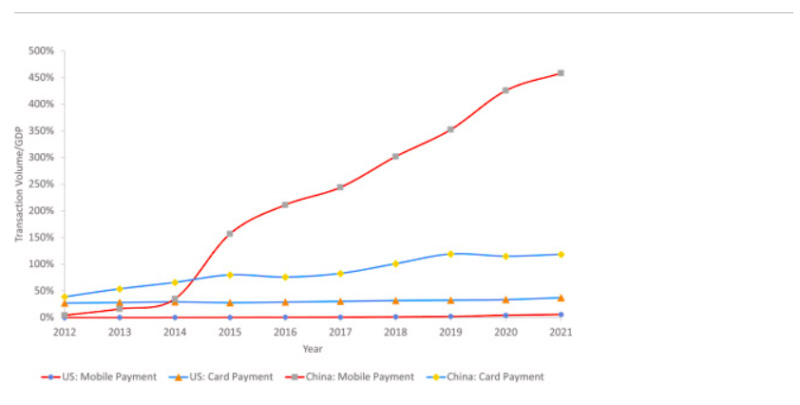
Data sources are the Statista Digital Market Outlook and the World Bank.
The results are hypothetical results and are NOT an indicator of future results and do NOT represent returns that any investor actually attained. Indexes are unmanaged and do not reflect management or trading fees, and one cannot invest directly in an index.
This paper investigates how cashless payment affects credit access for underserved populations using data from Alipay, a leading Chinese BigTech platform with over 1 billion users that offers a wide range of financial services. By exploiting the staggered rollout of Alipay-bundled shared bikes across cities as a natural experiment and analyzing a representative Alipay user sample, I find that cashless payment adoption increases credit access by 56.3% and that a 1% rise in payment flow increases credit lines by 0.41%. These effects are stronger for less educated and older individuals, who have traditionally faced greater barriers to accessing financial services.
The views and opinions expressed herein are those of the author and do not necessarily reflect the views of Alpha Architect, its affiliates or its employees. Our full disclosures are available here. Definitions of common statistics used in our analysis are available here (towards the bottom).
This site provides NO information on our value ETFs or our momentum ETFs. Please refer to this site.
Information posted on IBKR Campus that is provided by third-parties does NOT constitute a recommendation that you should contract for the services of that third party. Third-party participants who contribute to IBKR Campus are independent of Interactive Brokers and Interactive Brokers does not make any representations or warranties concerning the services offered, their past or future performance, or the accuracy of the information provided by the third party. Past performance is no guarantee of future results.
This material is from Alpha Architect and is being posted with its permission. The views expressed in this material are solely those of the author and/or Alpha Architect and Interactive Brokers is not endorsing or recommending any investment or trading discussed in the material. This material is not and should not be construed as an offer to buy or sell any security. It should not be construed as research or investment advice or a recommendation to buy, sell or hold any security or commodity. This material does not and is not intended to take into account the particular financial conditions, investment objectives or requirements of individual customers. Before acting on this material, you should consider whether it is suitable for your particular circumstances and, as necessary, seek professional advice.












Join The Conversation
For specific platform feedback and suggestions, please submit it directly to our team using these instructions.
If you have an account-specific question or concern, please reach out to Client Services.
We encourage you to look through our FAQs before posting. Your question may already be covered!