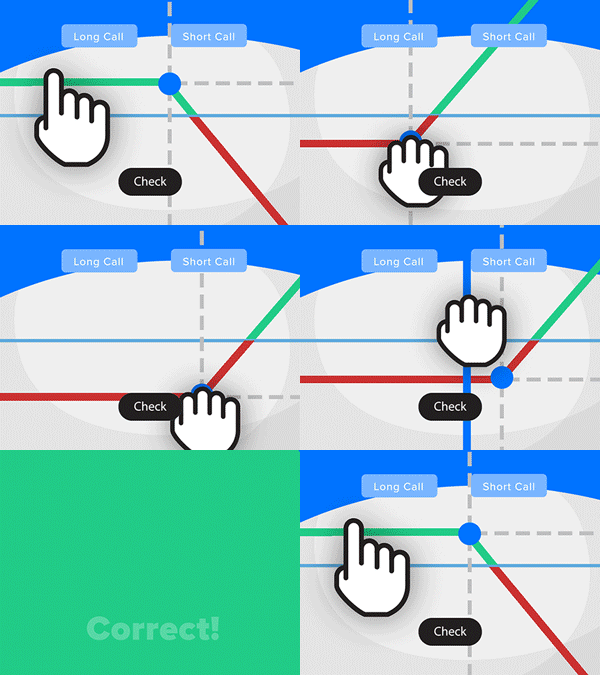
- Solve real problems with our hands-on interface
- Progress from basic puts and calls to advanced strategies
Interactive Options Course

Posted October 22, 2026 at 1:28 pm
Tech stocks are plunging as lackluster earnings reports spark AI slowdown worries with investors increasingly unsure about the return prospects of the massive investments. That caution has participants charging into safe-haven Treasurys, and cratering yields as a result, are helping the defensive and economically delicate areas of equities hang in there. Indeed, despite the Nasdaq 100 tanking over 2.5%, 6 of the 11 principal sectors are advancing alongside modest climbs from the rate-sensitive Russell 2000 and the Dow Jones Industrial indices, as cheaper borrowing costs incentivize a lift of cyclical exposures while Wall Street attempts to shrug off the AI concerns via rotation. Meanwhile, fixed income is outperforming strongly even though crude oil is rising on the back of Middle East hostilities countering the positive effect of rebounding export volumes from the Strait of Hormuz, and credit assets are also overlooking lighter-than-expected initial unemployment claims, as anxiety pertaining to the fragility of the capex boom overwhelms the more traditional factors that typically shift bond values. The curve is descending aggressively in bull-flattening motion led by duration, as the longer tenors stand to benefit disproportionately from a deceleration in activity. Elsewhere, the retreat in speculative enthusiasm is weighing on cryptocurrencies and non-energy commodities, while the greenback strengthens and volatility protection instruments see heavier premiums in light of the risk-off sentiment in markets.
Unemployment claims remained subdued in the past two weeks amidst low layoff appetites across corporate America. Initial filings fell to a three-month trough of 194k during the week that ended Oct. 17, arriving beneath the expected 200k, which would have been unchanged from the prior period. Conversely, continuing applications rose slightly to 1.728 million throughout the seven days culminating on Oct. 10, exceeding the projected 1.720 million and the previous interval’s 1.703 million. Four-week moving averages were relatively steady, shifting from 198.75k and 1.707 million to 197.75k and 1.711 million.

With this week’s Magnificent 7 quarterly calls behind us, the tech selloff is poised to catch a break for a few sessions prior to Microsoft, Alphabet and Amazon reporting. The series of high-impact prints will kick off shortly after the Federal Reserve’s October rate decision, which is largely anticipated to feature a pause following a significant lessening in financial conditions stemming from growth worries. Investors are hoping to hear better news on AI expenditure, integration and monetization momentum that could bolster the outlook for investment returns, as that’ll help support the Nasdaq, which is threatening to slip further into freefall. Meanwhile, revenue and profit numbers are in the nosebleeds and somewhat of a slowdown is to be expected; however, the degree of the deceleration is what ultimately holds the key for the markets and the economy. A gradual tapering that leaves earnings expanding in the double digits would be fine for Wall Street, as those figures would be conducive to a healthy cyclical backdrop amidst easing yields that could drive a broadening in market participation. But a sharp contraction of sales and income would spark recession risk and send the broad indices into correction as bottom lines could begin to contract and effectively disincentivize equity exposure. I continue to be optimistic in consideration of the major trends remaining intact across the landscape.
Mexico’s Consumer Price Index depicted costs climbing 0.41% during the first two weeks of October, resulting in a year-over-year (y/y) increase of 3.62% as summer subsidies for electricity terminated, according to the county’s statistical agency INEGI. The metrics were slightly higher than in the second half of September, when the headline gauge was up only 0.33% relative to the preceding two weeks and 3.49% on an annual basis. The two-week change, furthermore, was hotter than the economist consensus estimate for a 0.37% climb. October ended with a two-week overall energy ascent of 3% with electricity rates jumping 18.5% following the expiration of subsidies. The core CPI, which excludes perishable food and energy, also accelerated with the two-week-over-two-week rate climbing from 0.17% to 0.25% and surpassing the economist consensus estimate of 0.18%. The 12-month rate, nevertheless, was virtually unchanged at approximately 3.7%.
Mexico’s unemployment rate sank from 2.7% in August to 2.6% last month and 3% in the year-ago period. Meanwhile, the country’s labor participation, or portion of population is either working or actively seeking work, sank from 59.6% to 58.5% y/y.
After two successive increases this past summer, the Bank of Korea decided yesterday to hold its key benchmark, the seven-day repurchase rate, at 3%. The decision to make no change was widely expected by economists. The organization is striving to trim headline and core inflation to 2%. In September, the two metrics hit 2.9% and 2.8%, respectively. Meanwhile, policymakers say they are watching if the Middle East conflict is strengthening price pressures. For the full year, the central bank anticipates headline and core inflation to average 2.7% and 2.5% and gross domestic product expansion to exceed 3.3%.
Canada’s New Home Price Index sank 0.2% month over month (m/m) in September, a worse decline than the 0.1% economist consensus, which would have matched August’s result. The index has now fallen for seven consecutive months, according to Statistics Canada. With the exception of a 0.3% March ascent and a flat December print, the indicator has been negative in every month since April of last year.
Gate prices of goods produced in Canada climbed 2% m/m in September, a significant uptick following August’s 1.2% rise, according to the Industrial Product Price Index. The print was also considerably hotter than the economist consensus estimate of 0.9%. Statistics Canada attributes much of the increase to the US and Iran war causing energy commodities to become more costly and it notes that the IPPI ex energy and petroleum products edged northward by only 0.3%. Within the headline IPPI, the energy and petroleum category was up 12.1% m/m after August’s 3.7% jump. Within this category, price pressures were the most acute for diesel, which became 18.4% more costly. Gate prices were also 14.5% higher than in the year-ago period following August’s 13.2% jump. In a related matter, manufacturers dished out 4.8% more for raw materials compared to August as depicted by the Raw Materials Price Index. The gauge also showed prices climbing 27% y/y. Similar to the IPPI, the rapid ascent was attributed primarily to higher energy costs.
Hong Kong’s CPI was up 1.9% y/y in September, a hotter reading that the 1.7% print in the preceding month, according to the Census and Statistics Department. Increased charges for holiday events and loftier costs for inbound and outbound travel accounted for much of the change.
New to Interactive Brokers?
Open AccountInformation posted on IBKR Campus that is provided by third-parties does NOT constitute a recommendation that you should contract for the services of that third party. Third-party participants who contribute to IBKR Campus are independent of Interactive Brokers and Interactive Brokers does not make any representations or warranties concerning the services offered, their past or future performance, or the accuracy of the information provided by the third party. Past performance is no guarantee of future results.
This material is from IBKR Macroeconomics, an affiliate of Interactive Brokers LLC, and is being posted with its permission. The views expressed in this material are solely those of the author and/or IBKR Macroeconomics and Interactive Brokers is not endorsing or recommending any investment or trading discussed in the material. This material is not and should not be construed as an offer to buy or sell any security. It should not be construed as research or investment advice or a recommendation to buy, sell or hold any security or commodity. This material does not and is not intended to take into account the particular financial conditions, investment objectives or requirements of individual customers. Before acting on this material, you should consider whether it is suitable for your particular circumstances and, as necessary, seek professional advice.
Futures, event contracts, and forecast contracts are not suitable for all investors. Before trading these products, please read the CFTC Risk Disclosure. For a copy, visit our Warnings and Disclosures Page.
Trading in digital assets, including cryptocurrencies, is especially risky and is only for individuals with a high risk tolerance and the financial ability to sustain losses. Eligibility to trade in digital asset products may vary based on jurisdiction.
Related Articles

















Join The Conversation
For specific platform feedback and suggestions, please submit it directly to our team using these instructions.
If you have an account-specific question or concern, please reach out to Client Services.
We encourage you to look through our FAQs before posting. Your question may already be covered!