- Solve real problems with our hands-on interface
- Progress from basic puts and calls to advanced strategies
Interactive Options Course

Posted September 4, 2026 at 10:30 am
After months of weakness, Bitcoin is once again showing signs of life.
This is not the first time our models have pointed to a potentially bullish phase for Bitcoin. In September 2025, in a previous article published on IBKR Campus, I highlighted how seasonality and historical analogues were suggesting a favorable setup for Bitcoin heading into the final quarter of the year. The market subsequently moved higher, and today a different set of indicators is once again sending an interesting message.
The cryptocurrency recently staged a sharp rebound, moving from the $60,000 area toward $80,000 in a relatively short period of time. A move of more than 20% naturally raises an important question for investors:
Is Bitcoin’s bear market finally over, or are we simply looking at another temporary rebound within a larger downtrend?
No single indicator can answer that question with certainty. However, when different analytical approaches start pointing in the same direction, the signal becomes more interesting.
At the moment, three elements deserve particular attention: the positioning of speculative traders, a major technical breakout, and Bitcoin’s apparent two-year market cycle.
Speculative Traders Started Buying During the Decline
One of the most interesting signals emerged from the Cot Report ( Commitments of Traders ) while Bitcoin was still falling.
Looking at futures positioning, we can observe the net exposure of non-commercial traders on Bitcoin, a category generally associated with speculative market participants.
What makes the recent data particularly interesting is the divergence between price and positioning.
While Bitcoin continued to decline, non-commercial traders progressively increased their net exposure.
In other words, while prices were moving lower, a significant group of speculative market participants was moving in the opposite direction.
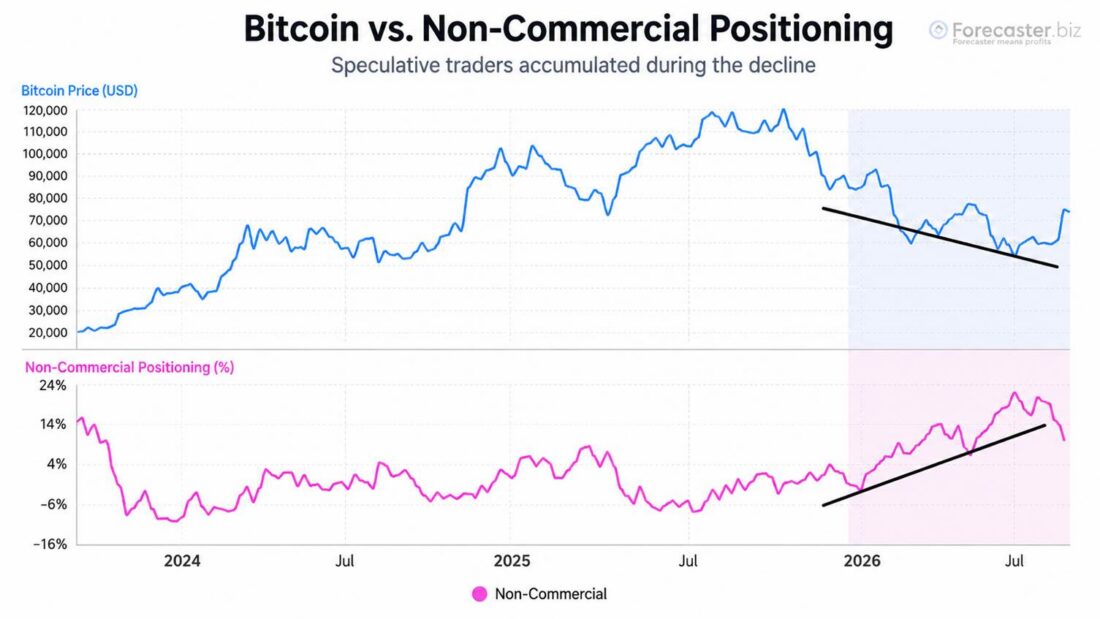
This kind of divergence can be worth monitoring because large market participants often need time to build meaningful positions.
Unlike a small investor, an institutional participant cannot necessarily establish a large position with a single transaction. Accumulation may take place progressively over several weeks or months.
This does not automatically mean that a bottom has been reached. But when positioning begins to improve during a prolonged decline, it can indicate that some investors are already looking beyond the current weakness.
And that appears to have happened with Bitcoin.
Positioning alone would not be enough to build a bullish scenario.
The second piece of the puzzle comes directly from price action.
Bitcoin recently broke above a descending trendline that had contained prices for approximately 11 months.
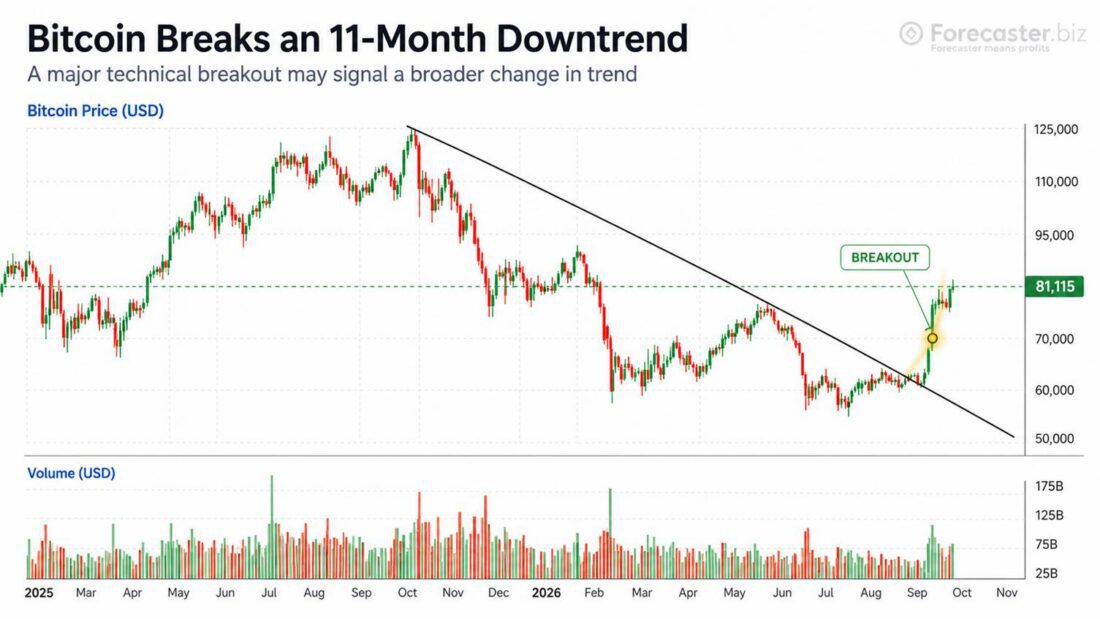
The duration of the trendline matters.
A breakout from a short-term trendline may simply represent a temporary change in momentum. A breakout from a structure that has dominated the market for almost one year potentially carries more significance.
From a cyclical perspective, the length of the trend that has been broken may also provide information about the market cycle that is changing.
In this case, the breakout may suggest that Bitcoin is not simply experiencing a short-term bounce, but could instead be entering a different phase of its broader cycle.
Of course, a breakout is never a guarantee.
False breakouts happen frequently, especially in volatile markets such as cryptocurrencies. For this reason, it is useful to look for confirmation from independent indicators.
And this is where Bitcoin’s historical cycle becomes particularly interesting.
If we examine Bitcoin’s major lows over recent years, a surprisingly regular pattern emerges.
The latest significant low occurred around the July-August period of 2026.
Going back approximately two years takes us to the summer of 2024, where another important market low can be identified.
Going back another two years takes us to July-August 2022, where Bitcoin was once again trading around a major cyclical low.
This creates a sequence worth monitoring:
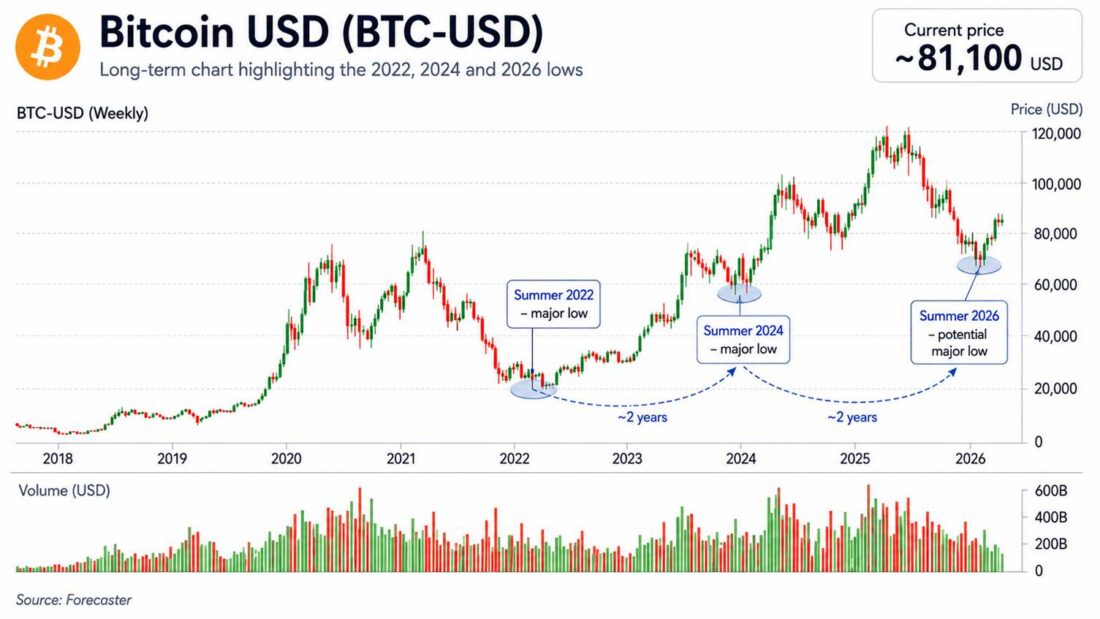
The repetition does not imply that Bitcoin must continue following the same pattern in the future. Financial-market cycles are rarely perfectly regular, and their duration can expand or contract.
Nevertheless, the alignment is notable because it provides independent confirmation of what the trendline breakout appears to be signaling.
If a two-year cycle did indeed turn higher during the summer of 2026, the implications could extend well beyond the recent rebound.
A two-year cycle contains approximately one year of expansion and one year of contraction. Therefore, a new upward phase could theoretically support Bitcoin for several months rather than just a few weeks.
That would represent a very different scenario from a simple bear-market rally.
The most interesting aspect of the current Bitcoin setup is not any single indicator.
It is their combination.
We currently have:
Positioning: speculative traders accumulated exposure while Bitcoin was declining.
Technical analysis: Bitcoin has broken a descending trendline that lasted almost one year.
Cycle analysis: the recent low appears to align with previous major lows approximately two years apart.
When positioning, technical analysis and cycle analysis begin to reinforce one another, the probability of a broader market transition deserves closer attention.
That does not mean Bitcoin will move higher in a straight line.
Even during powerful bull markets, Bitcoin has historically experienced significant corrections along the way. Volatility remains one of the defining characteristics of the asset.
But the key question is no longer whether Bitcoin has rebounded from its lows.
It clearly has.
The more relevant question is whether the underlying market structure has changed.
And several indicators suggest that it may have.
A good market analysis should not focus exclusively on the signals supporting the base case.
It is equally important to understand what could prove it wrong.
The first warning would be a failure of the recent technical breakout.
If Bitcoin were to fall back decisively below the broken descending trendline and return toward previous lows, the idea of a new cyclical expansion would become considerably weaker.
Positioning should also continue to be monitored.
If speculative traders aggressively reverse the accumulation seen during the decline while prices fail to make further progress, the divergence that supported the bullish thesis would lose part of its significance.
Finally, cycle analysis should always be treated as a framework rather than a precise forecasting tool.
Cycles help investors organize market behaviour and identify recurring structures. They do not dictate exactly where or when prices must move.
Information posted on IBKR Campus that is provided by third-parties does NOT constitute a recommendation that you should contract for the services of that third party. Third-party participants who contribute to IBKR Campus are independent of Interactive Brokers and Interactive Brokers does not make any representations or warranties concerning the services offered, their past or future performance, or the accuracy of the information provided by the third party. Past performance is no guarantee of future results.
This material is from Forecaster.biz and is being posted with its permission. The views expressed in this material are solely those of the author and/or Forecaster.biz and Interactive Brokers is not endorsing or recommending any investment or trading discussed in the material. This material is not and should not be construed as an offer to buy or sell any security. It should not be construed as research or investment advice or a recommendation to buy, sell or hold any security or commodity. This material does not and is not intended to take into account the particular financial conditions, investment objectives or requirements of individual customers. Before acting on this material, you should consider whether it is suitable for your particular circumstances and, as necessary, seek professional advice.
Trading Bitcoin involves significant risk. Bitcoin prices can be highly volatile and may fluctuate rapidly, potentially resulting in substantial losses. Because Bitcoin operates on a decentralized blockchain, network congestion or technical issues may occasionally delay transaction settlement. Regulatory frameworks for digital assets are still evolving and could impact availability, liquidity, or pricing. When trading through Interactive Brokers, execution and custody are facilitated by regulated partners such as Paxos or Zero Hash; however, these arrangements do not eliminate the possibility of operational or counterparty risk.
Trading in digital assets, including cryptocurrencies, is especially risky and is only for individuals with a high risk tolerance and the financial ability to sustain losses. Eligibility to trade in digital asset products may vary based on jurisdiction.
TRADING IN BITCOIN FUTURES IS ESPECIALLY RISKY AND IS ONLY FOR CLIENTS WITH A HIGH RISK TOLERANCE AND THE FINANCIAL ABILITY TO SUSTAIN LOSSES. More information about the risk of trading Bitcoin products can be found on the IBKR website. If you're new to bitcoin, or futures in general, see Introduction to Bitcoin Futures.
Related Articles


















Join The Conversation
For specific platform feedback and suggestions, please submit it directly to our team using these instructions.
If you have an account-specific question or concern, please reach out to Client Services.
We encourage you to look through our FAQs before posting. Your question may already be covered!