
- Solve real problems with our hands-on interface
- Progress from basic puts and calls to advanced strategies
Interactive Options Course
Posted August 28, 2026 at 1:24 pm
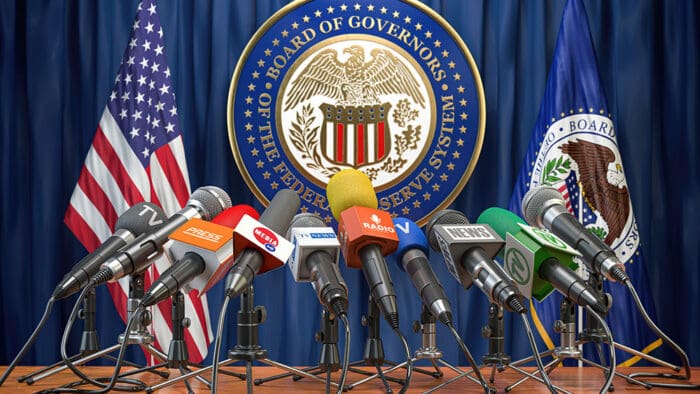
Financial markets had seemingly ground to a halt this morning as traders waited for Federal Reserve Chair Kevin Warsh’s highly anticipated address to the Kansas City Fed’s Jackson Hole Economic Symposium. Considering that a portion of the speech was devoted to the notion of a less communicative Fed, the half-hour length took some listeners by surprise. The immediate outcomes were: a 7-basis-point rise in 2-year yields, reflecting higher rate-hike odds; a flattish long end of the Treasury curve; and a “you may resume your regularly scheduled rally” response from stock traders.
While all financial markets pay close attention to central bankers, fixed-income investors are especially tethered to their utterances. Short-term rates move higher and lower based on perceptions about the likelihood of central bank activity. The rise in short-term yields tells us that the bond market is re-solidifying the prospect of rate hikes. Expectations for a 25-basis point hike at the September meeting rose from 31% to 50% on IBKR Prediction Markets and from 35% to 57% according to CME FedWatch, using Fed Funds futures. That said, the first hike still isn’t fully priced in until December. This has been my opinion for some time because I don’t think Warsh wants to take flak for hiking before the midterm elections. Perhaps more importantly, a second hike is now fully priced in the middle of 2027. Hence, we see higher short-term rates.
Long bond yields are relatively stable, but the cause is trickier to discern. Because long-term rates are heavily influenced by inflationary expectations, it is difficult to say whether the main influence for today’s relatively stable 10- and 30-year yields is Warsh’s inflation-fighting rhetoric or traders’ reticence to challenge Treasury Secretary Bessent’s buyback. Unfortunately, the Chair did not address the pressing question of whether the Treasury’s actions are countering the Fed’s desire for price stability. (By the way, literally as I was typing this, the Japanese yen weakened to 160 vs. the dollar for the first time since the Treasury intervened to prop up the yen on July 31st.)
Meanwhile, stocks seemed to be saying, “You’re now free to resume your regularly scheduled rally.” Today’s initial upward move was quite a bit more balanced than yesterday’s, which can be summed up mainly as “forget about this rotation thing, we’re back to buying tech.” In recent weeks, we have seen many investors favoring a wider range of stocks, including more value-oriented basic industries and consumer-related shares. Yesterday, with relatively few exceptions, it was tech and only tech. This was evidenced by 197 more decliners than advancers among the S&P 500 (SPX) yesterday and by the fact that only one sector – technology – gained in SPX yesterday. (As I type this, SPX advances are leading declines by 35 and about half the SPX sectors are higher.)
I just finished an interview with a foreign journalist who asked some pointed questions about Federal Reserve credibility. He understandably wondered whether a Fed Chair who talks tough about fighting inflation risks squandering valuable credibility via inaction, especially if the FOMC waits until December for its first move. If the stasis is indeed politically motivated, it is fair to wonder whether the committee is missing a valuable opportunity to assert its independence, especially when the Treasury’s pseudo-“Operation Twist” seems to be at odds with Warsh’s rhetoric. For obvious reasons, Warsh made no mention of that key question today.
During the time I spent speaking to the media, stocks began to fade. SPX was about 20 points higher when I started writing today; now it’s down by nearly the same amount; and 2-year rates are now up by more than 10 basis points instead of 7. The adage “don’t short a dull tape” often applies on a summer Friday with few catalysts. Warsh’s speech was the third key catalyst of the week, after the PCE report and Nvidia (NVDA) earnings. For the bond market, at least, today’s speech was a very important catalyst. For markets as a whole, two out of three proved very consequential.
New to Interactive Brokers?
Open AccountAlready an Interactive Brokers Client?
Request Trading PermissionThe analysis in this material is provided for information only and is not and should not be construed as an offer to sell or the solicitation of an offer to buy any security. To the extent that this material discusses general market activity, industry or sector trends or other broad-based economic or political conditions, it should not be construed as research or investment advice. To the extent that it includes references to specific securities, commodities, currencies, or other instruments, those references do not constitute a recommendation by IBKR to buy, sell or hold such investments. This material does not and is not intended to take into account the particular financial conditions, investment objectives or requirements of individual customers. Before acting on this material, you should consider whether it is suitable for your particular circumstances and, as necessary, seek professional advice.
The views and opinions expressed herein are those of the author and do not necessarily reflect the views of Interactive Brokers, its affiliates, or its employees.
Futures, event contracts, and forecast contracts are not suitable for all investors. Before trading these products, please read the CFTC Risk Disclosure. For a copy, visit our Warnings and Disclosures Page.
Event Contracts are only available to eligible clients, 21 years and older, of Interactive Brokers LLC, Interactive Brokers Canada Inc., Interactive Brokers Hong Kong Limited, Interactive Brokers Ireland Limited and Interactive Brokers Singapore Pte. Ltd. ForecastEx Forecast Contracts on US election results are only available to eligible US residents.
Displayed outcomes and prices are based on real-time market sentiment from ForecastEx LLC, an affiliate of IB LLC, as well as other CFTC-registered DCMs, including Kalshi and CME. For more information, see ibkr.com/realfex Note: Real-time market sentiment updates are only active during exchange open trading hours. Updates to current market sentiment for overnight activity will be reflected at the open on the next trading day. This information is not intended by IBKR as an opinion or likelihood of a potential outcome.
This is commentary on economic, political and/or market conditions within the meaning of CFTC Regulation 1.71, and is not meant provide sufficient information upon which to base a decision to enter into a derivatives transaction.
Interactive Brokers LLC is a CFTC-registered Futures Commission Merchant and a clearing member and affiliate of ForecastEx LLC (“ForecastEx”). ForecastEx is a CFTC-registered Designated Contract Market and Derivatives Clearing Organization. Interactive Brokers LLC provides access to ForecastEx Forecast Contracts for eligible customers. Interactive Brokers LLC does not make recommendations with respect to any products available on its platform, including those offered by ForecastEx.
There is a substantial risk of loss in foreign exchange trading. The settlement date of foreign exchange trades can vary due to time zone differences and bank holidays. When trading across foreign exchange markets, this may necessitate borrowing funds to settle foreign exchange trades. The interest rate on borrowed funds must be considered when computing the cost of trades across multiple markets.
Spot currencies are not available at IBKR Singapore.
Municipal Bonds are only available from Interactive Brokers for IBKR LLC, IBKR Canada, IBKR Hong Kong, IBKR Australia and IBKR Singapore entities.
Related Articles
















Join The Conversation
For specific platform feedback and suggestions, please submit it directly to our team using these instructions.
If you have an account-specific question or concern, please reach out to Client Services.
We encourage you to look through our FAQs before posting. Your question may already be covered!