
- Solve real problems with our hands-on interface
- Progress from basic puts and calls to advanced strategies
Interactive Options Course
Posted June 26, 2026 at 8:58 am
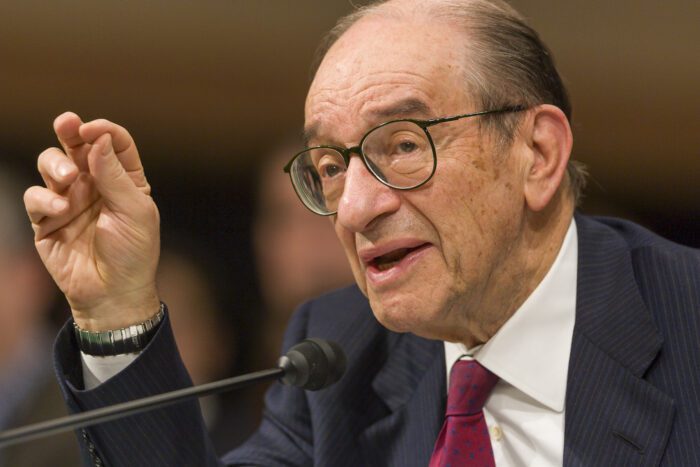
Alan Greenspan made the Federal Reserve impossible for investors to ignore.
That seems normal now. Markets move on Federal Reserve statements, speeches, meeting minutes, press conferences, and small changes in wording. A slightly different phrase about inflation or employment can move Treasury yields before the Fed changes a single interest rate. But that habit took shape over time, and he did more than almost anyone to make the central bank a daily part of market life.
He chaired the Fed from August 1987 to January 2006, serving under Ronald Reagan, George H.W. Bush, Bill Clinton, and George W. Bush. His tenure covered Black Monday, the 1990s technology boom, the Asian financial crisis, the collapse of Long-Term Capital Management, the dot-com bust, and the long credit buildup that ended after he left office.
He helped build the modern market-facing Fed with careful language, alert to financial stress, and powerful enough to shape expectations. He also trusted financial markets to manage their own risks far more than the 2008 crisis would justify.
Greenspan became Fed chair on August 11, 1987. Barely two months later, on October 19, the Dow Jones Industrial Average fell 22.6% in a single session, still its largest one-day percentage decline.
The Fed’s response was short and forceful. On October 20, he said the central bank was ready “to serve as a source of liquidity to support the economic and financial system.”
It signaled to Wall Street that the central bank would not sit still if a market crash threatened the credit system. The Fed was not promising to protect stock prices. It was promising to keep money and credit moving where a breakdown could damage the broader economy.
That became one of his lasting marks on central banking. Liquidity, confidence, and market functioning moved closer to the center of the Fed’s public role.
Greenspan’s public language became a market event of its own.
He was famous for sentences that sounded engineered to survive a congressional hearing without revealing too much. Traders, economists, and journalists treated his remarks like a puzzle because they believed there was information hidden in the phrasing.
The best-known example came in December 1996, when he asked whether “irrational exuberance” had “unduly escalated asset values.” He did not say stocks were in a bubble. He did not tell investors to sell. He posed a question inside a broader speech on central banking, and the phrase became a warning label for markets that seemed to be outrunning reality.
He was willing to consider that the economy’s capacity had changed, rather than forcing new data into old assumptions. That served him well in the late 1990s, when productivity gains allowed growth to run faster without the inflation many models expected. It served him less well when confidence in markets became confident that they could police themselves.
Modern Fed watching owes a lot to that period. Today, investors parse the Federal Open Market Committee (FOMC) statement, the press conference, the dot plot, and speeches from Fed officials. He did not invent central-bank communication, but he helped make it part of the market’s daily routine.
The most durable phrase attached to Greenspan was the “Greenspan Put.”
In options markets, a put option offers downside protection. The “Greenspan Put” described the belief that if markets fell hard enough, the Fed would ease policy or supply liquidity. Investors saw that pattern after the 1987 crash, during the Asian financial crisis, after
Long-Term Capital Management nearly collapsed in 1998, and after the dot-com bubble burst.
There was a practical case for acting this way. Financial systems can fail when everyone tries to raise cash at once. If the central bank can stop a liquidity panic from spreading, it can prevent market stress from hitting households and businesses.
But repeated support changes incentives.
If investors come to believe the Fed will soften every serious market fall, taking more risk can start to look rational. Borrowing looks safer, complex products draw less scrutiny, and losses seem easier to survive. He did not set out to encourage speculation, but the Fed’s credibility made downside risk feel less dangerous than it was.
The Fed’s interventions helped stop panics, but they also made some investors more comfortable with risks they might otherwise have avoided.
His strongest policy judgment came in the late 1990s.
The United States economy was growing quickly. Unemployment was falling. Equity prices were rising. Older inflation models suggested the economy should have been overheating. A more rigid central banker might have raised rates faster.
He saw another possibility. He argued that technology, real-time business information, software, logistics, and better inventory control were lifting productivity. In a 1999 speech, he described an “avalanche of real-time data” that helped businesses reduce wasted labor and inventory.
That judgment mattered. If productivity was rising, the economy could grow faster without producing the same inflation pressure. For a while, that proved right. The late-1990s expansion delivered strong growth, low unemployment, and contained inflation.
This was Greenspan at his best. He was willing to consider that the economy’s underlying capacity had changed, rather than forcing new data into old assumptions. It was the kind of judgment central banking requires, though the same instinct could become dangerous when it turned into conviction.
His deepest conviction was that markets, especially sophisticated financial markets, were usually better at managing risk than regulators.
After the dot-com bust, the Fed cut interest rates sharply and kept them low. Critics later argued that easy credit helped feed the housing and mortgage boom that followed. That was not the whole cause of the crisis, but it was part of the setting in which the bubble grew.
The deeper problem was that he trusted self-regulation more than the crisis would warrant. He believed banks and lenders had every reason to avoid reckless behavior because their own capital, reputations, and shareholders were exposed.
The mortgage market showed how badly that assumption could fail. Subprime loans were packaged into securities, sold across the financial system, and tied to derivatives that many firms did not fully understand. Risk was not removed from the system. It was passed around until it became harder to see who would be left holding it.
By October 2008, he was forced to confront the weakness in that belief. Testifying before Congress, he said “Those of us who have looked to the self-interest of lending institutions to protect shareholders’ equity, myself especially, are in a state of shocked disbelief.”
Pressed by Representative Henry Waxman, Greenspan went further. “I found a flaw,” he said. He described it as a “flaw in the model” he had believed explained “how the world works.”
That was not a minor forecasting error. It was a break in the philosophy that had guided much of his career. He had believed firms would manage risk because they had money on the line. The crisis showed that individual firms could act in their own interest while still creating danger for the whole system.
Greenspan deserves credit for helping the Fed preserve anti-inflation credibility after the Volcker era. He guided policy through several shocks. He recognized the productivity boom earlier than many of his peers. He also understood that expectations could move markets before policy itself changed.
The criticism is just as real.
He was too comfortable with the idea that markets could discipline themselves. He was too slow to see how mortgage securities, derivatives, thin capital cushions, and short-term incentives could turn private risk-taking into a public crisis. He also helped normalize the belief that the Fed would His
career shows how deceptive calm can be. Low inflation can hide credit excess, rising asset prices can flatter weak lending decisions, and financial innovation can make risk look safely dispersed until the system has to find out where it really sits.
Greenspan left the Fed in 2006, but investors still operate in the world he helped create.
Markets read the central bank for signals before decisions are made, watch for policy pivots when financial conditions tighten, and argue over how much market pain the Fed will tolerate before stepping in.
That is his lasting contribution to economics and markets: he showed that central banks shape expectations as much as interest rates. He also showed how dangerous it can be when confidence in markets is mistaken for discipline.
Greenspan’s legacy is large because it is unresolved. He made the Fed more flexible, more attentive to markets, and more aware that expectations can shape financial conditions before policy changes. But he also left central bankers with a warning that has aged as well as any of his insights: markets can reveal a great deal, but they cannot always be trusted to discipline themselves.
IBKR InvestMentor (dba “InvestMentor”) is a service of Interactive Academy LLC, an affiliate of IB LLC and majority-owned by IBG LLC. All content provided by InvestMentor is for informational and educational purposes only and should not be interpreted as implying any sponsorship, partnership, endorsement, recommendation, or approval by IB LLC or its affiliates.
Information posted on IBKR Campus that is provided by third-parties does NOT constitute a recommendation that you should contract for the services of that third party. Third-party participants who contribute to IBKR Campus are independent of Interactive Brokers and Interactive Brokers does not make any representations or warranties concerning the services offered, their past or future performance, or the accuracy of the information provided by the third party. Past performance is no guarantee of future results.
This material is from InvestMentor, an affiliate of Interactive Brokers LLC, and is being posted with its permission. The views expressed in this material are solely those of the author and/or InvestMentor and Interactive Brokers is not endorsing or recommending any investment or trading discussed in the material. This material is not and should not be construed as an offer to buy or sell any security. It should not be construed as research or investment advice or a recommendation to buy, sell or hold any security or commodity. This material does not and is not intended to take into account the particular financial conditions, investment objectives or requirements of individual customers. Before acting on this material, you should consider whether it is suitable for your particular circumstances and, as necessary, seek professional advice.
Related Articles















Join The Conversation
For specific platform feedback and suggestions, please submit it directly to our team using these instructions.
If you have an account-specific question or concern, please reach out to Client Services.
We encourage you to look through our FAQs before posting. Your question may already be covered!