
- Solve real problems with our hands-on interface
- Progress from basic puts and calls to advanced strategies
Interactive Options Course

Posted June 26, 2026 at 11:15 am
Evaluating a listed company is never about one single number. A stock may look expensive on one metric and attractive on another. A business may trade at a high valuation because it is growing quickly, or it may trade cheaply because the market expects future difficulties. That is why financial ratios are useful: they help investors transform raw financial statements into comparable indicators.
Ratios can be used in three main ways. First, they allow investors to compare a company with its own history. Second, they make it easier to compare businesses operating in the same industry. Third, they can be used as a starting point for screening a large universe of stocks, such as the components of a major index.
This is also why we recently introduced a dedicated Ratios section inside the Forecaster Terminal. The objective is not to provide a black-box answer, but to make the data easier to read, compare and interpret. For each company, investors can look at the current ratio, its historical evolution and, where useful, compare it with the stock price over time. In the Rankings section, the same ratios can also be used to sort the components of an index and identify companies that deserve further research.
Below are some of the most useful ratios to evaluate a company.
EV/EBITDA compares a company’s enterprise value with its EBITDA, which stands for earnings before interest, taxes, depreciation and amortization. In simple terms, it tells us how many times investors are paying for the company’s operating profitability. For example, if a company has an enterprise value of $10 billion and generates $1 billion of EBITDA, its EV/EBITDA is 10. This means investors are valuing the company at ten times its operating profit.
This ratio is particularly useful because enterprise value includes both equity and net debt, making it broader than market capitalization alone. It is often used to compare companies within the same sector, especially when they have different capital structures. A lower EV/EBITDA may suggest a more attractive valuation, but it should never be interpreted in isolation. A company with a structurally lower multiple may also have weaker growth prospects, lower margins or higher risk.
The historical perspective is important. A company trading at a high absolute EV/EBITDA may still be close to the lower end of its own historical range if its profitability has improved significantly. Conversely, a company trading at a seemingly reasonable multiple may be expensive compared with its own past. This is where looking at the ratio over time can provide useful context.
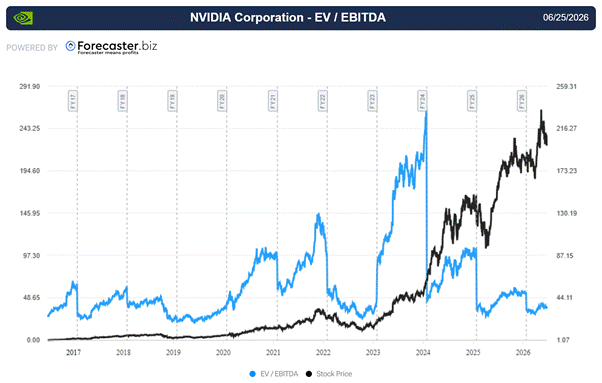
NVIDIA’s stock price continued to climb in 2025–2026, while its EV/EBITDA multiple fell sharply from the 2024 peak. This suggests that, despite the strong share-price performance, earnings growth has helped absorb part of the valuation premium. Data as of 06/25/2026. Source: Forecaster Terminal Nvidia valuation ratios section.
Return on Invested Capital, or ROIC, measures how efficiently a company uses its capital to generate profits. A company with a high ROIC is generally able to produce strong returns from the money invested in the business. For example, if a company invests $1 billion and generates $150 million in operating profit after tax, its ROIC is 15%.
ROIC is one of the most useful quality indicators because it helps investors understand whether a company has an efficient business model. A consistently high ROIC may suggest the presence of a competitive advantage, such as pricing power, strong brands, network effects, technology leadership or operational efficiency. In other words, it can be a quantitative clue that the company has a moat.
The trend is just as important as the absolute number. If ROIC is improving, the business may be becoming more efficient or more profitable. If it is deteriorating, investors should investigate why. Higher competition, margin pressure, poor capital allocation or acquisitions that fail to generate sufficient returns can all reduce ROIC over time.
ROIC is also useful for comparisons. Two companies may look similar from the outside, but one may generate much higher returns on capital than the other. In that case, the market may be willing to assign a higher valuation to the higher-quality business.
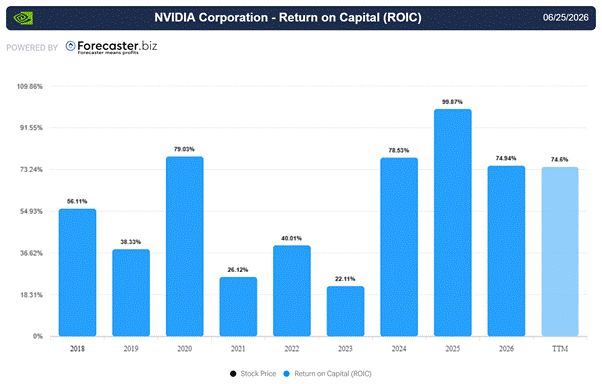
NVIDIA’s ROIC remains exceptionally high, reaching nearly 100% in 2025 and staying around 75% in 2026/TTM. This highlights the company’s ability to convert invested capital into profits with remarkable efficiency, even after the explosive AI-driven growth phase. Data as of 06/25/2026. Source: Forecaster Terminal Nvidia Financial ratios section.
Free Cash Flow Yield measures how much free cash flow a company generates compared with its market value. Free cash flow is the cash left after a company has paid for operating expenses and capital expenditures. It is important because it represents cash that can potentially be used for dividends, buybacks, debt reduction, acquisitions or reinvestment in the business.
For example, if a company is worth $10 billion and generates $800 million in free cash flow, its Free Cash Flow Yield is 8%. A higher Free Cash Flow Yield can indicate that investors are receiving more cash generation for each dollar of market value. This can make the stock look more attractive from a cash-flow perspective.
However, this ratio requires caution. A very high Free Cash Flow Yield is not always a positive signal. Sometimes the market assigns a low valuation because it expects future problems, such as declining revenues, falling margins, high debt, cyclicality or disruption. In other words, a high yield can indicate value, but it can also indicate risk.
The best use of Free Cash Flow Yield is to combine it with other indicators. If a company has solid financial health, stable margins, positive growth prospects and a reasonable valuation, a healthy Free Cash Flow Yield can strengthen the investment case. If the company has deteriorating fundamentals, the same ratio may be a warning sign rather than an opportunity.
Forecaster Terminal allows users to rank the components of any major index by financial ratios. In this example, the S&P 500 constituents are sorted by Free Cash Flow Yield, making it easier to identify companies that generate high free cash flow relative to their market value.
The Altman Z-Score is a financial strength indicator designed to estimate the probability of corporate distress or bankruptcy risk. It combines several balance sheet and income statement variables, including profitability, leverage, liquidity, solvency and efficiency. The result is a single score that helps investors assess whether a company appears financially solid or vulnerable.
This ratio is especially useful because valuation alone can be misleading. A stock may look cheap on traditional multiples, but if the company has a weak balance sheet and high financial distress risk, the apparent discount may be justified. The Altman Z-Score can help investors avoid focusing only on upside potential while ignoring downside risk.
A rising Altman Z-Score can suggest improving financial stability, while a declining score may indicate growing pressure. As always, the trend matters. A single number is useful, but the direction of travel can be even more informative.
Investors should remember that the Altman Z-Score is not a prediction with certainty. It is a model based on accounting data and should be used as part of a broader analysis, especially when evaluating cyclical businesses, financial companies or firms undergoing major restructuring.
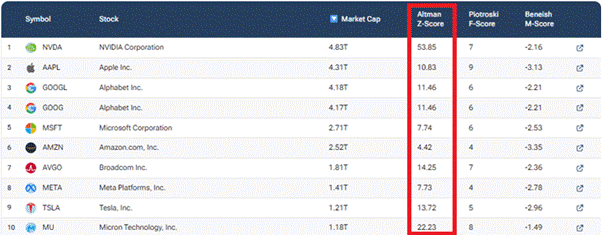
The Altman Z-Score ranking in Forecaster Terminal highlights the financial solidity of the largest U.S. companies. In this example, the biggest S&P 500 constituents show scores well above the traditional distress zone, suggesting that none of these mega-cap companies currently display bankruptcy-risk signals according to this metric.
The Piotroski F-Score is a nine-point scoring system used to evaluate the financial strength of a company. It looks at areas such as profitability, leverage, liquidity, operating efficiency and share issuance. The final score ranges from 0 to 9, with higher scores generally indicating stronger fundamentals.
This score is useful because it acts like a structured checklist. Instead of focusing only on valuation, investors can assess whether the company’s financial condition is improving or weakening. A company with a high Piotroski F-Score may have improving profitability, stronger cash generation, better margins or a healthier balance sheet.
The Piotroski F-Score can be particularly interesting when used together with valuation ratios. For example, a company that looks cheap but also has a weak F-Score may deserve caution. A company with a reasonable valuation and a strong F-Score may be more interesting for further research.
Like every ratio, it has limits. It does not replace qualitative analysis, industry research or forward-looking estimates. But it can help investors quickly separate companies with improving fundamentals from those where the financial picture is deteriorating.
In this Forecaster Terminal ranking, Apple stands out as the strongest company among the largest S&P 500 constituents based on the Piotroski F-Score, with a score of 9. Amazon and Meta show the lowest score in this sample, both at 4, suggesting a comparatively weaker financial quality profile according to this specific metric.
The Beneish M-Score is designed to detect the risk of earnings manipulation or aggressive accounting practices. It uses several accounting variables to identify companies where reported earnings may deserve closer scrutiny. While it does not prove that a company is manipulating its accounts, it can highlight situations where investors should investigate further.
This ratio is useful because earnings quality matters. Two companies may report similar profits, but the quality and sustainability of those profits can be very different. If profits are supported by strong cash flow, stable margins and transparent accounting, they may be more reliable. If earnings growth is accompanied by unusual accruals, deteriorating receivables or other warning signs, investors should be cautious.
The Beneish M-Score is not a standalone investment tool. It should be used as a risk-control indicator. When the score signals possible red flags, the next step is to look deeper into the financial statements, cash flow, revenue recognition, margins and management commentary.
For long-term investors, avoiding companies with poor accounting quality can be just as important as finding companies with attractive growth prospects.
The PEG ratio compares a company’s valuation with its expected earnings growth. It is usually calculated by dividing the forward price-to-earnings ratio by the expected earnings growth rate. The idea is simple: a high valuation may be more reasonable if the company is expected to grow quickly, while a low valuation may be less attractive if growth is weak.
For example, if a company trades at a P/E of 30 and analysts expect earnings to grow by 30%, the PEG ratio is 1. This suggests that the valuation is broadly aligned with expected growth. A lower PEG may indicate that the market is paying less for each unit of expected growth, while a higher PEG may suggest that expectations are already demanding.
This ratio is particularly useful for growth companies. Traditional valuation multiples can make fast-growing companies look expensive, but the PEG ratio adds an important layer by including expected growth. However, investors should remember that the ratio depends heavily on analyst estimates, which can change quickly.
PEG should therefore be used with caution. It can help investors understand how much they are paying for future growth, but it does not guarantee that the expected growth will materialize. When expectations are very high, even a company with strong fundamentals may disappoint the market if results fall short.
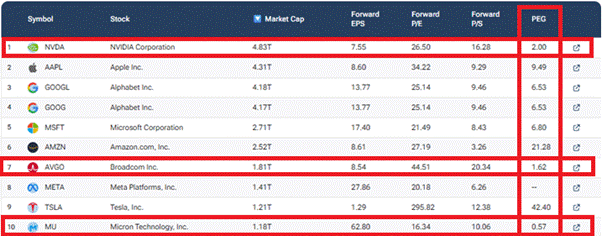
Despite the strong rally in AI and semiconductor-related stocks, the PEG ratio in Forecaster Terminal still highlights names such as NVIDIA, Broadcom and Micron as comparatively attractive within the S&P 500. This suggests that, once expected earnings growth is taken into account, some of the market’s strongest performers may still trade at valuations that are not excessive relative to their growth profile.
The real value of ratios comes from context. A single data point rarely tells the full story. Looking at the historical evolution of a ratio can help investors understand whether a company is becoming more expensive or cheaper, more efficient or less efficient, financially stronger or weaker.
This is one of the reasons why the new Ratios feature in the Forecaster Terminal was built around both current values and historical charts. Investors can analyze a company from different angles, compare the ratio with the stock price, and then use the Rankings section to sort index components by the same metric.
This workflow can be helpful, but it should always be the beginning of the analysis, not the end. Ratios are tools for asking better questions. Why is this company trading at a premium? Is the premium justified by quality or growth? Why is another company trading at a discount? Is it an opportunity, or is the market pricing in real risk?
There is no perfect ratio. EV/EBITDA can help evaluate operating valuation. ROIC can highlight business quality. Free Cash Flow Yield can measure cash generation relative to market value. Altman Z-Score, Piotroski F-Score and Beneish M-Score can help investors assess financial strength and accounting risk. Forward PEG can connect valuation with expected growth.
Used together, these ratios can provide a more complete view of a company. They do not eliminate uncertainty, and they should not be used as automatic buy or sell signals. But they can help investors make their research process more structured, disciplined and data-driven.
The information in this article is provided for educational purposes only and should not be considered investment advice, a recommendation, or an offer to buy or sell any financial instrument. Investors should conduct their own research and consider their objectives, risk tolerance and financial situation before making any investment decision.
—
Originally Posted June 25, 2026
Information posted on IBKR Campus that is provided by third-parties does NOT constitute a recommendation that you should contract for the services of that third party. Third-party participants who contribute to IBKR Campus are independent of Interactive Brokers and Interactive Brokers does not make any representations or warranties concerning the services offered, their past or future performance, or the accuracy of the information provided by the third party. Past performance is no guarantee of future results.
This material is from Forecaster.biz and is being posted with its permission. The views expressed in this material are solely those of the author and/or Forecaster.biz and Interactive Brokers is not endorsing or recommending any investment or trading discussed in the material. This material is not and should not be construed as an offer to buy or sell any security. It should not be construed as research or investment advice or a recommendation to buy, sell or hold any security or commodity. This material does not and is not intended to take into account the particular financial conditions, investment objectives or requirements of individual customers. Before acting on this material, you should consider whether it is suitable for your particular circumstances and, as necessary, seek professional advice.
Related Articles

















Join The Conversation
For specific platform feedback and suggestions, please submit it directly to our team using these instructions.
If you have an account-specific question or concern, please reach out to Client Services.
We encourage you to look through our FAQs before posting. Your question may already be covered!